Sistine Chapel ceiling - Persian Sibyl
Michelangelo · 1511
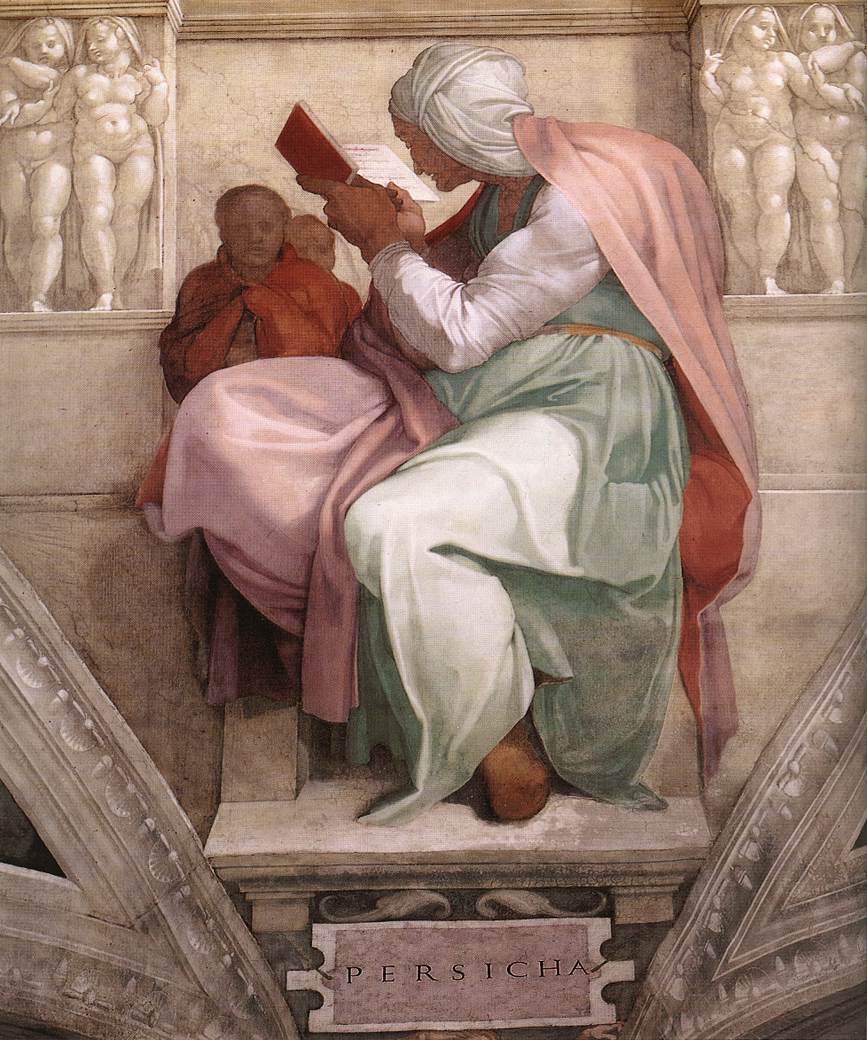
High on the Sistine ceiling an old woman, bent and powerful, squints into a book of prophecies held close to her eyes. Michelangelo painted the Persian Sibyl in fresco in 1511 to 1512.
The story behind the painting
The Persian Sibyl is a fresco about 400 by 380 cm, part of the ceiling of the Sistine Chapel commissioned by Pope Julius II, today in the Vatican Museums in Rome. Michelangelo painted the bays of the vault starting near the entrance door used for the pope's solemn entries and ending with the bay above the altar. The Persian Sibyl sits in the seventh bay from the door, and belongs to the second phase of the work, painted between autumn 1511 and October 1512. Wikidata gives the date as 1511.
What to look for
She is one of the Seers, set on great architectural thrones. Like each of them she sits on a marble seat between pillars with painted pairs of putti, and her name, PERSICHA, is written on a tablet held by a putto under the base of the throne. Michelangelo shows her, like the Cumaean Sibyl, as an old woman bent under a large hump, struggling to read the book of prophecies she holds close to her eyes in her strong arms. She turns toward the wall, face and chest in shadow, while her right arm and legs are lit violently. Two little angels hide behind her, one wrapped in a red cloak.
Meaning and intent
The bright colours of her robes make the figure glow and stand out from the many folds of drapery. The pairing of water green and salmon pink is sober and elegant. Her body is Herculean and powerful: like all of Michelangelo's women she has a masculine musculature, typical of an art whose central theme is the nude male body in motion. Age and strength meet in one figure. She is frail with years, almost blind over her pages, yet built like a giant, and her effort to read becomes a picture of the long, hard work of seeing the future.
Legacy
The Persian Sibyl remains in place on the vault of the Sistine Chapel, one of the Seers on their painted thrones. Visitors who walk from the entrance toward the altar follow, bay by bay, the order in which Michelangelo painted, and reach her in the later part of the ceiling, painted in the second phase of the work. Her shadowed face and blazing arm can be compared with the Cumaean Sibyl, the other aged prophetess Michelangelo painted in the same way. Together they show how he made old age monumental.
Schon gewusst?
- Fresco, about 400 by 380 cm, on the Sistine Chapel ceiling.
- Painted between autumn 1511 and October 1512.
- Seventh bay from the entrance door.
- Her name, PERSICHA, is on a tablet held by a putto.
Über den Künstler
Michelangelo (1475-1564)
Hochrenaissance · mythologische Malerei · Vatikanische Museen
Mehr von Michelangelo
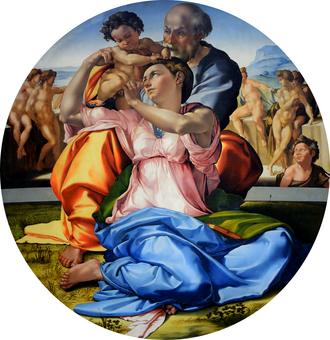 Tondo Doni - Michelangelo (1500s)
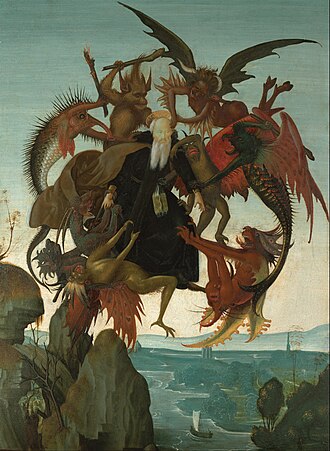 Die Versuchung des Hl. Antonius - Michelangelo (1487)
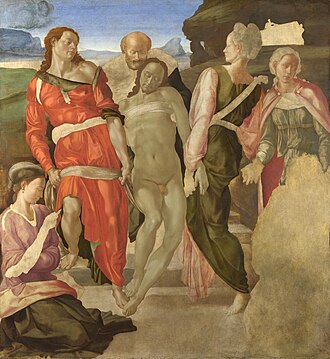 Die Grablegung Christi - Michelangelo (1500s)
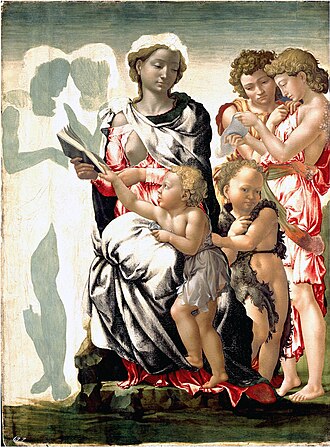 Madonna Manchester - Michelangelo (1494)
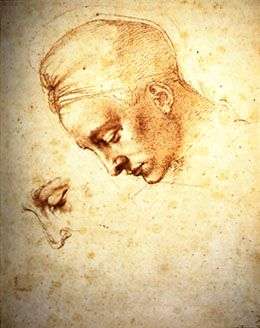 Leda - Michelangelo (1530)
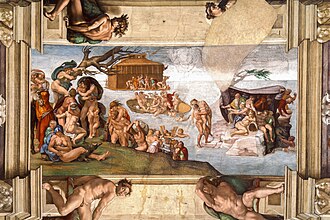 Die Sintflut - Michelangelo (1508)
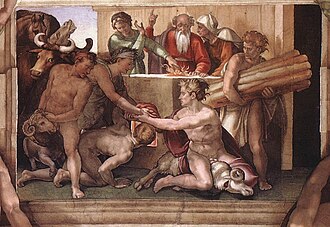 The Sacrifice of Noah - Michelangelo (1508)
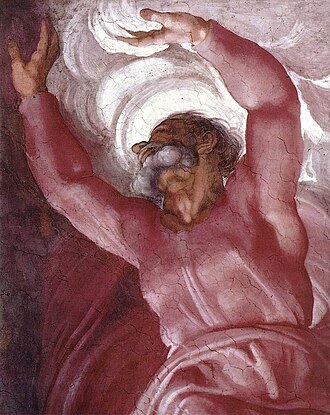 Trennung von Licht und Dunkelheit - Michelangelo (1512)
Werke verwandter Künstler
 Sixtinische Madonna - Raphael (1510s)
 La Fornarina - Raphael
 Venus von Urbino - Titian (1538)
 Mariä Himmelfahrt - Titian (1510s)
 Mona Lisa - Leonardo da Vinci (1503-1519)
 Dame mit dem Hermelin - Leonardo da Vinci (1490)
 Selbstbildnis im Pelzrock - Albrecht Dürer (1500)
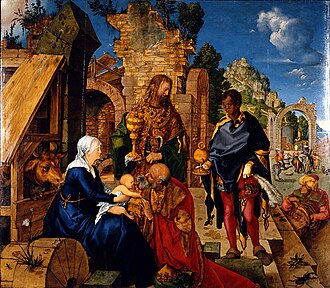 Anbetung der Könige - Albrecht Dürer (1504)
 Die Geburt der Venus - Sandro Botticelli (c. 1485)
 Primavera - Sandro Botticelli (1480s)
 Der Garten der Lüste - Hieronymus Bosch
 Das Narrenschiff - Hieronymus Bosch (1500s)