Self-portrait with Dr Arrieta
Francisco Goya · 1820
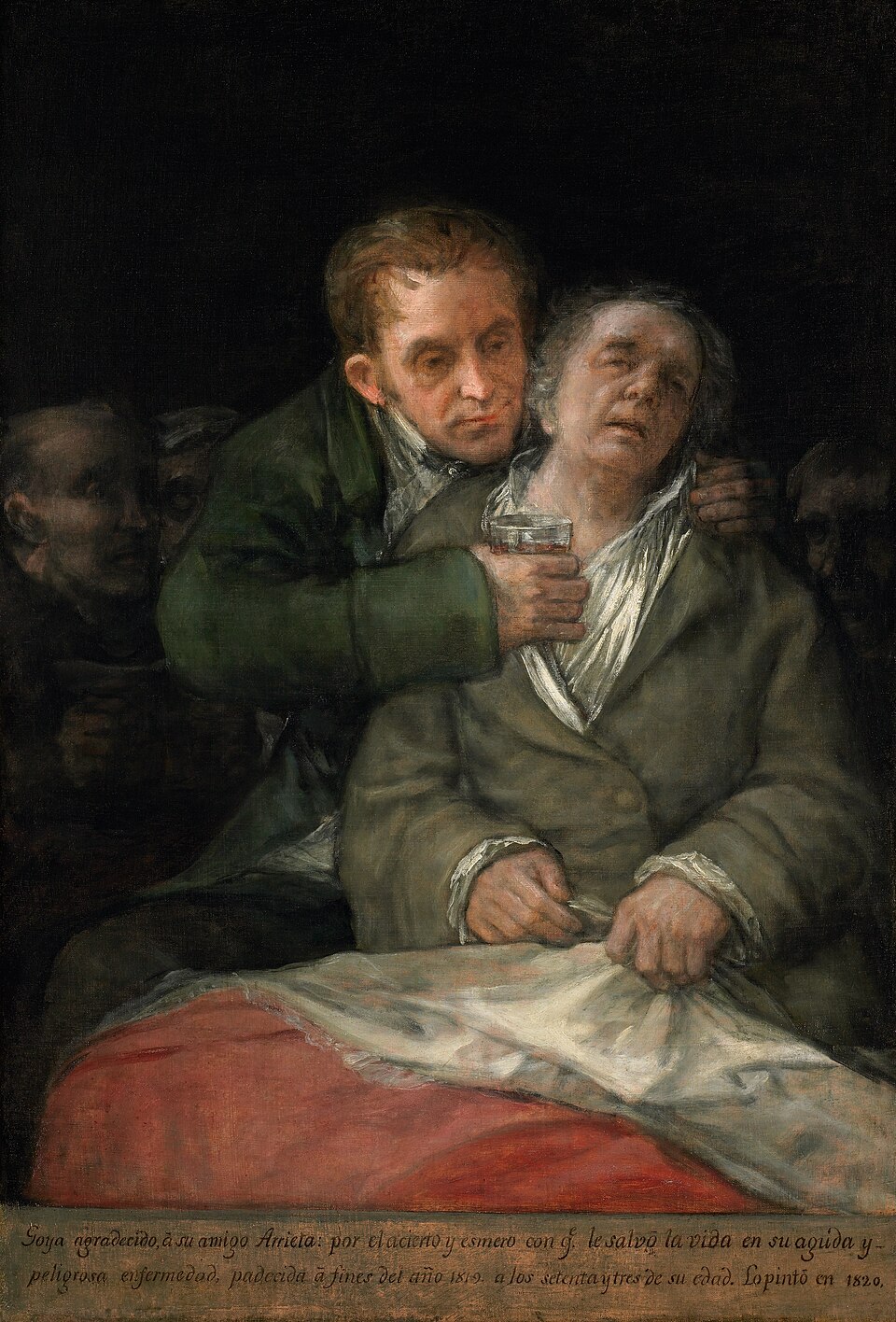
An old man clutches his bedsheet while a doctor holds a glass to his lips. Goya painted this after a friend pulled him back from death, and wrote his thanks across the bottom of the canvas.
The story behind the painting
In 1792 Goya fell seriously ill and by 1793 he was completely deaf. Toward the end of 1819, in his seventy-third year, a second dangerous illness struck. Almost all we know of it comes from this painting. The inscription below the figures says Goya made it in gratitude to his friend Arrieta, for the compassion and care with which he saved his life, and that he painted it in 1820. Goya may have expected to die, yet under Eugenio García Arrieta's care he recovered and lived another eight years. The picture was a gift, a thank-you for life itself.
What to look for
Goya sits on his bed, visibly weak, gripping the sheet as if holding on to life. Behind him Arrieta supports him with one arm and gently raises a glass of medicine to his lips. Everything is built on contrast. The doctor's gaze is focused, his face ruddy with health, and he wears green, a colour linked with hope. Goya's eyes are closed, his face greyish, his head tipped back, his robe grey. A warm red sheet glows at the bottom of the canvas, while shadowy figures in the background are painted in darker, phosphorescent tones and seem like faces of doom.
Meaning and intent
Because of its inscription, many scholars compare the work to church ex-votos, pictures that thanked God for a rescue. Here the thanks goes to a physician instead, and recovery is owed to science. Some see a secular communion in the raised cup, or echoes of Christ in Gethsemane, themes Goya had painted the year before. The background figures divide opinion: a woman offering help and a worried neighbour, a priest ready for the last rites, or feverish visions related to the Black Paintings. Baldwin argues the reverse, that this scene of private care is a painting about hope.
Legacy
The painting has been described as a sign of Spanish portraiture moving toward the modern period and toward secular subjects. Compared with a drawing Goya made of himself before 1792, sharp and youthful, this later self shows a hanging jaw and a weakened body, so it helps trace how illness changed his self-image. How long Arrieta kept it is uncertain. In 1820 the doctor travelled to Africa to study bubonic plague, and the picture probably stayed in Spain. It was shown in Madrid in 1860, owned by a Mr Martinez, then passed through private collections in Paris before reaching the Minneapolis Institute of Art.
Schon gewusst?
- Oil on canvas, painted in 1820.
- Goya's inscription thanks Dr Eugenio García Arrieta for saving his life in late 1819.
- Goya lived about eight more years after the illness.
- Held by the Minneapolis Institute of Art.
Über den Künstler
Francisco Goya (1746-1828)
Porträt · Mann · Selbstbildnis · Francisco de Goya
Mehr von Francisco Goya
 Die Erschießung der Aufständischen - Francisco Goya (1814)
.jpg) Die nackte Maja - Francisco Goya (1800)
Die nackte Maja - Francisco Goya (1800).jpg) Saturn verschlingt seinen Sohn - Francisco Goya (1819)
Saturn verschlingt seinen Sohn - Francisco Goya (1819) Die Familie Karls IV. - Francisco Goya (1800)
 Die Bekleidete Maja - Francisco Goya (1800)
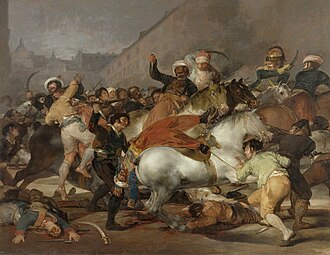 Kampf mit den Mamelucken am 2. Mai 1808 in Madrid - Francisco Goya (1814)
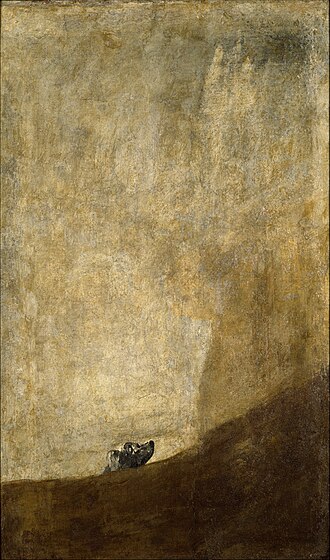 Hund - Francisco Goya (1819)
 Hexensabbat - Francisco Goya (1820s)
Werke verwandter Künstler
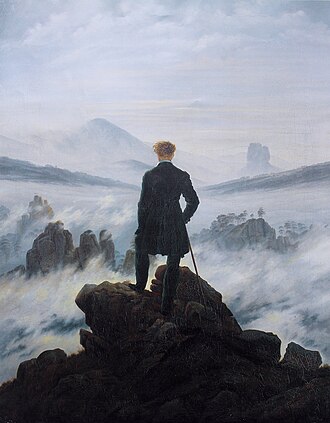 Der Wanderer über dem Nebelmeer - Caspar David Friedrich (c. 1818)
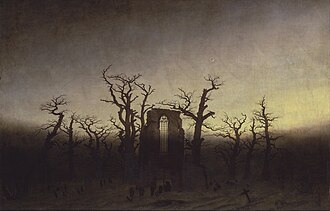 Abtei im Eichwald - Caspar David Friedrich (1800s)
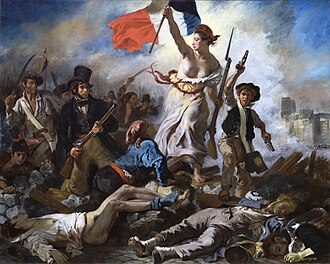 Die Freiheit führt das Volk - Eugène Delacroix (1830)
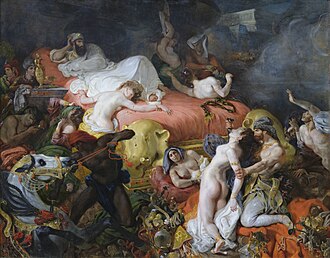 Der Tod des Sardanapal - Eugène Delacroix (1827)
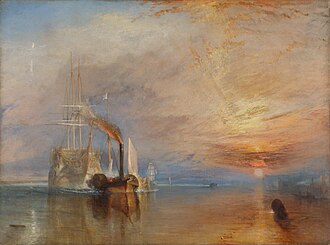 Die letzte Fahrt der Temeraire - J. M. W. Turner (1839)
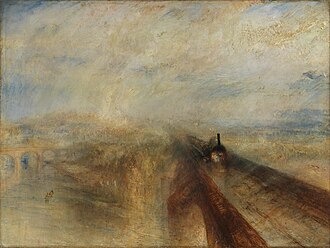 Rain, Steam and Speed - The Great Western Railway - J. M. W. Turner (1844)
.jpg) Knabe in Blau - Thomas Gainsborough (1770)
Knabe in Blau - Thomas Gainsborough (1770).jpg) Mr. und Mrs. Andrews - Thomas Gainsborough (1748)
Mr. und Mrs. Andrews - Thomas Gainsborough (1748)