Selbstporträt
Nicolas Poussin · 1650
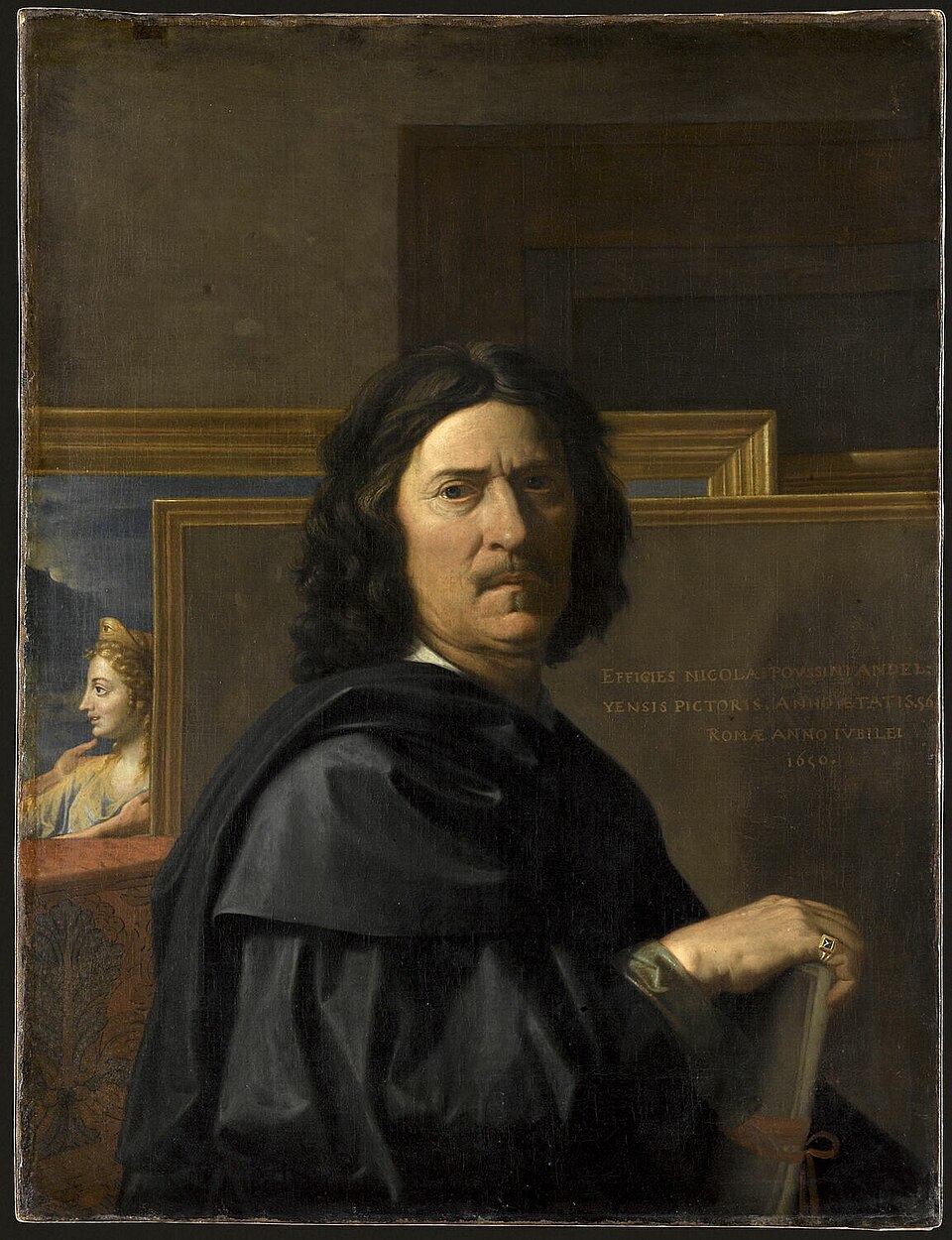
Poussin looks straight at us, half his face in shadow, his hand resting on a rolled paper, framed by canvases behind him. It is the painter as philosopher, made in Rome in 1650 for a friend.
The story behind the painting
Poussin's friend and patron Paul Fréart de Chantelou asked him for a self-portrait as early as 1647. It is one of only two self-portraits Poussin ever painted; the other, made in 1649 for another patron, the banker Jean Pointel, is now in the Gemäldegalerie in Berlin. Poussin wrote to Chantelou that he was keeping the better-made one for him, though in a letter of March 1650 he admitted he had little enthusiasm for such a work.
What to look for
He shows himself half-length, body turned three-quarters, face frontal with its left side in shadow, in a grey toga. His right hand rests on a paper rolled and tied with a red ribbon, like an ancient scroll, and on its little finger is a ring with a pyramid-cut diamond. Behind him hang gilded frames: one bears a Latin inscription, portrait of Nicolas Poussin, painter from Les Andelys, aged 56, in Rome in the Jubilee year 1650. Another shows a woman in profile wearing a diadem with an eye, embraced by two arms.
Meaning and intent
The dignified pose, the toga and the ring on the little finger, a Stoic symbol of strength and constancy, make this the archetype of the painter-philosopher. The ring may also carry a Christian meaning, as early Christians wore one on the right little finger. Bellori read the woman with the eye as an allegory of Painting, of a learned painting; the embracing arms suggest the love of Painting, and the friendship between the painter and Chantelou.
Legacy
The vertical oil on canvas, about 98 by 74 cm, is in the Louvre in Paris and is catalogued in Nicolas Milovanovic's 2021 catalogue of the Louvre's 17th-century French paintings. Its inscription fixes the moment: Rome, the Jubilee year 1650, the painter aged 56, far from his birthplace of Les Andelys. With the Berlin portrait, it is one of only two images Poussin left of himself, and the one he judged the better made.
Schon gewusst?
- One of only two self-portraits by Poussin.
- Painted in Rome in 1650 for Chantelou.
- The inscription gives his age as 56.
- In the Louvre.
Über den Künstler
Nicolas Poussin (1594-1665)
Mann · Gemäldeabteilung des Louvre · Selbstbildnis · Maler
Mehr von Nicolas Poussin
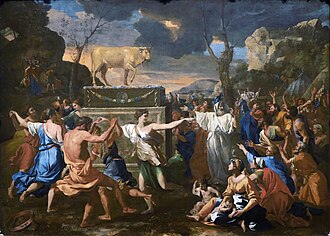 Die Anbetung des goldenen Kalbes - Nicolas Poussin (1634)
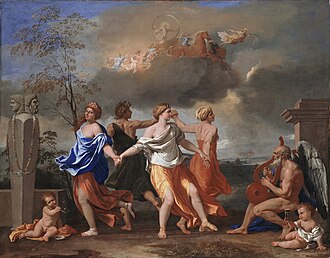 Tanz zu Musik und Zeit - Nicolas Poussin (1630s)
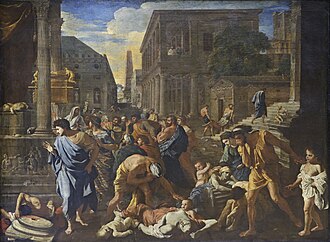 Die Pest von Ashdod - Nicolas Poussin (1630)
.jpg) Urteil des Salomon - Nicolas Poussin (1649)
Urteil des Salomon - Nicolas Poussin (1649)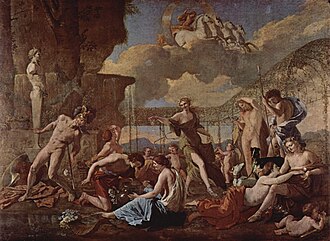 Das Reich der Flora - Nicolas Poussin (1631)
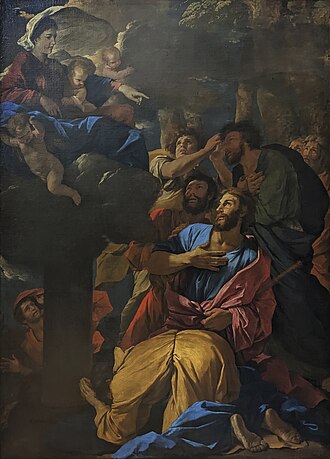 Die Jungfrau erscheint dem Hl. Jacobus - Nicolas Poussin (1620s)
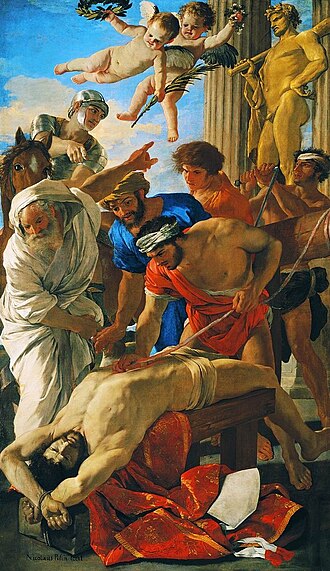 Das Martyrium des Hl. Erasmus - Nicolas Poussin (1628)
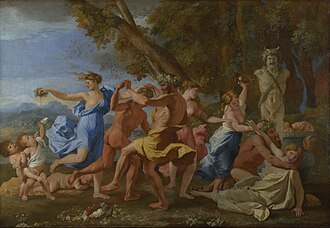 Bacchanal vor einer Pan-Büste - Nicolas Poussin (1630s)