Et in Arcadia ego
Nicolas Poussin · 1638
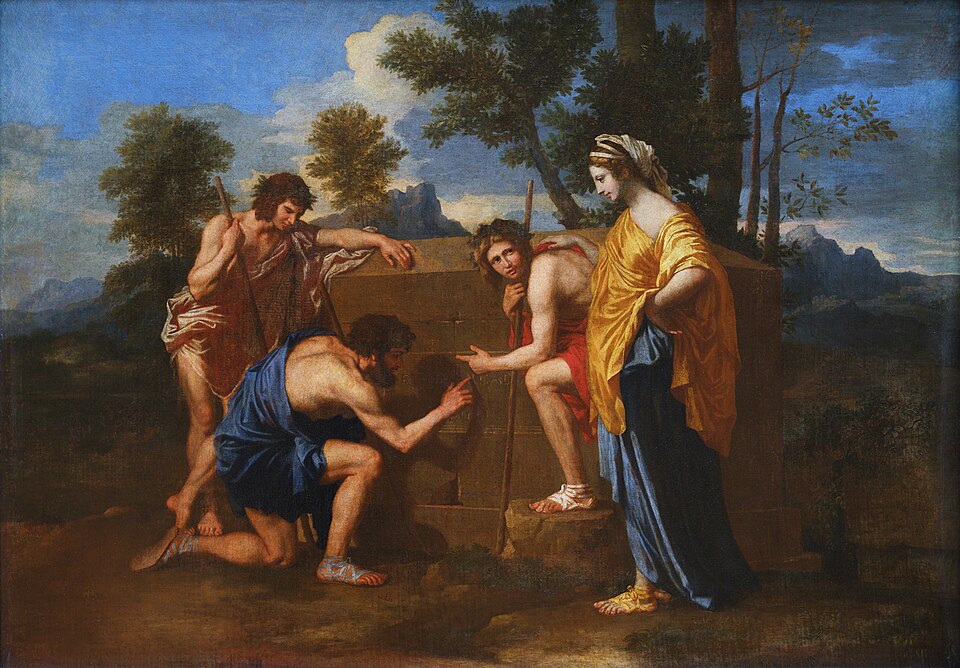
Shepherds in a golden land gather around a plain tomb and slowly read its words: even in Arcadia, I am here. Poussin's second version of this scene, in the Louvre, became one of the most influential meditations on death in Western art.
The story behind the painting
Poussin painted the subject twice. The first version, dated 1628 to 1630, is at Chatsworth House in Derbyshire and was very probably a commission inspired by a canvas by Guercino. Ten years later, in 1637 to 1638, he painted this second version, now in the Louvre and also known as The Shepherds of Arcadia. The idea of a tomb in an idyllic Arcadia goes back to Virgil's Eclogues, was revived in Renaissance Italy around Lorenzo de' Medici, and was fixed in the Western imagination by Jacopo Sannazaro's long poem Arcadia of 1502. Guercino's earlier painting had made the message plainer with a skull in the foreground.
What to look for
Idealised shepherds of classical antiquity gather around a severe tomb. Compared with the more Baroque Chatsworth picture, where shepherds pull back plants to uncover a half hidden tomb with curious faces, this version is built more geometrically and the figures are more contemplative. One shepherd kneels and traces with his finger the shadow of his companion cast on the stone, beside the carved words. On the right stands a richly dressed young woman whose calm, expressionless face follows the convention of the Greek profile. In the first version a skull sat on the tomb; here death is suggested only by that shadow.
Meaning and intent
Et in Arcadia ego can mean I, Death, am also in Arcadia, or I who am dead also lived in Arcadia; both point to the same idea that no one escapes mortality, even in an ideal land. Today it is most widely read as a memento mori, though Poussin's biographer André Félibien took it to mean that the person buried had also enjoyed life. The traced shadow recalls an old tradition, reported by Pliny the Elder, of the birth of painting, so the shadow is both the first image and a sign of death. One reading sees art, embodied by the young woman, answering death. Jean-Louis Vieillard-Baron read it as the painter surviving death through his work.
Legacy
The Louvre version had a major influence on the history of art. The poet Jacques Delille evoked it in his poem Les Jardins, and Denis Diderot discussed it in his writing on dramatic poetry. Yves Bonnefoy devoted an essay to the two canvases, tracing Poussin's thinking from the first to the second. The motto has also attracted esoteric theories: some read the Latin as an anagram for secrets of God, and an inscribed slab at Rennes-le-Château became part of a famous local legend. A novel by Joël Pagé even makes Poussin part of a fictional plot about hidden treasure.
Schon gewusst?
- Poussin's second version, painted 1637-1638.
- An earlier, more Baroque version is at Chatsworth House.
- A shepherd traces a companion's shadow on the tomb.
- Today usually read as a memento mori.
Über den Künstler
Nicolas Poussin (1594-1665)
Frau · Mann · mythologische Malerei · Gemäldeabteilung des Louvre · Laubbaum · Berg · Lesen · Schäfer
Mehr von Nicolas Poussin
 Die Anbetung des goldenen Kalbes - Nicolas Poussin (1634)
 Tanz zu Musik und Zeit - Nicolas Poussin (1630s)
 Die Pest von Ashdod - Nicolas Poussin (1630)
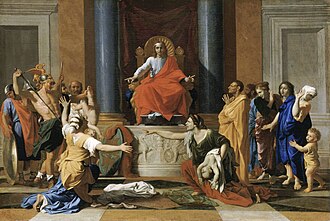 Urteil des Salomon - Nicolas Poussin (1649)
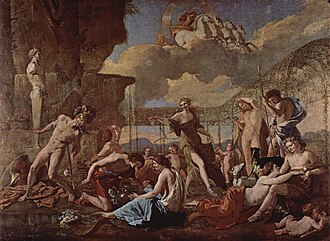 Das Reich der Flora - Nicolas Poussin (1631)
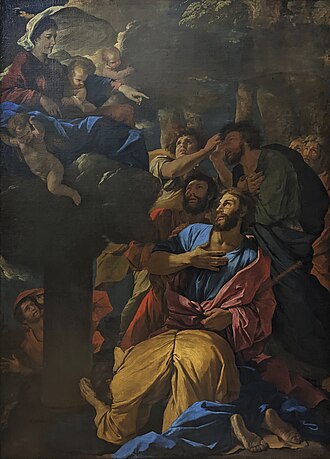 Die Jungfrau erscheint dem Hl. Jacobus - Nicolas Poussin (1620s)
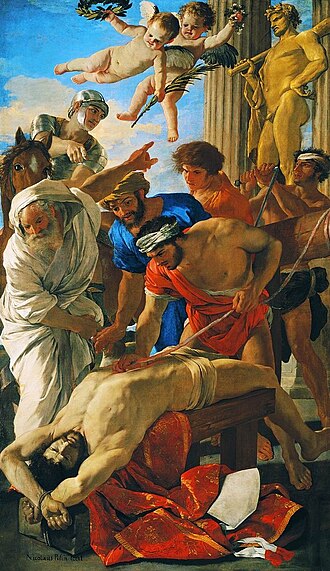 Das Martyrium des Hl. Erasmus - Nicolas Poussin (1628)
 Die Überquerung des Roten Meeres - Nicolas Poussin (1630s)