San Giorgio Maggiore in der Dämmerung
Claude Monet · 1908
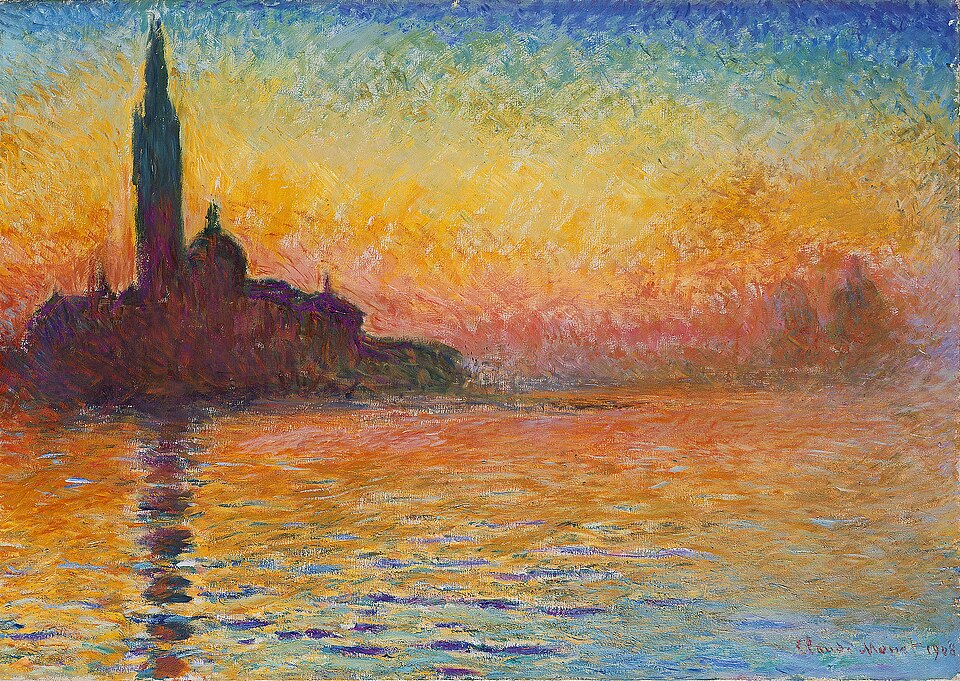
A church and its bell tower rise out of a glowing Venetian sunset, so softly that they seem to float on the water. Monet called Venice a city too beautiful to be painted, and then painted it anyway.
The story behind the painting
In 1908 Claude Monet made his only visit to Venice, with his wife Alice. They stayed first at the Palazzo Barbaro and then at the Hotel Britannia until December. There he began a series of Venetian views, including a group showing the monastery-island of San Giorgio Maggiore, which he painted under six different lighting conditions. This dusk view seems to have been painted not from the hotel but from the waterfront known as the Riva degli Schiavoni, though Monet was said to be reluctant to work there, disliking tourist crowds. The picture exists in more than one version: this one, acquired in Paris by the Welsh collector Gwendoline Davies, she bequeathed to the National Museum in Cardiff, and another is in the Artizon Museum in Tokyo.
What to look for
The Church of San Giorgio Maggiore stands at the centre, its bell tower rising almost to the top edge. Look to the right and you may make out the faint domes of Santa Maria della Salute and the mouth of the Grand Canal. The buildings are only gently set into the scene, enough to be recognised but no more, so that they seem to appear magically from the surrounding light. Notice how sky and water share the same burning colours, and how the architecture dissolves into them. Monet was especially moved by Venice's sunsets, which he described as splendid and unique in the world. The canvas, a little over 65 by 92 centimetres, is filled with that glow.
Meaning and intent
Monet's interest was less in the building than in what light did to it. By painting the same church at different moments, he made the series about the nature of experience: how a place changes as the hour changes. He had followed sunsets before, in Normandy with the Rouen Cathedral and Haystacks series of the 1890s and in London with the Houses of Parliament. Here the solid stone of a famous church becomes almost a memory of itself, held for a moment in the evening air. Monet also worried about simply repeating painters drawn to Venice before him, Turner among them, and his answer was to paint not the view but the sensation.
Legacy
Monet took many of the Venice canvases home to Giverny unfinished and worked on them there, and the death of Alice in 1911 seems to have played a part in their completion. In 1912, twenty-nine of the Venetian paintings were shown at the Bernheim-Jeune gallery in Paris in an exhibition titled Claude Monet Venise, after which most were dispersed. This image later reached a wide audience through the 1999 film The Thomas Crown Affair, where it is shown being stolen from the Metropolitan Museum of Art, which does not in fact own it. A detail also appeared on the cover of a recording of Fauré's Nocturnes and Barcarolles by pianist Marc-André Hamelin.
Schon gewusst?
- Painted during Monet's only visit to Venice, begun in 1908.
- At least two versions: Cardiff (bequeathed by Gwendoline Davies) and the Artizon Museum, Tokyo.
- Twenty-nine Venice canvases were exhibited at Bernheim-Jeune, Paris, in 1912.
Über den Künstler
Claude Monet (1840-1926)
Impressionismus · Stadtlandschaft
Mehr von Claude Monet
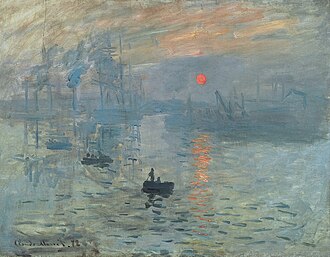 Impression, Sonnenaufgang - Claude Monet (1872)
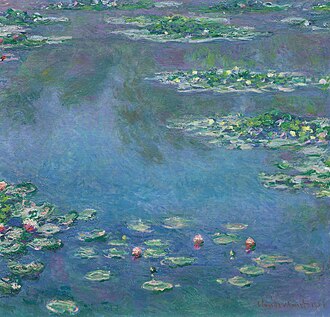 Seerosen - Claude Monet (1906)
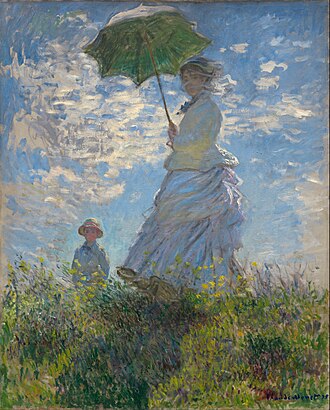 Die Frau mit dem Sonnenschirm - Claude Monet (1875)
 Garten in Sainte-Adresse - Claude Monet (1867)
 Frauen im Garten - Claude Monet (1866)
 Die Elster - Claude Monet (1868)
 Frau im Garten - Claude Monet (1867)
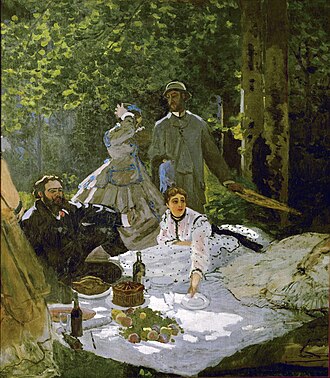 Das Frühstück im Grünen - Claude Monet (1866)
Werke verwandter Künstler
 Das Frühstück im Grünen - Édouard Manet (1863)
 Olympia - Édouard Manet (1863)
 Tanz im Moulin de la Galette - Pierre-Auguste Renoir (1876)
 Das Frühstück der Ruderer - Pierre-Auguste Renoir (1881)
 Die Sternennacht - Vincent van Gogh (1889)
.jpg) Caféterrasse am Abend - Vincent van Gogh (1888)
Caféterrasse am Abend - Vincent van Gogh (1888)