Saint Frances Announcing the End of the Plague in Rome
Nicolas Poussin · 1657
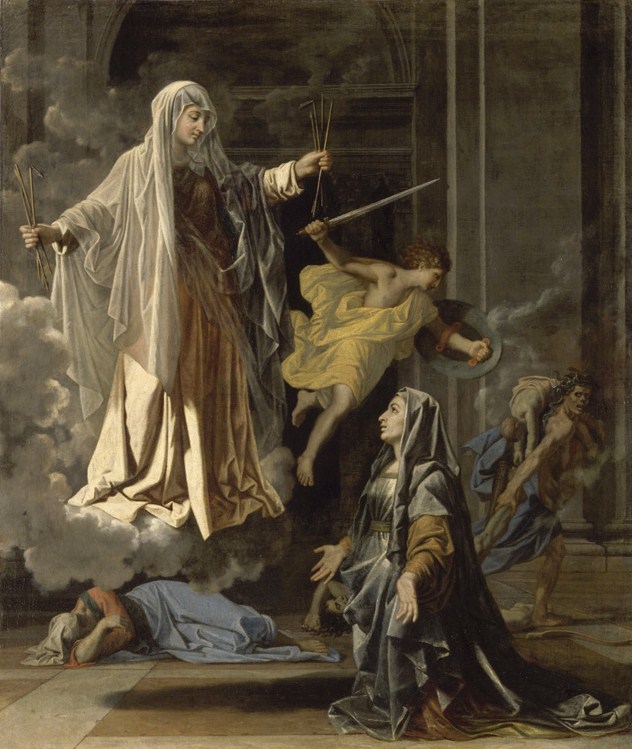
An angel drives the plague out of Rome while a saint holding broken arrows appears to a kneeling woman. Poussin painted this thanksgiving in 1657, and for a long time it was thought lost.
The story behind the painting
The painting was commissioned from Poussin by Cardinal Giulio Rospigliosi, the future Pope Clement IX, to celebrate the end of the plague in Rome. It stayed in the cardinal's family until 1798. By 1873 it belonged to Alexis Le Go, secretary of the Villa Medici, who took it to his château in Le Val, in the Var, where it passed down his family. The scholar Jacques Thuillier considered it lost.
What to look for
On the right, the plague, in human form, is chased away by an angel. Saint Frances of Rome holds broken arrows, the arrows of the disease now powerless, and appears to a Roman lady, perhaps Anna Colonna, who died in 1658. The canvas is about 130 by 101 cm. The 1999 restoration, led by Jean-Pierre Cuzin, removed old varnish and later repaints and repaired a tear from an earlier relining, so the colours read as Poussin left them.
Meaning and intent
The picture was made to celebrate the end of the plague in Rome, and there are two readings of it. Either the kneeling woman is the Roman lady and the apparition is Saint Frances, bringing the news that the disease is broken. Or the kneeling woman is Saint Frances herself, and the figure appearing to her is the Virgin or the Church. Either way, it is a picture of relief after fear, of a city told it may breathe again.
Legacy
It reappeared in 1999, was authenticated by Eric Turquin and entered the Louvre with the help of the Société des Amis du Louvre and the Fonds du Patrimoine, under inventory number RF 1999.1. The sale was challenged in court by members of the family in 2001, but French courts, up to the Cour de Cassation in 2007, upheld the will and the owner's title. From December 2013 to April 2014 it was shown at the Louvre-Lens in the exhibition Voir le sacré.
Schon gewusst?
- Commissioned by the future Pope Clement IX.
- Considered lost until it reappeared in 1999.
- Restored in 1999 and entered the Louvre.
- Shown at the Louvre-Lens in 2013-2014.
Über den Künstler
Nicolas Poussin (1594-1665)
religiöse Kunst · Gemäldeabteilung des Louvre
Mehr von Nicolas Poussin
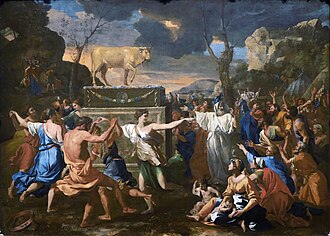 Die Anbetung des goldenen Kalbes - Nicolas Poussin (1634)
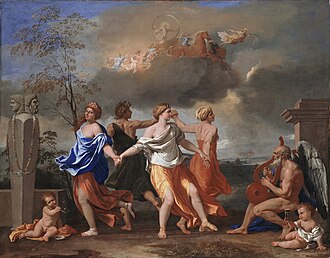 Tanz zu Musik und Zeit - Nicolas Poussin (1630s)
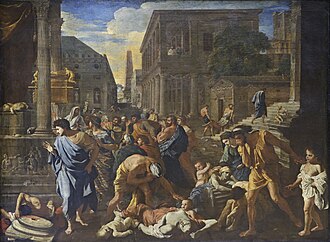 Die Pest von Ashdod - Nicolas Poussin (1630)
.jpg) Urteil des Salomon - Nicolas Poussin (1649)
Urteil des Salomon - Nicolas Poussin (1649)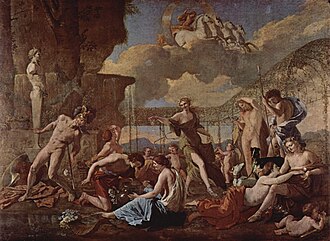 Das Reich der Flora - Nicolas Poussin (1631)
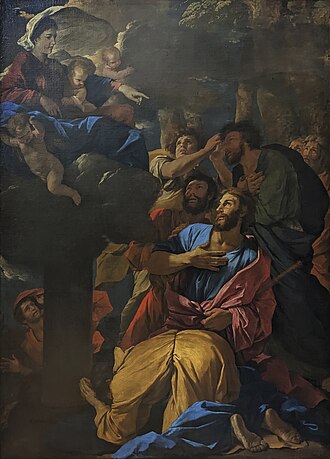 Die Jungfrau erscheint dem Hl. Jacobus - Nicolas Poussin (1620s)
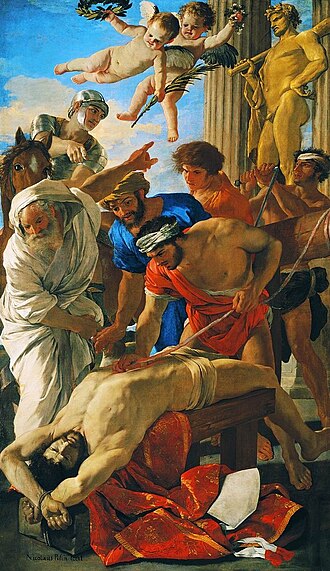 Das Martyrium des Hl. Erasmus - Nicolas Poussin (1628)
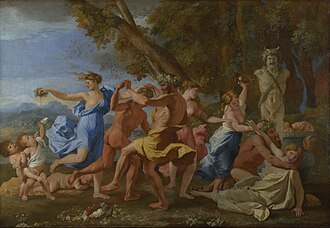 Bacchanal vor einer Pan-Büste - Nicolas Poussin (1630s)