Die Opferung Isaacs
Tizian · 1540s
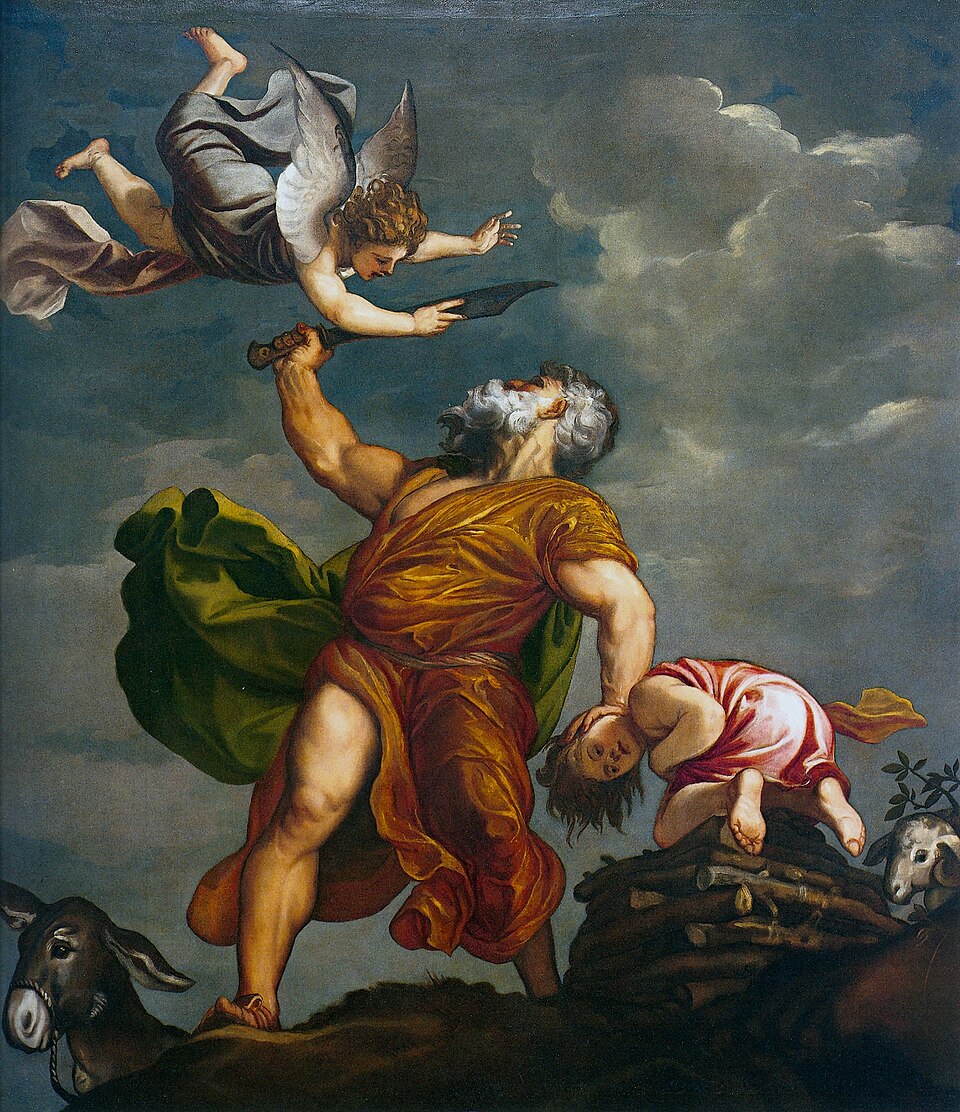
Seen from far below, Abraham towers against a heavy, clouded sky, his knife raised over the boy on the woodpile, as he twists round to the angel who stops him. Titian painted the scene for a Venetian ceiling around 1543 to 1544.
The story behind the painting
At the beginning of the 1540s Titian received commissions for a great number of pictures from the brothers of the Venetian church of Santo Spirito, who already owned his early San Marco Enthroned. Among them, about 1543 to 1544, he painted three scenes from the Old Testament for a ceiling: Cain and Abel, Abraham and Isaac, and David and Goliath. In the 17th century the whole collection of art treasures from Santo Spirito was moved to the basilica of Santa Maria della Salute, where these three pictures now sit in the ceiling of the sacristy, above the altar. Wikidata records the canvas at 328 by 284.5 cm.
What to look for
The subject is the moment from Genesis when Abraham, commanded to sacrifice Isaac in the land of Moriah, is stopped by an angel. In the words of the scholar Georg Gronau, the tall, erect Abraham acts twice at once: his left hand rests on the neck of the boy kneeling on the pile of wood, his right brandishes the knife, and he turns round to the angel who has stayed his movement. Around them lie brown soil and rocky cliffs under a gloomy sky. Gronau points to changing lights on the cloud edges and Abraham's deep orange robe, set between reddish violet and grey blue.
Meaning and intent
Gronau saw the three ceiling pictures as a group chosen to display passionate movement, each with only two or three figures, perhaps by Titian's own choice and perhaps suggested by his patrons. He wrote that for grandeur of conception Titian here, if anywhere, approaches Michelangelo, with colossal, muscular, heroic forms, while the colour scheme is entirely his own. He also called the Sacrifice of Isaac the divine reward of unquestioning faith. In the biblical story, Abraham slew a ram found on the spot and received the promise of numerous descendants and abundant prosperity as a reward for his obedience.
Legacy
The painting has stayed in Venice, in the church to which the treasures of Santo Spirito were transferred, and it is still seen as the brothers' commission intended: from below, as part of a ceiling. Its companions there, Cain and Abel and David and Goliath, share the same mountain setting and stormy sky, so the three are best viewed together as one cycle. Gronau's account stresses how the composition in colour contributes as much as the drawing to an effect of powerful life, a quality that still makes this work stand out in Titian's art.
Schon gewusst?
- Painted about 1543-1544 for the church of Santo Spirito in Venice.
- One of three Old Testament ceiling scenes.
- Now in the sacristy of Santa Maria della Salute.
- Georg Gronau compared its grandeur to Michelangelo.
Über den Künstler
Tizian (1488-1576)
religiöse Kunst · Engel · Santa Maria della Salute · Isaak
Mehr von Tizian
 Venus von Urbino - Titian (1538)
 Mariä Himmelfahrt - Titian (1510s)
 Himmlische und Irdische Liebe - Titian (1510s)
 Kaiser Karl V. nach der Schlacht bei Mühlberg - Titian (1548)
 Flora - Titian (1517)
 Allegorie der von der Klugheit beherrschten Zeit - Titian (1550)
 Diana und Actaeon - Titian (1550s)
 Bacchus und Ariadne - Titian (1520s)
Werke verwandter Künstler
 Das letzte Abendmahl - Jacopo Tintoretto (1563)
 Der heilige Markus befreit den gefesselten Sklaven - Jacopo Tintoretto (1540s)
 Die Hochzeit zu Kana - Paolo Veronese (1560s)
 Das Gastmahl im Hause des Levi - Paolo Veronese (1573)