Regatta at Sainte-Adresse
Claude Monet · 1867
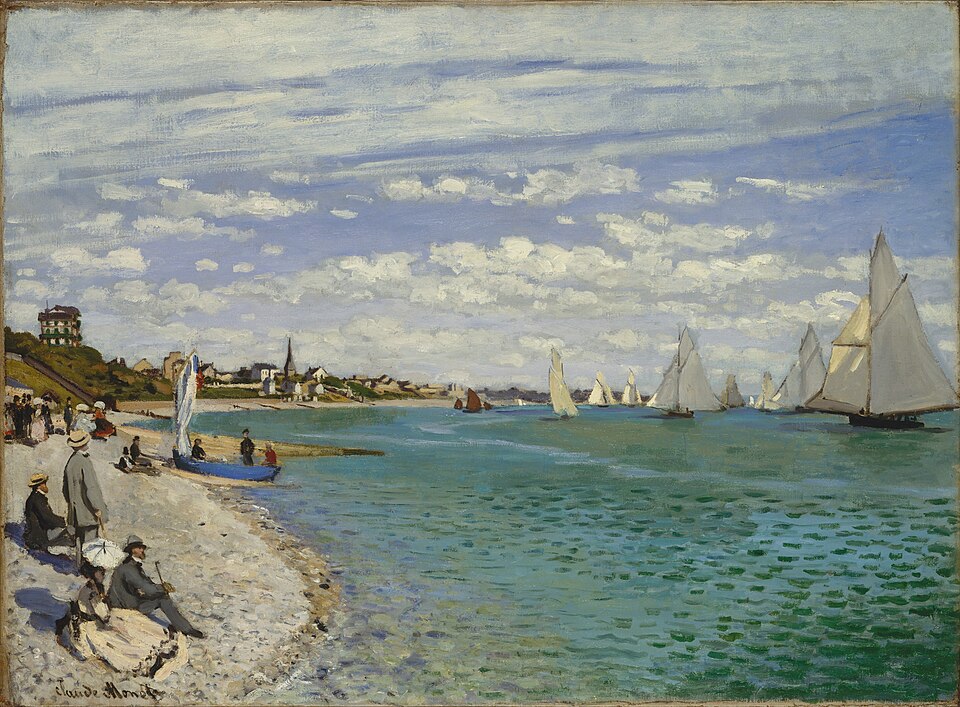
A bright summer day on the Normandy coast: sails dot the sea, and elegant spectators stroll the shore. Behind the sunshine lies a hard summer in the young Monet's life.
The story behind the painting
Sainte-Adresse, a well-to-do suburb of Le Havre, was home to Monet's father. In the summer of 1867, destitute, Monet stayed there with his father and his aunt Sophie Lecadre, at the cost of leaving behind his companion Camille Doncieux and their newborn son, Jean. He attended the birth in Paris and returned to the coast a few days later. On 25 June 1867 he wrote that he was working on about twenty pictures, among them the regattas of Le Havre with many figures on the beach and the outer harbor covered with small sails. The Regatta at Sainte-Adresse, oil on canvas, is one of the works of that summer.
What to look for
The scene takes place at high tide on a sunny day. Well dressed members of the bourgeoisie watch from the beach, some under parasols, while sailboats race across the water beyond. A church building stands among the subjects Wikidata lists for the view. The canvas measures 75.2 by 101.6 cm and is signed at the lower left. Its companion, The Beach at Sainte-Adresse in the Art Institute of Chicago, has the same size, and its viewpoint differs by only a few yards. There the mood changes: an overcast day at low tide, with fishing boats hauled up onto a beach peopled by sailors and workers.
Meaning and intent
Placed side by side, the two pictures seem to set leisure against labor, sunshine against gray. Yet Monet never exhibited them together, so the contrast was probably not meant as a social statement. Instead, it reflects the different conditions under which the same stretch of coast could be painted: tide, weather, light and the people they bring. That is the real subject. The same place, a few steps apart, becomes two different worlds as conditions shift. The bright sails of this canvas are one answer to a question Monet kept asking.
Legacy
The painting's later history is well documented. It may have been bought from the artist by Henri Hecht in 1873 and exhibited in 1868 in Bordeaux and in 1874 in London, though both are uncertain. It passed through Durand-Ruel to P. A. B. Widener near Philadelphia, then to William Church Osborn of New York, who owned it until his death in 1951. It now belongs to the Metropolitan Museum of Art. The painting appeared in exhibitions such as Hommage a Claude Monet in Paris in 1980 and Origins of Impressionism in New York in 1994-1995.
Schon gewusst?
- Painted in 1867 at Sainte-Adresse, near Le Havre (Wikipedia)
- Probably conceived as a pair with The Beach at Sainte-Adresse, Art Institute of Chicago (Wikipedia)
- Size 75.2 x 101.6 cm, Metropolitan Museum of Art (Wikidata)
Über den Künstler
Claude Monet (1840-1926)
Frau · Mann · Impressionismus · Metropolitan Museum of Art · Boot · Marinekunst · Kirchengebäude · Sonnenschirm · Segelboot · Sainte-Adresse
Mehr von Claude Monet
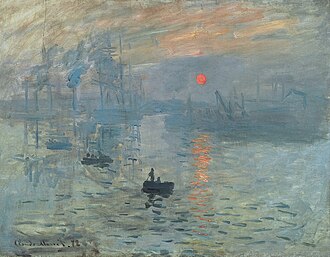 Impression, Sonnenaufgang - Claude Monet (1872)
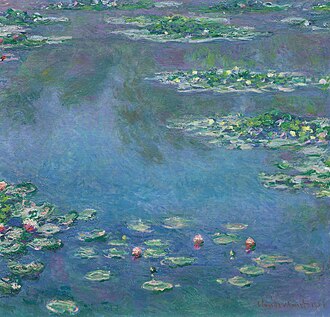 Seerosen - Claude Monet (1906)
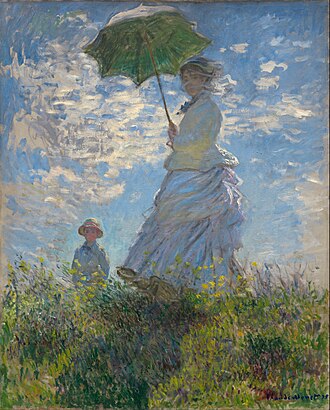 Die Frau mit dem Sonnenschirm - Claude Monet (1875)
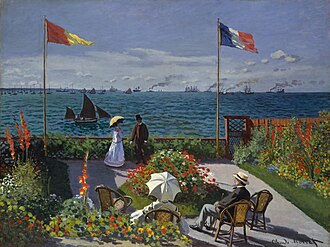 Garten in Sainte-Adresse - Claude Monet (1867)
 Frauen im Garten - Claude Monet (1866)
 Die Elster - Claude Monet (1868)
 Frau im Garten - Claude Monet (1867)
 Das Frühstück im Grünen - Claude Monet (1866)
Werke verwandter Künstler
 Das Frühstück im Grünen - Édouard Manet (1863)
 Olympia - Édouard Manet (1863)
 Tanz im Moulin de la Galette - Pierre-Auguste Renoir (1876)
 Das Frühstück der Ruderer - Pierre-Auguste Renoir (1881)
 Die Sternennacht - Vincent van Gogh (1889)
.jpg) Caféterrasse am Abend - Vincent van Gogh (1888)
Caféterrasse am Abend - Vincent van Gogh (1888)