Porträt der Infantin Maria Josefa Carmela
Francisco Goya · 1800
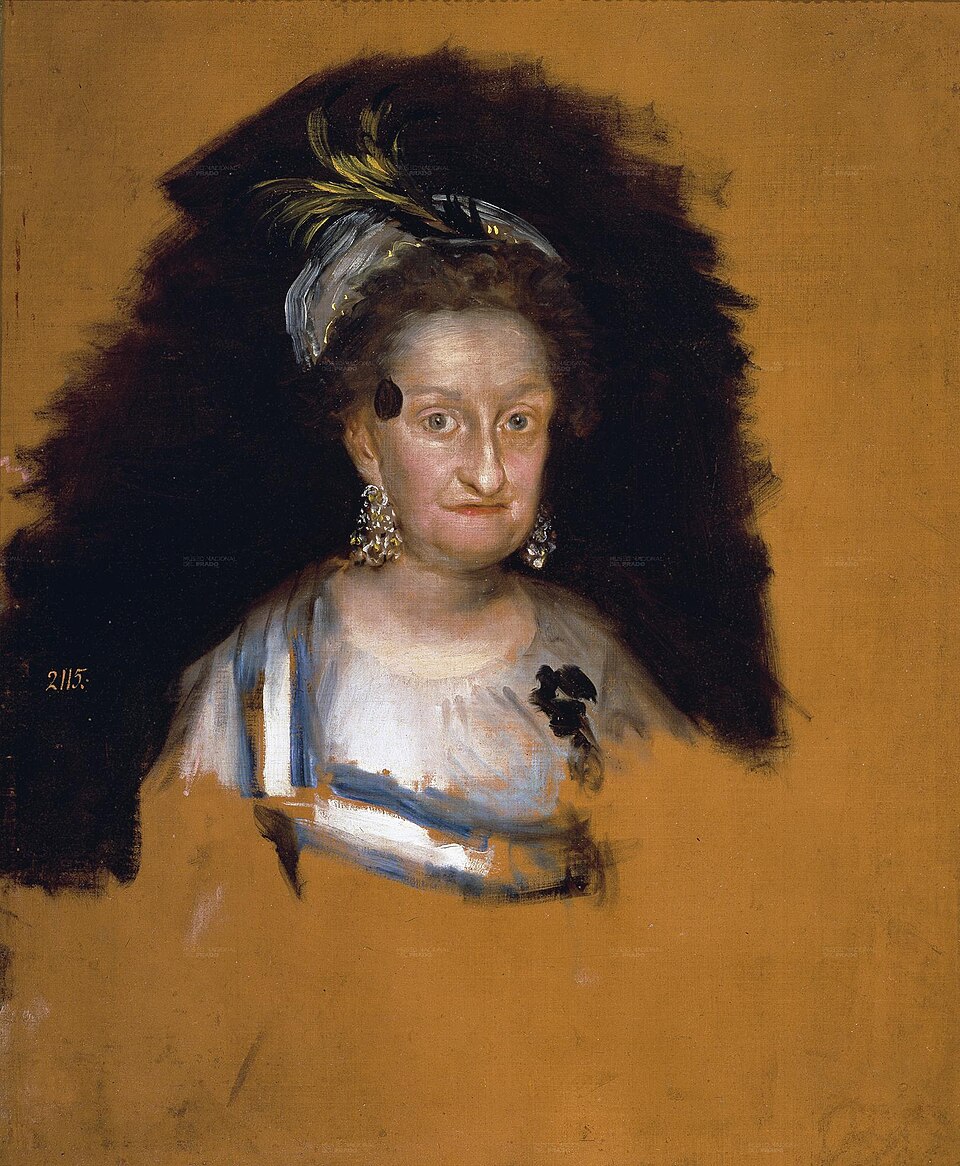
An unmarried Spanish princess, a bird of paradise feather in her hair, looks out from a dark mass of paint on a glowing ground. Goya painted Maria Josefa in the summer of 1800 as a study for The Family of Charles IV. She died a year later.
The story behind the painting
In the summer of 1800, at the Royal Palace of Aranjuez, Francisco de Goya painted ten studies from life for his great group portrait, The Family of Charles IV. Queen Maria Luisa of Parma wanted each member of the royal family painted separately, so that no one had to pose for long hours together. This is the study of the Infanta Maria Josefa, daughter of Charles III and Maria Amalia of Saxony, born in Gaeta when her father was still king of Naples. She never married, although a match with her uncle, the Infante Don Luis, had been proposed.
What to look for
All of these studies share a red ground layer, with the facial features and the main masses first built in a single tone, then shades of colour added once planes and proportions were set. Goya paints a dark figure on a bright background with quick, energetic strokes, but the face is drawn in delicate, precise, careful lines. Look for the sash of the Order of Queen Maria Luisa, the large diamond earrings, and the black ribbon on her chest, the badge of the Order of the Starry Cross, given only to ladies of the Spanish royal family.
Meaning and intent
Goya treated the Infanta with great intensity and attention to the expressions of her face; in the final group portrait she stands on the left. Her accessories tell a story of their own. The feather on her head, the bird of paradise plume, and the band at her temple show the influence of France on Spanish fashion. Yet that band was already out of fashion and was worn only as a medical remedy. She died one year after the portrait was painted, which gives this quick, frank study a quiet weight.
Legacy
The study came from the royal collections and was recorded at the Royal Palace of Madrid in 1814. It entered the Prado before 1834, since it appears in that year's inventory of the Royal Museum, and it was first listed in the Prado's official catalogue in 1872. Small, about 72 by 59 cm, it lets us see Goya at work before the formal group portrait: a painter looking hard and honestly at one princess. A pastel of her as a young woman by Lorenzo Tiepolo is also in the Prado.
Schon gewusst?
- One of ten life studies Goya painted at Aranjuez in summer 1800.
- A preparation for The Family of Charles IV.
- She wears the black ribbon of the Order of the Starry Cross.
- In the Prado since before 1834.
Über den Künstler
Francisco Goya (1746-1828)
Frau · Porträt · Museo del Prado · 1795-1820 in westlicher Mode
Mehr von Francisco Goya
 Die Erschießung der Aufständischen - Francisco Goya (1814)
 Die nackte Maja - Francisco Goya (1800)
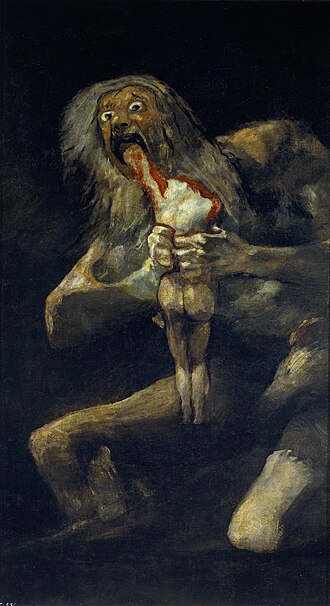 Saturn verschlingt seinen Sohn - Francisco Goya (1819)
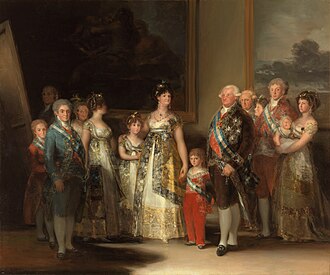 Die Familie Karls IV. - Francisco Goya (1800)
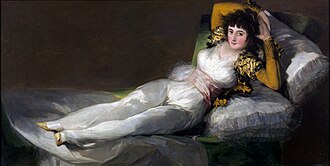 Die Bekleidete Maja - Francisco Goya (1800)
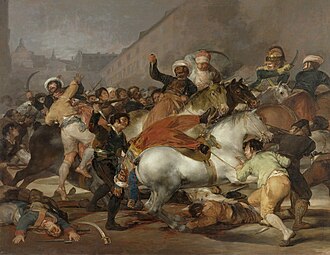 Kampf mit den Mamelucken am 2. Mai 1808 in Madrid - Francisco Goya (1814)
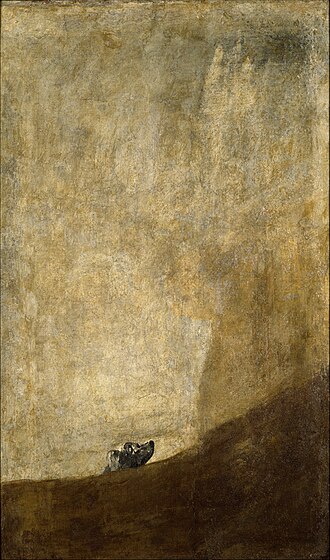 Hund - Francisco Goya (1819)
 Hexensabbat - Francisco Goya (1820s)
Werke verwandter Künstler
 Der Wanderer über dem Nebelmeer - Caspar David Friedrich (c. 1818)
 Abtei im Eichwald - Caspar David Friedrich (1800s)
 Die Freiheit führt das Volk - Eugène Delacroix (1830)
 Der Tod des Sardanapal - Eugène Delacroix (1827)
 Die letzte Fahrt der Temeraire - J. M. W. Turner (1839)
 Rain, Steam and Speed - The Great Western Railway - J. M. W. Turner (1844)
 Knabe in Blau - Thomas Gainsborough (1770)
 Mr. und Mrs. Andrews - Thomas Gainsborough (1748)