Porträt des Ippolito de' Medici.
Tizian · 1530s
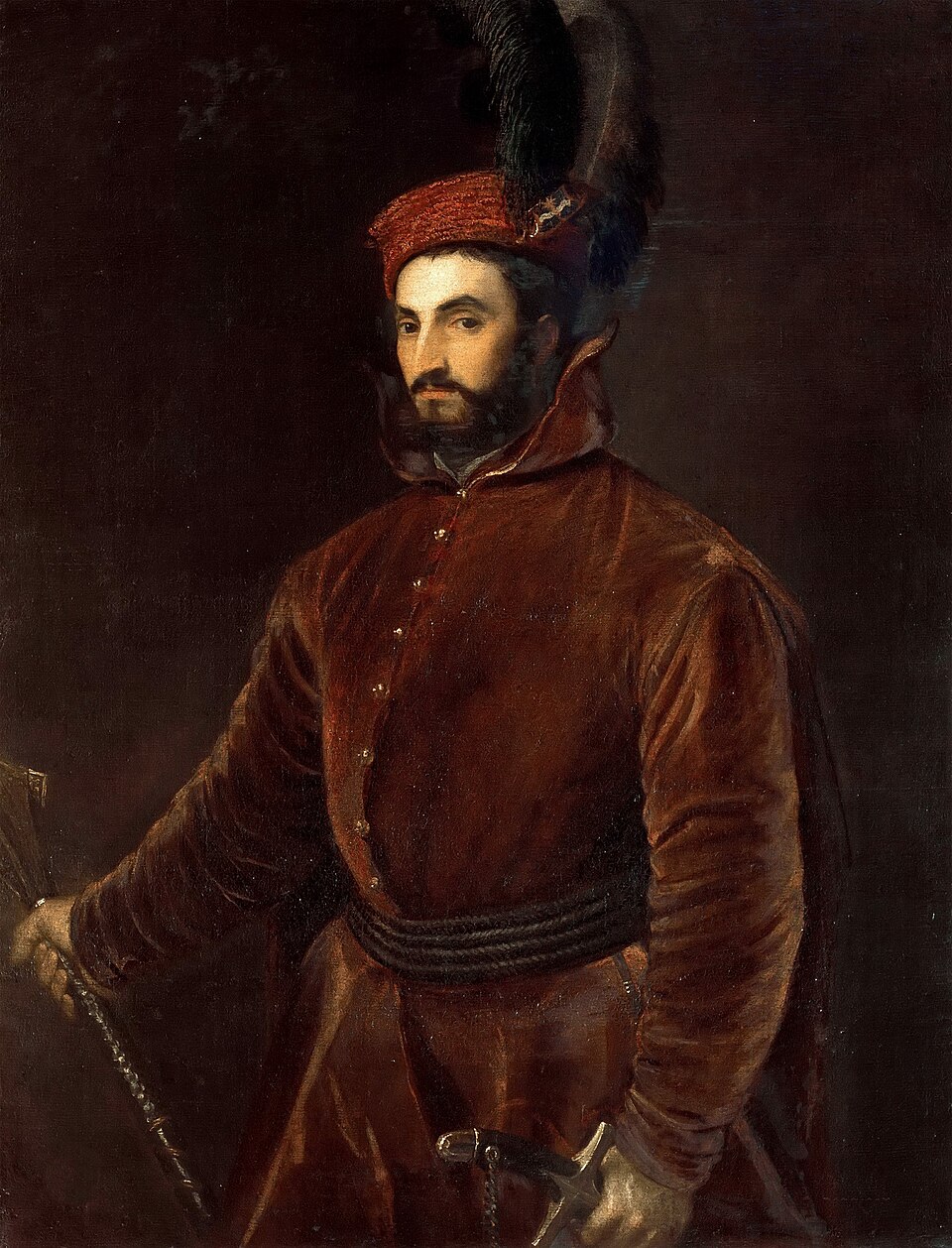
A young cardinal who would rather have been a soldier stands in a Hungarian horseman's costume, baton in hand. Titian painted Ippolito de' Medici in 1533, and the restless warrior in him still burns through the dark reds and purples.
The story behind the painting
Ippolito de' Medici was the son of Giuliano de' Medici, Duke of Nemours, and a nephew of Pope Clement VII. He was made a cardinal at eighteen, but as he grew older he found himself more drawn to war than to the Church. In 1532 he was sent to Hungary as papal legate and led 8,000 Hungarian soldiers against the Ottoman Turks. When Charles V returned to Italy in 1533, Ippolito followed him, and Titian, who had come to Bologna for the Emperor's second visit, painted this portrait that year.
What to look for
Against a dark background, deep reds, purples and amaranth tones gather around a face that is perfectly lit. The sitter wears the outfit of a Hungarian horseman. In a warlike pose he holds the baton of command in one hand, while his left hand rests on the hilt of his sword. Look at the expression: the Wikipedia article reads in it something of confidence and of cruelty, the look of a young leader. The canvas, about 139 by 107 cm, is large enough to give him real presence.
Meaning and intent
The costume is a memory of his campaign against the Turks, and the whole picture shows a churchman who wanted to be seen as a commander. The sources point out a small contradiction: he could not have been in Vienna during the Turkish siege of 1529, because he had just been made a cardinal and archbishop of Avignon and was in Bologna for the meeting of Clement VII and Charles. The place of painting is also unsure: Vasari says Bologna, while a document found in 2000 suggests Venice.
Legacy
Titian painted the Emperor with a Dog, now in the Prado, during the same Bologna visit, so the two portraits are close companions. According to Vasari, Ippolito also had a second, smaller portrait in armour made by Titian, but it did not survive. This one served as a model for various printed reproductions. It has been recorded at the Palazzo Pitti in Florence since 1716, moving through several rooms before reaching the Room of Mars in the Galleria Palatina, where it still hangs.
Schon gewusst?
- Painted by Titian in 1533, probably in Bologna.
- Ippolito wears the dress of a Hungarian horseman.
- A second Titian portrait of him in armour is lost.
- Recorded at the Palazzo Pitti since 1716.
Über den Künstler
Tizian (1488-1576)
Porträt · Venezianische Schule · Galleria Palatina
Mehr von Tizian
 Venus von Urbino - Titian (1538)
 Mariä Himmelfahrt - Titian (1510s)
 Himmlische und Irdische Liebe - Titian (1510s)
 Kaiser Karl V. nach der Schlacht bei Mühlberg - Titian (1548)
 Flora - Titian (1517)
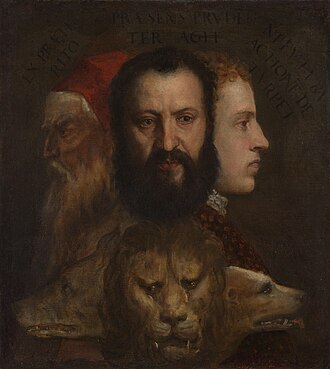 Allegorie der von der Klugheit beherrschten Zeit - Titian (1550)
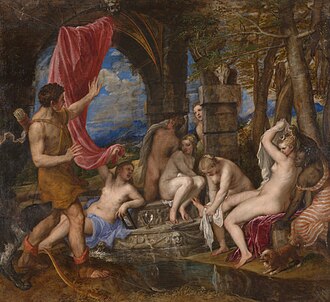 Diana und Actaeon - Titian (1550s)
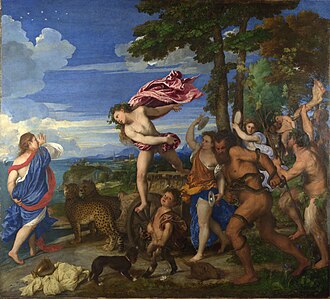 Bacchus und Ariadne - Titian (1520s)
Werke verwandter Künstler
 Das letzte Abendmahl - Jacopo Tintoretto (1563)
 Der heilige Markus befreit den gefesselten Sklaven - Jacopo Tintoretto (1540s)
 Die Hochzeit zu Kana - Paolo Veronese (1560s)
 Das Gastmahl im Hause des Levi - Paolo Veronese (1573)