Porträt von Eleonora Gonzaga della Rovere
Tizian · 1530s
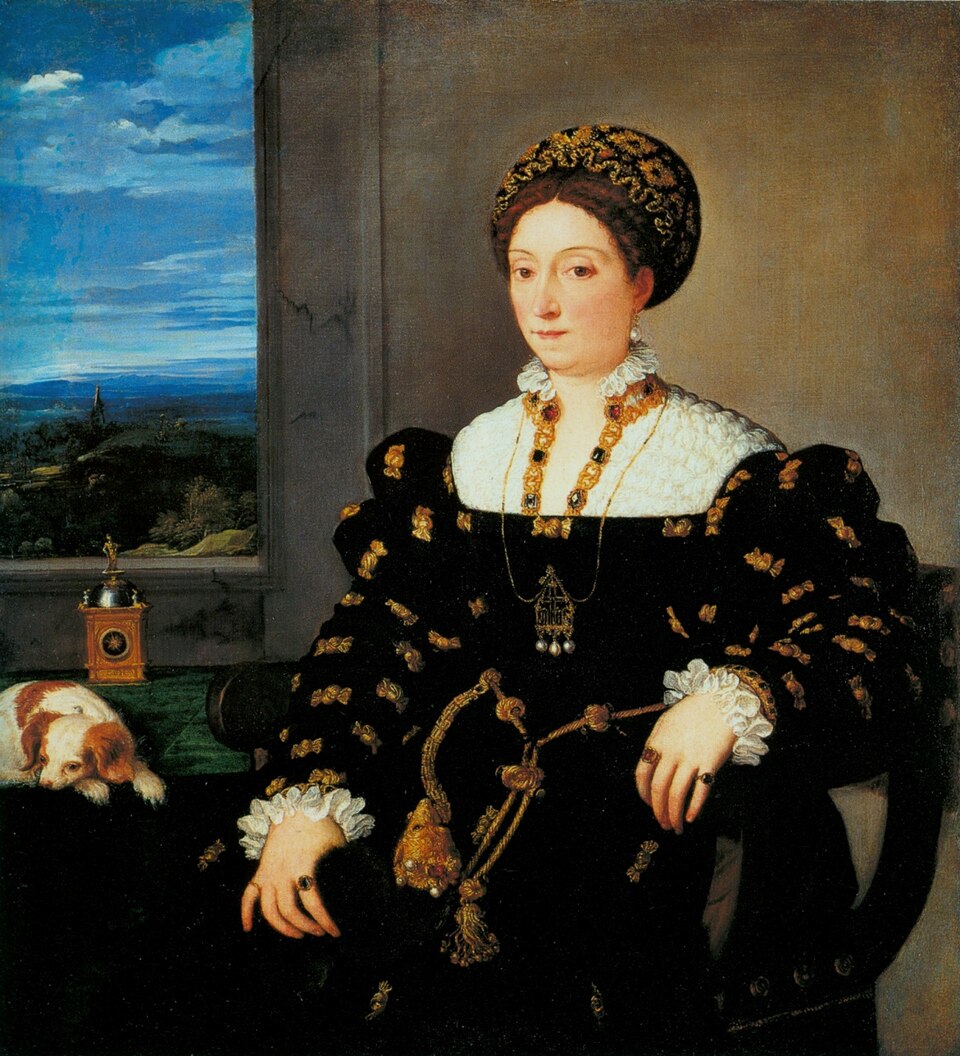
A duchess in dark velvet and gold strokes the fur of a jewelled marten while a small dog sleeps beside a golden clock. Titian painted Eleonora Gonzaga as the partner of her husband's portrait, and filled the scene with quiet signs of fidelity and time.
The story behind the painting
Eleonora Gonzaga della Rovere was Duchess of Urbino, and Titian painted her as the pair to his Portrait of Francesco Maria della Rovere, her husband. The two pictures hang together today in the Uffizi in Florence. Wikipedia dates the portrait to 1538, while Wikidata gives only the 1530s. The duchess portrait became a model for some of Titian's later portraits, such as that of Isabella of Portugal. The della Rovere had inherited the duchy of Urbino from the Montefeltro family, and that inheritance is woven into the colours of her dress.
What to look for
Eleonora sits in a three-quarter-length view, turned to the left. Her gold-embroidered headdress follows a fashion launched by Isabella d'Este. Her dress is dark velvet with gold bows, the neckline filled with white silk edged in gold and set with precious stones, colours that recall the Montefeltro livery, and silk puffs from the sleeves. From her gold cord belt hangs a marten with a jewelled gold head set with pearls and rubies, and she caresses its fur. Behind her, a window in the grey wall opens onto a green landscape. On a green-covered table sleep a spotted dog and a golden clock topped by a statuette.
Meaning and intent
The objects carry meaning. The dog, almost identical to the one in Titian's Venus of Urbino, stands for fidelity. Her pendant of drop-shaped pearls is a symbol of a bride's purity. The clock, which appears in other portraits such as Gentleman with a Watch in the Prado, may mean eternity, perhaps eternal faithfulness in marriage, or temperance through its regular ticking, or a memento mori for passing time. It may also simply be a status symbol, for the Dukes of Urbino collected such pieces, and Titian once helped them buy a watch from an Augsburg maker.
Legacy
Paired with her husband's portrait, Eleonora's image presents the virtues expected of a ruling wife: loyalty, purity and measured calm, all wrapped in the wealth of her house. The formula worked well enough that Titian reused it for later sitters, including Isabella of Portugal. The dog and the clock link this portrait to other works by Titian, showing how he built a shared language of symbols across his paintings. Today the duke and duchess still face each other in the Uffizi, as they were meant to be seen.
Schon gewusst?
- Painted by Titian, dated 1538 in Wikipedia.
- Pair to the portrait of her husband Francesco Maria della Rovere.
- The sleeping dog stands for fidelity; the clock for time or eternity.
- Held in the Uffizi, Florence.
Über den Künstler
Tizian (1488-1576)
Porträt · Venezianische Schule · Uffizien
Mehr von Tizian
 Venus von Urbino - Titian (1538)
 Mariä Himmelfahrt - Titian (1510s)
 Himmlische und Irdische Liebe - Titian (1510s)
 Kaiser Karl V. nach der Schlacht bei Mühlberg - Titian (1548)
 Flora - Titian (1517)
 Allegorie der von der Klugheit beherrschten Zeit - Titian (1550)
 Diana und Actaeon - Titian (1550s)
 Bacchus und Ariadne - Titian (1520s)
Werke verwandter Künstler
 Das letzte Abendmahl - Jacopo Tintoretto (1563)
 Der heilige Markus befreit den gefesselten Sklaven - Jacopo Tintoretto (1540s)
 Die Hochzeit zu Kana - Paolo Veronese (1560s)
 Das Gastmahl im Hause des Levi - Paolo Veronese (1573)