Papst Paul III. und seine Nepoten
Tizian · 1546
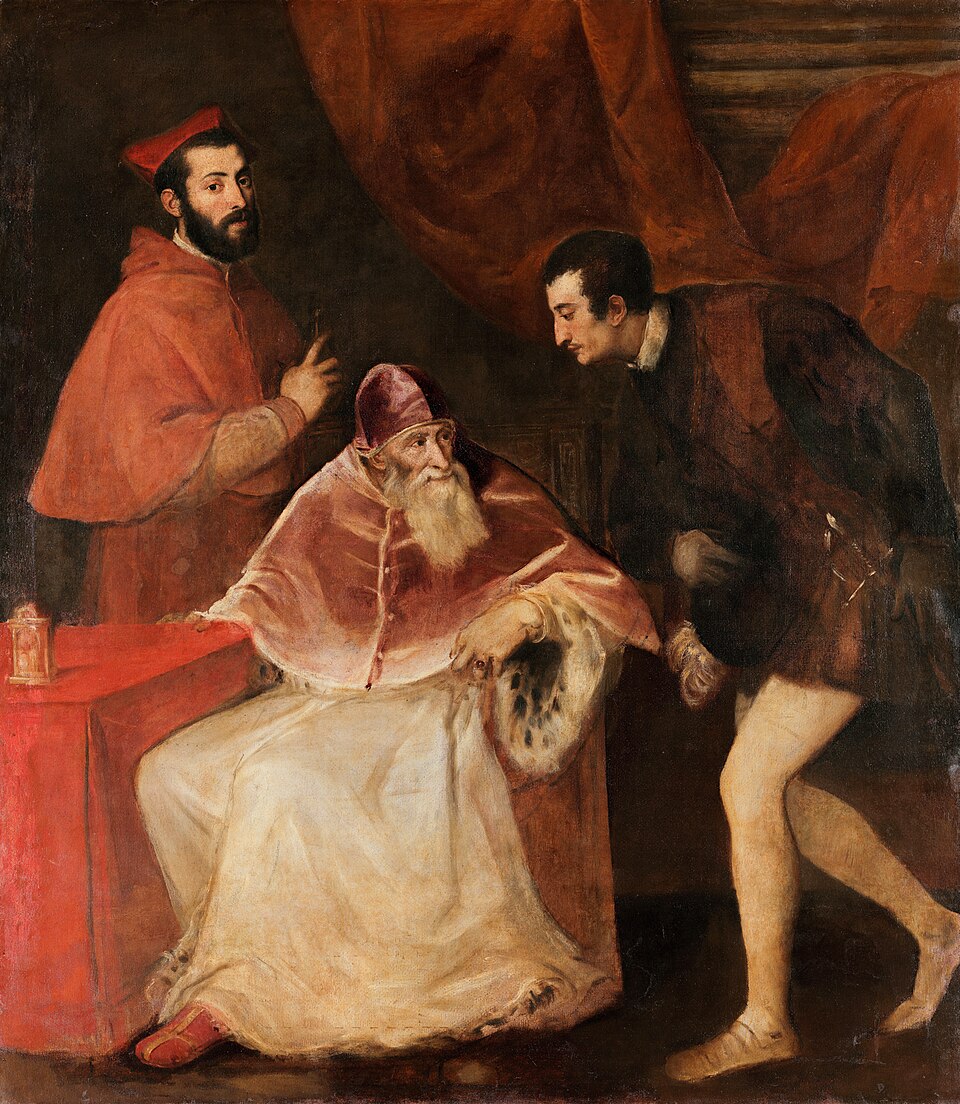
An old pope, stooped and wary, turns toward a grandson who bows before him, while another grandson in cardinal's red stands watching. A clock ticks on the table. Titian never finished it.
The story behind the painting
Titian painted this portrait in Rome between autumn 1545 and June 1546, commissioned by the Farnese family. Paul III had become pope in 1534 and placed relatives in high positions; his grandson Alessandro was made a cardinal at 14, while Ottavio received the family's rights of succession and married the emperor's daughter. By the mid-1540s Titian was the Farnese's preferred portraitist. He had long resisted travelling, and he sought a church benefice for his son Pomponio in return for his work. Once in Rome he was treated as the city's most important guest. Yet he abandoned the canvas unfinished, and it languished unframed in a Farnese cellar for a century.
What to look for
Paul, in his late seventies, sits in the centre. His camauro covers his baldness, but age shows in his long nose, dark beady eyes, stooped shoulders and long uneven beard. On the right, Ottavio kneels in a bowing gesture; behind the pope, Alessandro stands in cardinal's dress. The deep red background, the deep reds of the tablecloth and the almost spectral whites of Paul's gown give the picture its famous rich colouring, while heavy brushstrokes create an anxious, tense atmosphere. On the table beside the pope stands a clock. To some critics, Paul seems to glare at Ottavio with an accusing look.
Meaning and intent
The painting explores ageing and the manoeuvring behind succession. The clock is both a memento mori and a reminder that time is running out, and the grandsons' presence suggests that the commission was prompted by thoughts of who would follow. Paul is old and tired, yet still a powerful, alert patriarch. The source describes how the canvas captures subtle contradictions in his character and the complex psychological dynamic between the three men: an ambitious grandfather, a younger grandson rising in the world, and an elder one bound by a church career he would come to regret. Politics here becomes a family drama.
Legacy
Although unfinished and less technically polished than Titian's earlier Portrait of Pope Paul III, this group portrait ranks among his finest and most penetrating works. History soon proved its tension real: in 1547 Ottavio claimed the duchies of Parma and Piacenza against the wishes of both Paul and the emperor, and Alessandro lost faith in his grandfather's hints that he might become pope. Today the painting hangs in the Museo di Capodimonte in Naples, about 210 by 176 cm. It remains a rare portrait in which power, family love and suspicion seem to share the same red room.
Schon gewusst?
- Painted in Rome, autumn 1545 to June 1546
- Left unfinished; kept unframed in a Farnese cellar for about 100 years
- Museo di Capodimonte, Naples
- Wikidata size: 210 x 176 cm
Über den Künstler
Tizian (1488-1576)
Venezianische Schule · Tisch · Gruppenporträt · Vorhang · Museo Nazionale di Capodimonte · Tischdecke
Mehr von Tizian
.jpg) Venus von Urbino - Titian (1538)
Venus von Urbino - Titian (1538)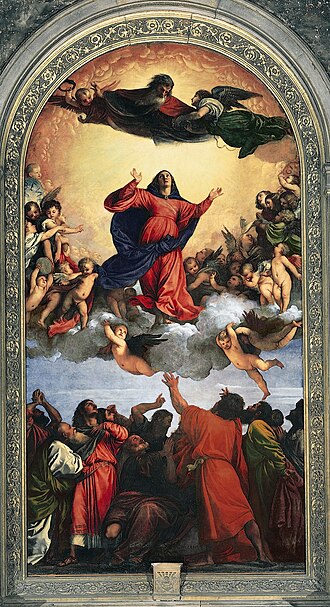 Mariä Himmelfahrt - Titian (1510s)
FXD.jpg) Himmlische und Irdische Liebe - Titian (1510s)
Himmlische und Irdische Liebe - Titian (1510s)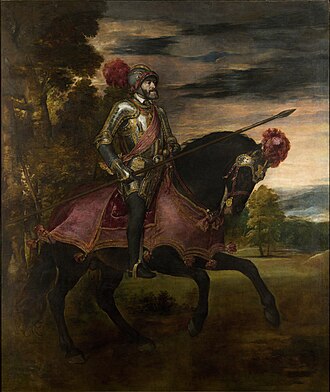 Kaiser Karl V. nach der Schlacht bei Mühlberg - Titian (1548)
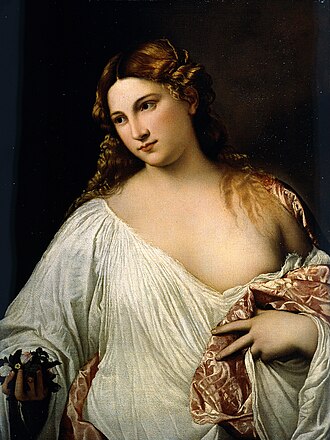 Flora - Titian (1517)
 Allegorie der von der Klugheit beherrschten Zeit - Titian (1550)
 Bacchus und Ariadne - Titian (1520s)
%20nave%20left%20-%20Altar%20of%20Madona%20di%20Ca'Pesaro.jpg) Pesaro Madonna - Titian
Pesaro Madonna - Titian