Pietà
Tizian · 1570s
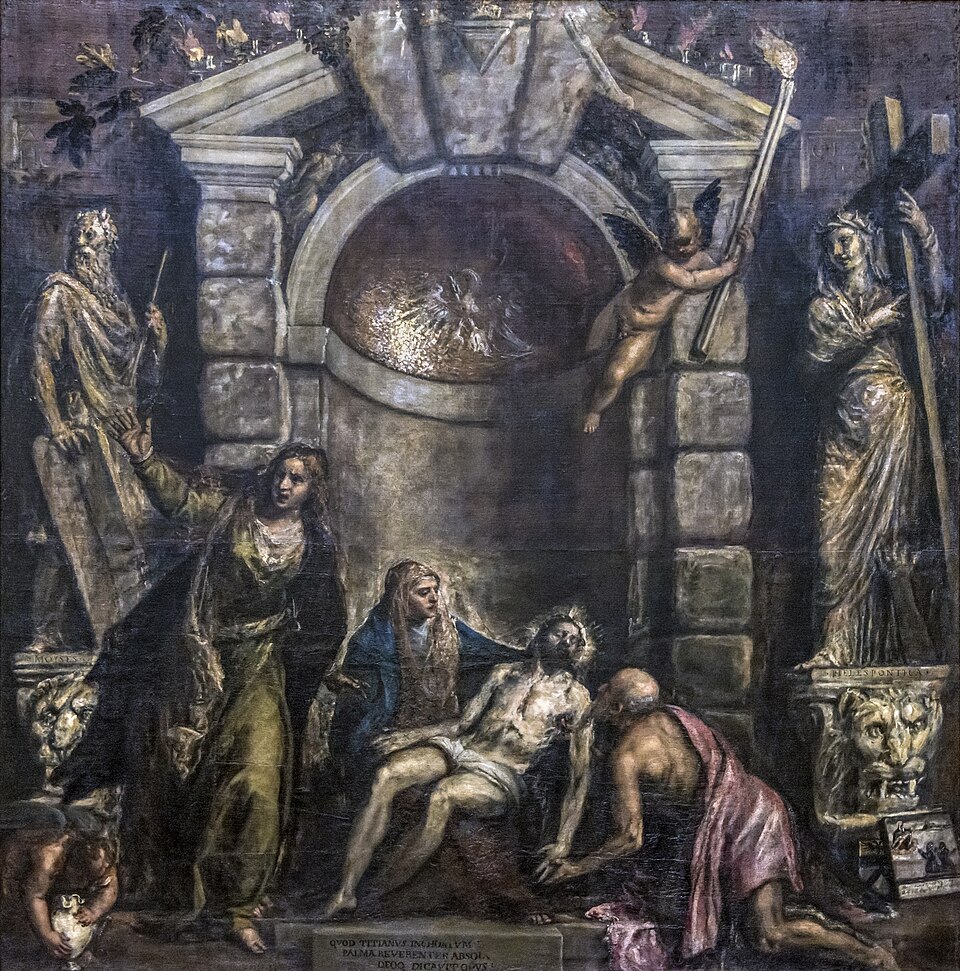
An old man kneels in the dark and reaches out to touch the hand of the dead Christ. He is generally agreed to be Titian himself, painting the picture he hoped would hang over his own grave.
The story behind the painting
This Pietà, from 1575-1576, is one of Titian's last paintings; Wikidata dates it to the 1570s. He intended it to hang over his grave. He first chose a chapel in the Frari church in Venice and presented a smaller composition there, but the friars would not move a famous crucifix and hung it elsewhere. Furious, Titian obtained a papal decree of 1 March 1575 for its return, then planned burial in Pieve di Cadore, where he was baptised, and enlarged the canvas to fit its altar. He died in 1576 during a plague epidemic, followed days later by his son Orazio, leaving the painting unfinished.
What to look for
The Virgin cradles the dead Christ before a massive rusticated niche, flanked by statues of Moses and the Hellespontine Sibyl standing on plinths carved with lion heads. Flaming lamps along the broken pediment give a dull light, and a small angel's torch reveals a gold mosaic of a pelican feeding its young with its own blood, a symbol of Christ's Passion. Saint Jerome, or Nicodemus, kneels to touch Christ's hand. Mary Magdalene, on the left, seems in motion, arriving or rushing away in horror. Titian's late brushwork is bold and loose; forms emerge from darkness as flickering colour and light.
Meaning and intent
Few paintings are so personal. The kneeling old man is generally agreed to be a self-portrait, and in the lower right corner a small votive picture shows two men praying to a Pietà in the air. They are agreed to represent Titian and his son Orazio, probably praying to be spared from the plague, which killed them both. Behind it is partly hidden Titian's coat of arms. The scene, set at night, joins grief over Christ with an old painter's fear and hope at the end of his life. The source notes the pelican, the Sibyl and the stone blocks all point to sacrifice and faith.
Legacy
Palma Giovane completed the work and added an inscription below Christ recording his part. His interventions seem minimal and matched to Titian's style; at least the angel with the torch is thought to be his. Because Titian's heirs disputed his estate, the painting never reached Cadore. Titian himself was quietly buried in the Frari, near his Assunta and Pesaro altarpieces. Only after Palma died in 1628 did the Pietà hang in a church, Sant'Angelo in Venice. Today it is in the Gallerie dell'Accademia, measuring about 352 by 349 cm, a farewell painted in darkness and flickering light.
Schon gewusst?
- Oil on canvas, 1575-1576, Gallerie dell'Accademia, Venice
- Left unfinished at Titian's death; completed by Palma Giovane
- Includes a votive panel showing Titian and his son Orazio
- Wikidata size: 352 x 349 cm
Über den Künstler
Tizian (1488-1576)
religiöse Kunst · Maria · Jesus Christus · Venezianische Schule · langes Haar · Engel · Maria Magdalena
Mehr von Tizian
.jpg) Venus von Urbino - Titian (1538)
Venus von Urbino - Titian (1538)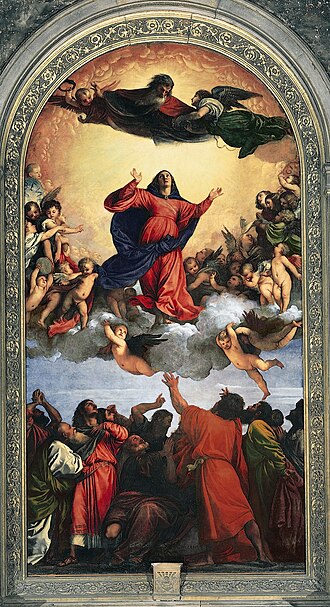 Mariä Himmelfahrt - Titian (1510s)
FXD.jpg) Himmlische und Irdische Liebe - Titian (1510s)
Himmlische und Irdische Liebe - Titian (1510s)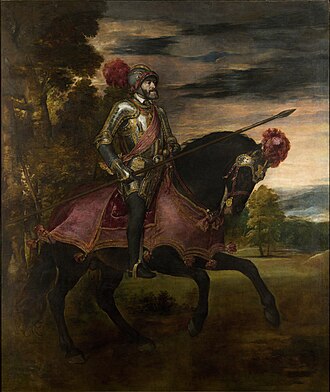 Kaiser Karl V. nach der Schlacht bei Mühlberg - Titian (1548)
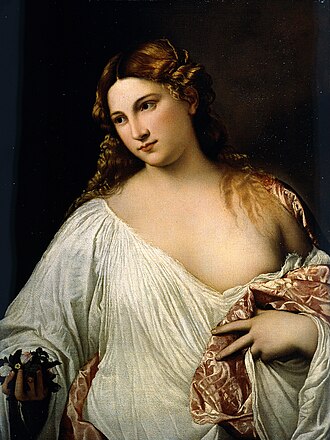 Flora - Titian (1517)
 Allegorie der von der Klugheit beherrschten Zeit - Titian (1550)
 Bacchus und Ariadne - Titian (1520s)
%20nave%20left%20-%20Altar%20of%20Madona%20di%20Ca'Pesaro.jpg) Pesaro Madonna - Titian
Pesaro Madonna - Titian