Nymphe und Schäfer
Tizian · 1570s
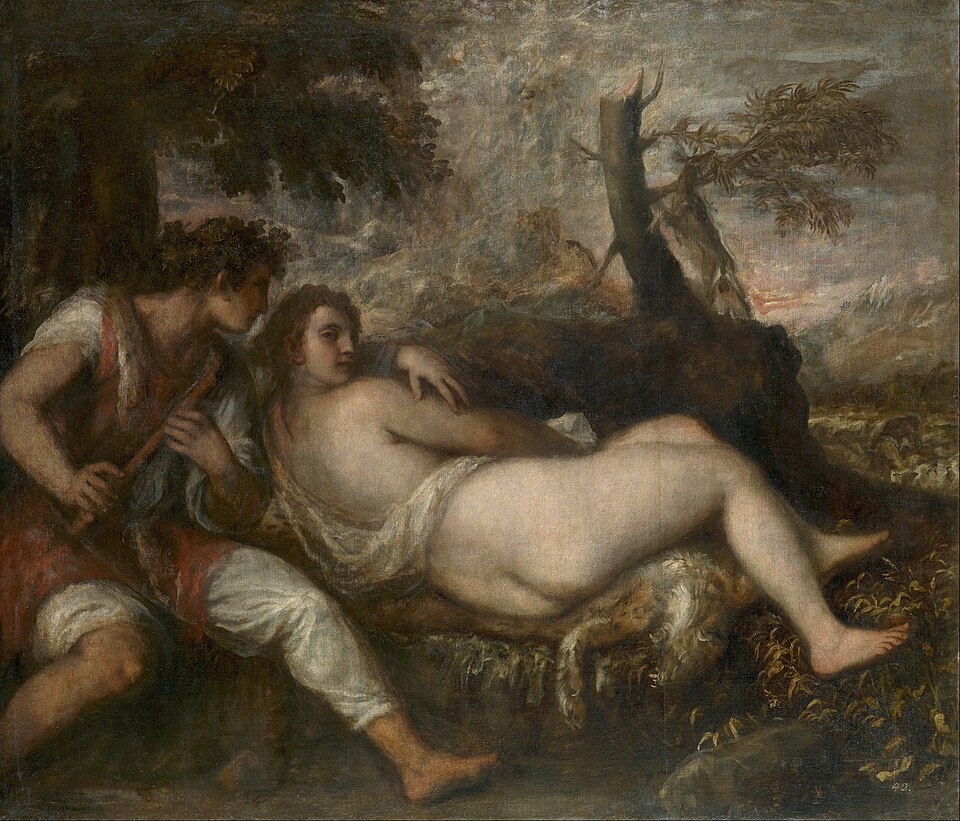
A shepherd plays a pipe under a tree, while a nude nymph lies on an animal skin, her back to us, looking over her shoulder. Titian painted it near the end of his life, partly with his fingers.
The story behind the painting
Nymph and Shepherd, also called Shepherd and Nymph, is an oil painting by the Venetian master Titian, made about 1570, late in his long career. Its travels can be followed through great collections. In 1636 it belonged to Bartolomeo della Nave in Venice. From 1638 to 1649 it was in the collection of James Hamilton, 1st Duke of Hamilton, in England. By 1660 it was owned by Archduke Leopold Wilhelm of Austria. It is now in the Kunsthistorisches Museum in Vienna. Wikidata dates it more broadly to the 1570s and gives its size as about 149.6 by 187 cm.
What to look for
This is a pastoral scene in a forest. In the foreground a male shepherd sits and plays what appears to be a flute. Beside him reclines a nude nymph, a mythical female figure, seated on an animal skin with her back turned to the viewer, yet looking back over her shoulder. The pair rest against a tree. In the background, a goat is climbing a tree stump. Look closely at the surface: the brushwork is loose and very visible, the colours are muted, and the material of the canvas itself becomes part of the final image.
Meaning and intent
The painting is placed in the Mannerist phase of the late Italian Renaissance, and it looks different from Titian's earlier works, with more emphasis on brushwork and a quieter palette. Restorations from 2002 to 2007 allowed a study of his technique. It revealed a wide range of brush sizes, shown by the length of the strokes, and that the artist also applied paint with his fingers. Scholars debate who the two figures are. Many think they stand for a mythological couple, either Dionysus and Ariadne, or Paris and Oenone. The painting itself does not settle the question.
Legacy
The expressive, very visible strokes of this late canvas have been discussed as an anticipation of Impressionism, a movement that would come centuries later. That makes the painting a striking record of an old master still changing his way of working. Rather than smoothing his surfaces, Titian let the hand show, with fingers and brushes of many sizes. After its passage through Venice, the Hamilton collection and the Habsburg archduke, the canvas remains in Vienna, where the 2002 to 2007 restoration gave a closer look at how it was made.
Schon gewusst?
- Painted about 1570 by Titian, late in his career.
- Restored 2002-2007, revealing that Titian also painted with his fingers.
- The figures may be Dionysus and Ariadne, or Paris and Oenone.
- In the Kunsthistorisches Museum, Vienna.
Über den Künstler
Tizian (1488-1576)
mythologische Malerei · Venezianische Schule · Kunsthistorisches Museum Wien · Nymphe · Schäfer · Sammlung von James Hamilton, 1. Herzog von Hamilton
Mehr von Tizian
 Venus von Urbino - Titian (1538)
 Mariä Himmelfahrt - Titian (1510s)
 Himmlische und Irdische Liebe - Titian (1510s)
 Kaiser Karl V. nach der Schlacht bei Mühlberg - Titian (1548)
 Flora - Titian (1517)
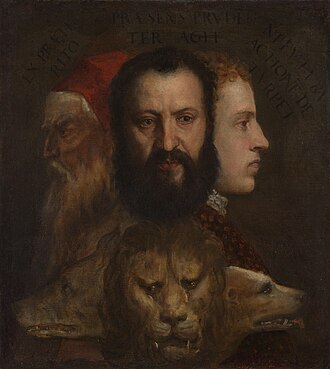 Allegorie der von der Klugheit beherrschten Zeit - Titian (1550)
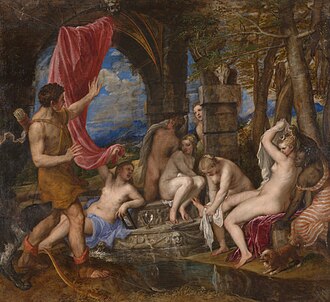 Diana und Actaeon - Titian (1550s)
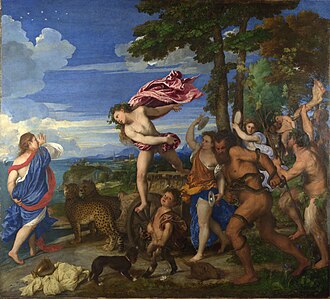 Bacchus und Ariadne - Titian (1520s)
Werke verwandter Künstler
 Das letzte Abendmahl - Jacopo Tintoretto (1563)
 Der heilige Markus befreit den gefesselten Sklaven - Jacopo Tintoretto (1540s)
 Die Hochzeit zu Kana - Paolo Veronese (1560s)
 Das Gastmahl im Hause des Levi - Paolo Veronese (1573)