Narcisa Barañana de Goicoechea
Francisco Goya · 1815
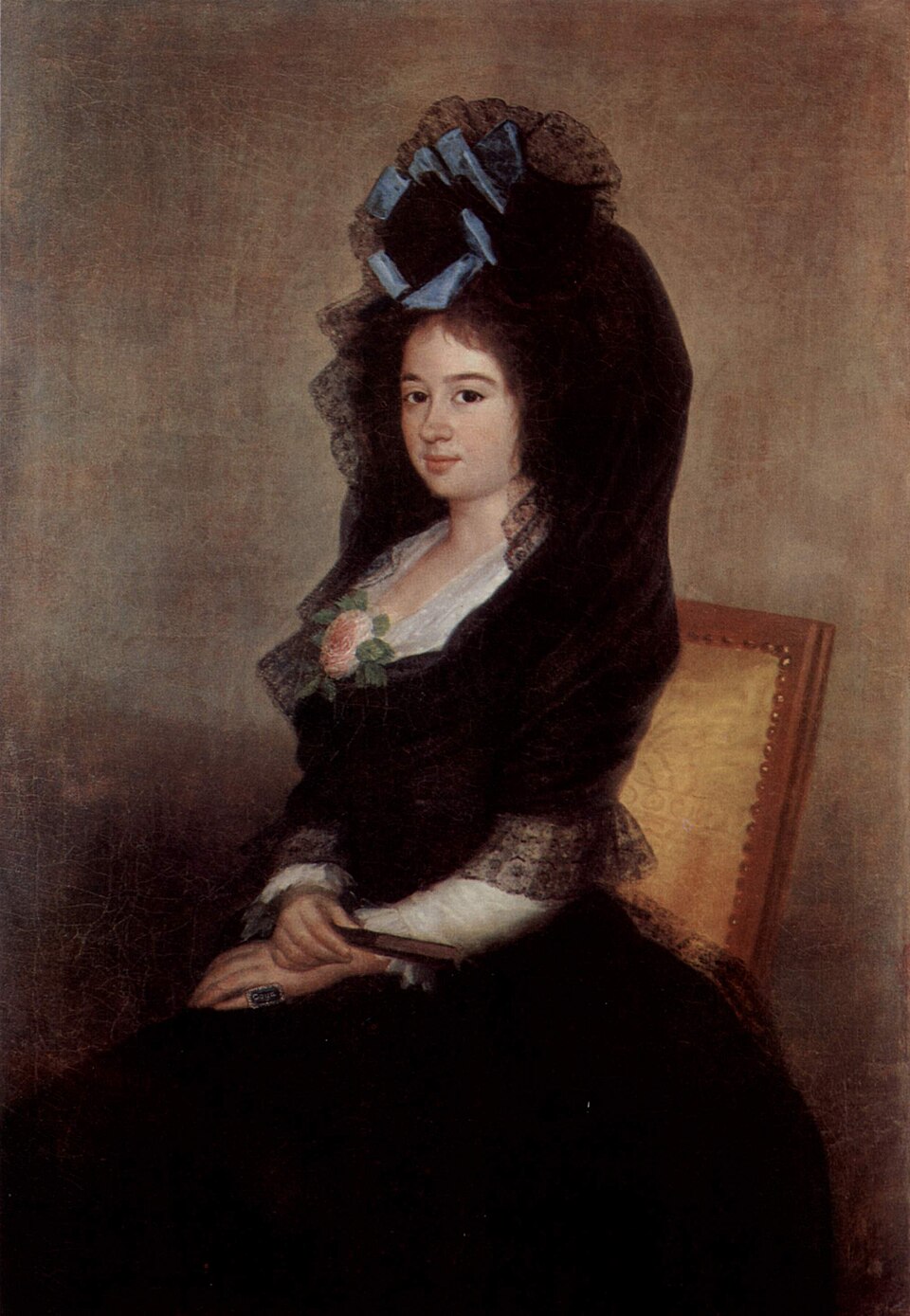
A woman in black lace and a mantilla sits in a yellow armchair, a rose at her neckline, a closed fan in her hand, and looks at us with complete assurance. Goya hid his signature in the large ring on her finger.
The story behind the painting
Goya probably knew Narcisa Baranana and her husband Juan Bautista de Goicoechea well, because they were relatives of his daughter-in-law Gumersinda Goicoechea. When his son Javier married Gumersinda in July 1805, the painter made portraits of many members of the Goicoechea family. According to the Metropolitan Museum, Narcisa's portrait could date from around the time of that wedding, or at the latest from 1815 to 1816; Wikidata gives 1815. Goya also painted her husband in a portrait seen as its companion, dated 1810 or 1815.
What to look for
Narcisa sits in an elegant pose in an armchair upholstered in yellow. She wears a black dress whose sleeves and collar are edged with lace, and a rose decorates her neckline. On her head is a black mantilla with an ornament shaped like a large blue bow, a combination of Spanish and French fashions. In her left hand she holds a closed fan. Look closely at the large ring: it carries the painter's signature, a device typical of Goya, as is the pose. Notice too how he renders the silk and the tulle.
Meaning and intent
The portrait shows a confident woman who fixes the viewer with an assured gaze, dressed in a mix of Spanish and French styles that marks her as a woman of her time. For Goya it was also a family picture, one of a group painted around his son's marriage into the Goicoechea family. Its authorship is not entirely settled: the signature on the ring and the pose point to Goya, and the work is attributed to him, but some historians have expressed doubts about this attribution.
Legacy
The portraits of Narcisa and her husband were first shown to the public at a Goya exhibition in Madrid in 1900, when they belonged to the collection of Felipe Modeta. Narcisa's portrait then entered the Durand-Ruel collection in Paris. In 1903 it was bought by the Havemeyer family of New York, who gave it to the Metropolitan Museum of Art in 1929. The canvas, about 112 by 78 cm, has been in the museum ever since, apart from the companion portrait of her husband.
Schon gewusst?
- The sitter was related to Goya's daughter-in-law Gumersinda Goicoechea.
- Dated from about 1805 to 1815-1816; Wikidata gives 1815.
- Goya's signature appears on her large ring.
- Given to the Metropolitan Museum by the Havemeyer family in 1929.
Über den Künstler
Francisco Goya (1746-1828)
Frau · Porträt · Metropolitan Museum of Art · Porträt · Fächer · Rose · Ring · Spitze · Mantilla
Mehr von Francisco Goya
 Die Erschießung der Aufständischen - Francisco Goya (1814)
 Die nackte Maja - Francisco Goya (1800)
 Saturn verschlingt seinen Sohn - Francisco Goya (1819)
 Die Familie Karls IV. - Francisco Goya (1800)
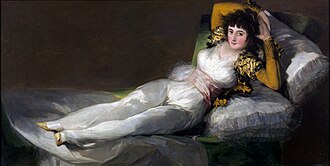 Die Bekleidete Maja - Francisco Goya (1800)
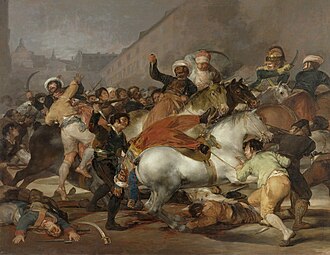 Kampf mit den Mamelucken am 2. Mai 1808 in Madrid - Francisco Goya (1814)
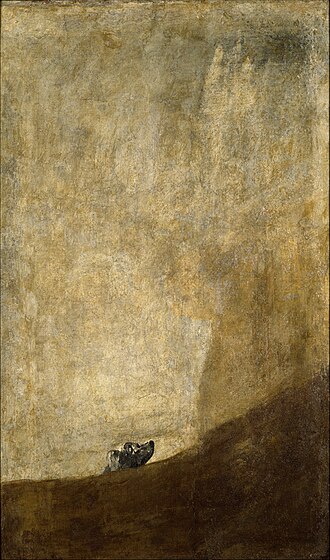 Hund - Francisco Goya (1819)
 Hexensabbat - Francisco Goya (1820s)
Werke verwandter Künstler
 Der Wanderer über dem Nebelmeer - Caspar David Friedrich (c. 1818)
 Abtei im Eichwald - Caspar David Friedrich (1800s)
 Die Freiheit führt das Volk - Eugène Delacroix (1830)
 Der Tod des Sardanapal - Eugène Delacroix (1827)
 Die letzte Fahrt der Temeraire - J. M. W. Turner (1839)
 Rain, Steam and Speed - The Great Western Railway - J. M. W. Turner (1844)
 Knabe in Blau - Thomas Gainsborough (1770)
 Mr. und Mrs. Andrews - Thomas Gainsborough (1748)