Madonna and Child with Saints Luke and Catherine of Alexandria
Tizian · 1560s
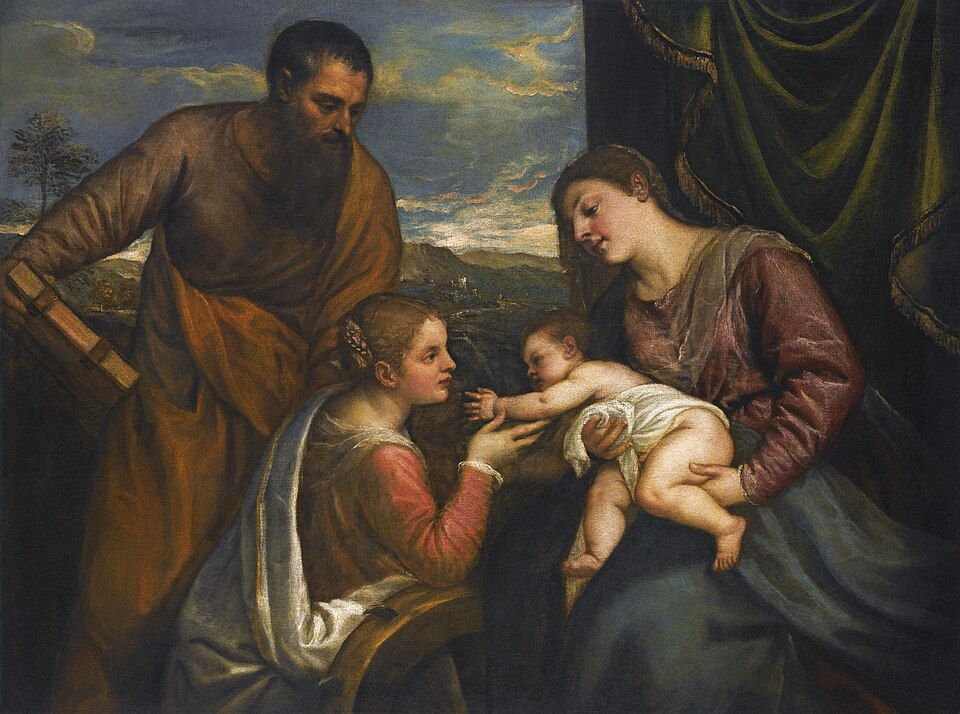
A playful baby tips forward, arms out, towards Saint Catherine, who leans to meet him. Titian's Holy Conversation survived a captured ship, a Bonaparte and a demolished English house.
The story behind the painting
Titian painted this oil on canvas around 1560, at the height of his career and fame. It is one of his several versions of the Madonna and Child, and is also known simply as Holy Conversation. Tradition says it was made for the artist's friends, the Dondi dell'Orologio family of Padua. The painting stayed with them until Sir Richard Worsley bought it while serving as the last British Resident of Venice, from 1793 to 1797. The ship carrying it back to England was captured by a French privateer, and the painting was acquired by Lucien Bonaparte, then Napoleonic ambassador in Madrid.
What to look for
Look first at the Christ Child, shown as a playful baby, slightly off balance as he tips forward with arms stretched out towards Catherine. She leans gently towards him in return, and that small exchange is the heart of the picture. Saint Luke and a curtain complete the scene. The source suggests that members of Titian's Venice workshop probably painted the curtain and Luke, because those parts are of lower quality. The canvas measures 127.8 by 169.7 cm.
Meaning and intent
This is a mature work, painted when Titian was at the peak of his powers. Rather than a solemn, frozen group, he shows a child's spontaneous movement and a saint's tender response, a holy conversation that feels like a real one. The meeting of the baby's reaching arms and Catherine's gentle lean turns a familiar devotional subject into a warm, human moment. The difference in quality between the master's figures and the workshop's parts also reminds us how a busy Renaissance studio worked.
Legacy
Lucien Bonaparte sold the painting in London in 1814. It passed to Sir John Rae Reid, Governor of the Bank of England, and by 1936 to the Panshanger estate in Hertfordshire, owned by Lord and Lady Desborough, where Ettie Desborough hosted the circle known as The Souls. Her sons died in the First World War and in a 1926 car accident, and after her death in 1952 Panshanger was demolished. The painting was auctioned at Christie's in 1954, bought in 1956 by Heinz Kisters, and sold at Sotheby's New York in 2011. It was rarely shown in public.
Schon gewusst?
- Painted by Titian around 1560.
- Also known as Holy Conversation.
- Captured at sea and acquired by Lucien Bonaparte.
- Curtain and Saint Luke probably by Titian's workshop.
Über den Künstler
Tizian (1488-1576)
religiöse Kunst · Frau · Maria · Jesuskind · Junge · Venezianische Schule · Mutter · Katharina von Alexandrien · Lukas der Evangelist
Mehr von Tizian
 Venus von Urbino - Titian (1538)
 Mariä Himmelfahrt - Titian (1510s)
 Himmlische und Irdische Liebe - Titian (1510s)
 Kaiser Karl V. nach der Schlacht bei Mühlberg - Titian (1548)
 Flora - Titian (1517)
 Allegorie der von der Klugheit beherrschten Zeit - Titian (1550)
 Diana und Actaeon - Titian (1550s)
 Bacchus und Ariadne - Titian (1520s)
Werke verwandter Künstler
 Das letzte Abendmahl - Jacopo Tintoretto (1563)
 Der heilige Markus befreit den gefesselten Sklaven - Jacopo Tintoretto (1540s)
 Die Hochzeit zu Kana - Paolo Veronese (1560s)
 Das Gastmahl im Hause des Levi - Paolo Veronese (1573)