Marienaltar
Albrecht Dürer · 1496
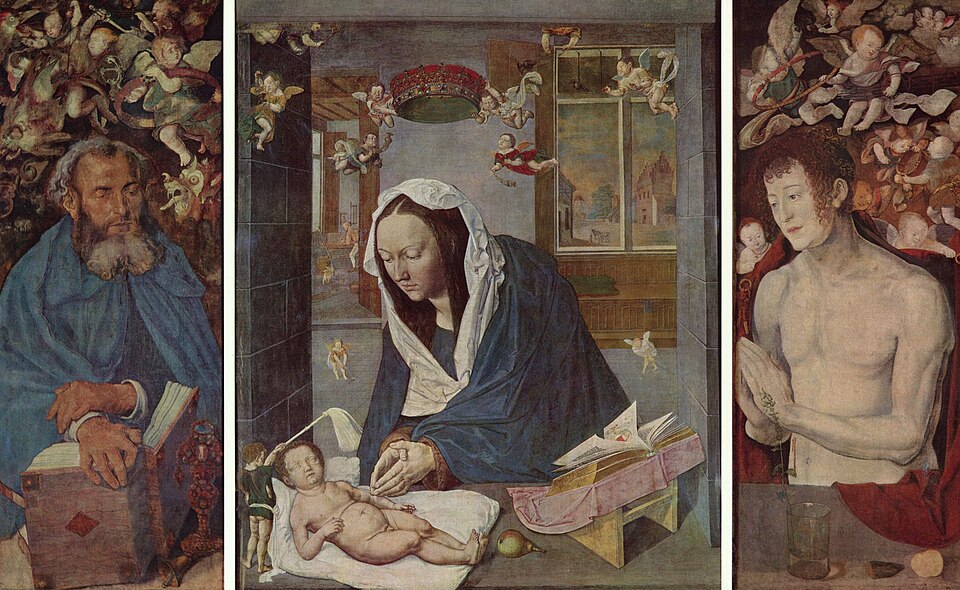
A child sleeps on a cushion while his mother bends over him in prayer, and angels hold a crown above her head. Dürer painted it for the Elector of Saxony, and the Virgin may be a portrait of his own wife, Agnes Frey.
The story behind the painting
Dürer met Frederick III, Elector of Saxony, during the elector's short stay in Nuremberg in April 1496. This triptych was among the first commissions he received from him, together with the Seven Sorrows Polyptych and a portrait of Frederick. It was meant for the chapel of Wittenberg Castle and at first was to have only the central panel with the Virgin and Child. The work was executed in 1496 to 1497, and perhaps continued in 1503 to 1504. Dürer used tempera, in an area where oil was already common, perhaps because it had to be finished quickly.
What to look for
In the centre the Madonna adores the Child, who sleeps on a cushion on a wide parapet. Beside him lie a book, standing for the holy texts, and a pear, an allegory of original sin. The room behind Mary is drawn in wide-angle perspective and opens onto another room with Saint Joseph's workshop, while a city view appears through a window. Above, angels hold Mary's floating crown and others swing censers. Mary's appearance recalls works by Dieric Bouts, Squarcione and Mantegna. The side panels show Saint Sebastian and Saint Anthony the Abbot, with many putti in the background.
Meaning and intent
The central panel joins tenderness and theology: the sleeping child, the book of scripture and the pear of sin together point to why he came into the world. In 1503 to 1504, perhaps after an outbreak of plague, the two wings were added with Saint Sebastian, patron of the sick, and Saint Anthony the Abbot, protector against ergotism. The altarpiece thus became a prayer for protection as well as an image of devotion. Unusually, the wings were painted on canvas and could not be closed, unlike most triptychs of the time.
Legacy
The work is now in the Gemäldegalerie Alte Meister in Dresden, which gives it its name. Questions remain open: the dating and attribution of the side panels are disputed, and differences in style among the putti may show the hands of assistants. The possibility that the Virgin is a portrait of Agnes Frey adds a personal note to one of the early commissions that linked Dürer to Frederick of Saxony.
Schon gewusst?
- Commissioned by Frederick III of Saxony after Dürer met him in 1496.
- Painted in tempera, central panel 1496 to 1497; wings perhaps 1503 to 1504.
- The wings show Saint Sebastian and Saint Anthony the Abbot.
- In the Gemäldegalerie Alte Meister, Dresden.
Über den Künstler
Albrecht Dürer (1471-1528)
religiöse Kunst · Frau · Maria · Jesuskind · Junge · Deutsche Renaissance · Staatliche Kunstsammlungen Dresden
Mehr von Albrecht Dürer
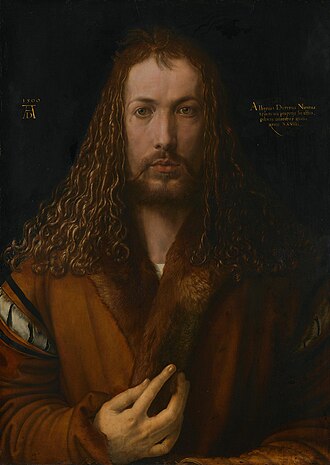 Selbstbildnis im Pelzrock - Albrecht Dürer (1500)
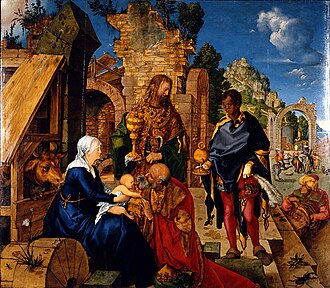 Anbetung der Könige - Albrecht Dürer (1504)
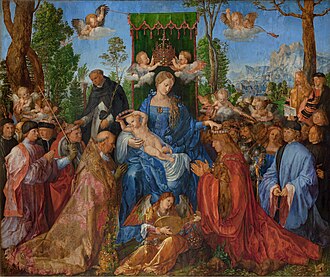 Das Rosenkranzfest - Albrecht Dürer (1506)
 Selbstporträt im Alter von 26 Jahren - Albrecht Dürer (1498)
 Selbstporträt mit einer Distel - Albrecht Dürer (1493)
 Heller-Altar - Albrecht Dürer (1500s)
 Marter der zehntausend Christen - Albrecht Dürer (1508)
 Allerheiligenbild - Albrecht Dürer (1511)
Werke verwandter Künstler
 Der Jungbrunnen - Lucas Cranach the Elder (1546)
 Venus mit Amor als Honigdieb - Lucas Cranach the Elder (1520s)