Diana Returning from the Hunt
François Boucher · 1745
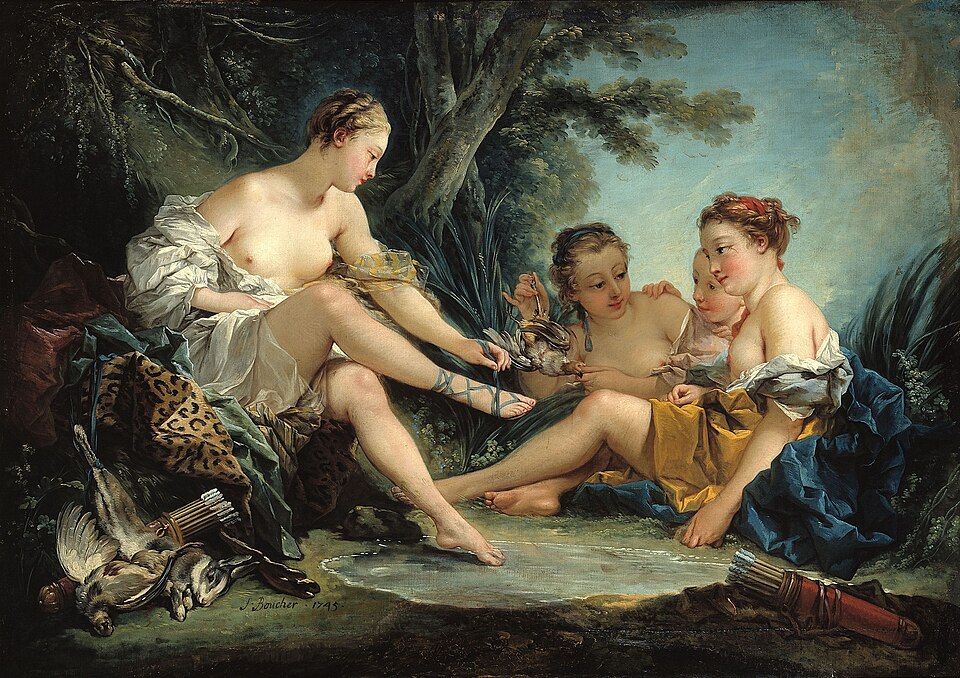
Back from the chase, a goddess reaches for her sandal while three nymphs rest nearby. Boucher painted this soft forest scene in 1745 to hang above a door, in a room nobody can now name for certain.
The story behind the painting
Diana Returning from the Hunt, also known as Nymphs Reposing from the Chase, is an oil painting by the French Rococo artist François Boucher, painted in 1745. It belongs to a group of overdoors, paintings made to hang above doorways, created for a setting that remains unknown. Four related overdoors by Boucher were all engraved by Claude Augustin Duflos, which suggests they formed a series of mythological scenes. Of the other three, one is in the Los Angeles County Museum of Art and two are in the Wallace Collection. This one is in the Musée Cognacq-Jay in Paris.
What to look for
Four women sit in a triangle around a small pool. On the left, the figure taken to be Diana reclines with crossed legs, reaching toward her sandal, her other bare foot resting in the water. She is loosely wrapped in pale fabric, her hair pinned back, sitting on fabrics and animal pelts beside a bow and quiver beneath a dead rabbit and bird. On the right, three nymphs overlap on the forest floor: the furthest holds a bird by the leg, the middle one embraces her, and the nearest gazes toward Diana. Dark forest greens and browns set off their pale skin.
Meaning and intent
The picture gathers three themes dear to Rococo art: idealised feminine beauty, lush nature and classical mythology. The graceful poses, loose drapery and soft, delicate skin show Boucher's care for surfaces, and he had used similar poses before, as in his Diana at the Bath of 1742. Yet the goddess is not certain. The leopard skin, her quiver and the secondary place of the nymphs support the name Diana, and Duflos's print shows a crescent moon in her hair. In the painting itself that crescent is missing, which makes her identity more ambiguous.
Legacy
Where the four overdoors first hung is still debated. They were linked to the Folie de Chartres in a Paris sale of November 1834, but Thérèse Burollet argued that the sale descriptions are too vague and that they could instead be the overdoors from Harlaxton Manor. The Folie de Chartres pavilion was also built only in 1769 to 1773, too late for paintings in this Rococo style, and if they had truly come from there Louis-Philippe would probably have reclaimed them as his father's property. The mystery stays open.
Schon gewusst?
- Painted by François Boucher in 1745 as an overdoor.
- One of four related overdoors engraved by Claude Augustin Duflos.
- Diana's identity is less certain in the painting than in the print.
- Its original setting, the Folie de Chartres or Harlaxton Manor, is disputed.
Über den Künstler
François Boucher (1703-1770)
Mehr von François Boucher
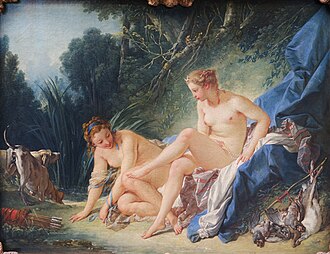 »Diana im Bade - Diana nach dem Bade« - François Boucher (1742)
 Odaliske - François Boucher (1740s)
 Sonnenuntergang - François Boucher (1752)
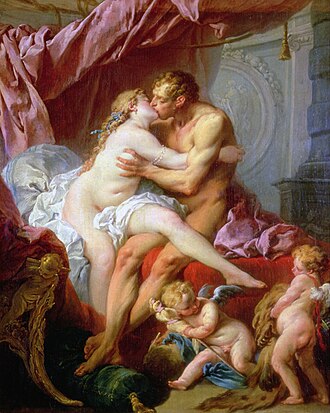 Herkules und Omphale - François Boucher (1730s)
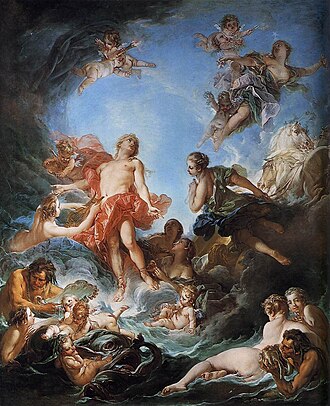 The Rising of the Sun - François Boucher (1753)
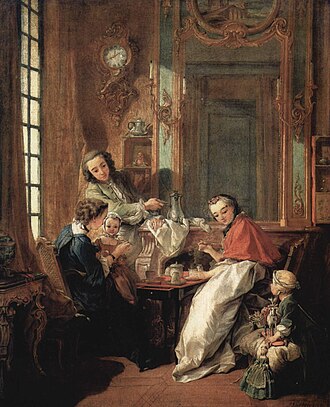 Das Frühstück - François Boucher (1739)
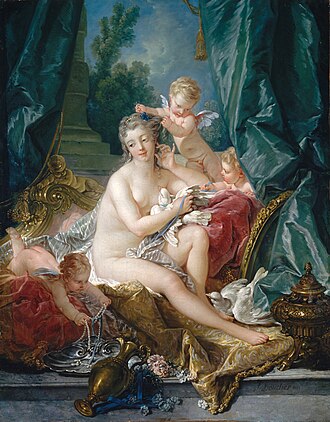 Die Toilette der Venus - François Boucher (1751)
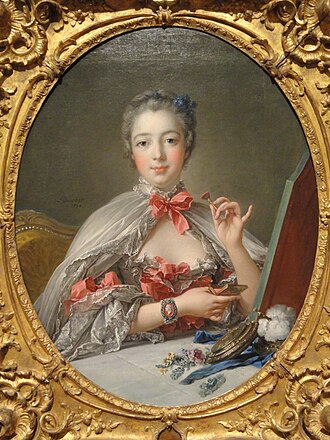 Jeanne-Antoinette Poisson, Marquise de Pompadour - François Boucher (1750)
Werke verwandter Künstler
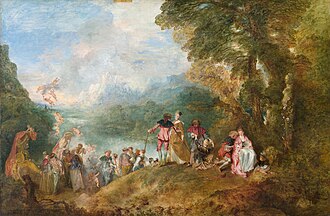 Einschiffung nach Kythera - Jean-Antoine Watteau (1717)
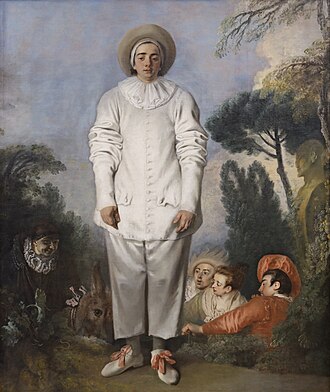 Gilles - Jean-Antoine Watteau (1718)
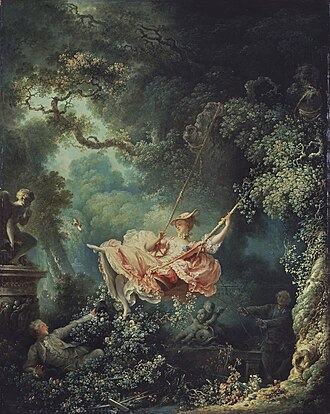 Die Schaukel - Jean-Honoré Fragonard (1760s)
 Lesende Frau - Jean-Honoré Fragonard (1770)
 Die Erschießung der Aufständischen - Francisco Goya (1814)
 Die nackte Maja - Francisco Goya (1800)