Countess of Chinchon
Francisco Goya · 1800
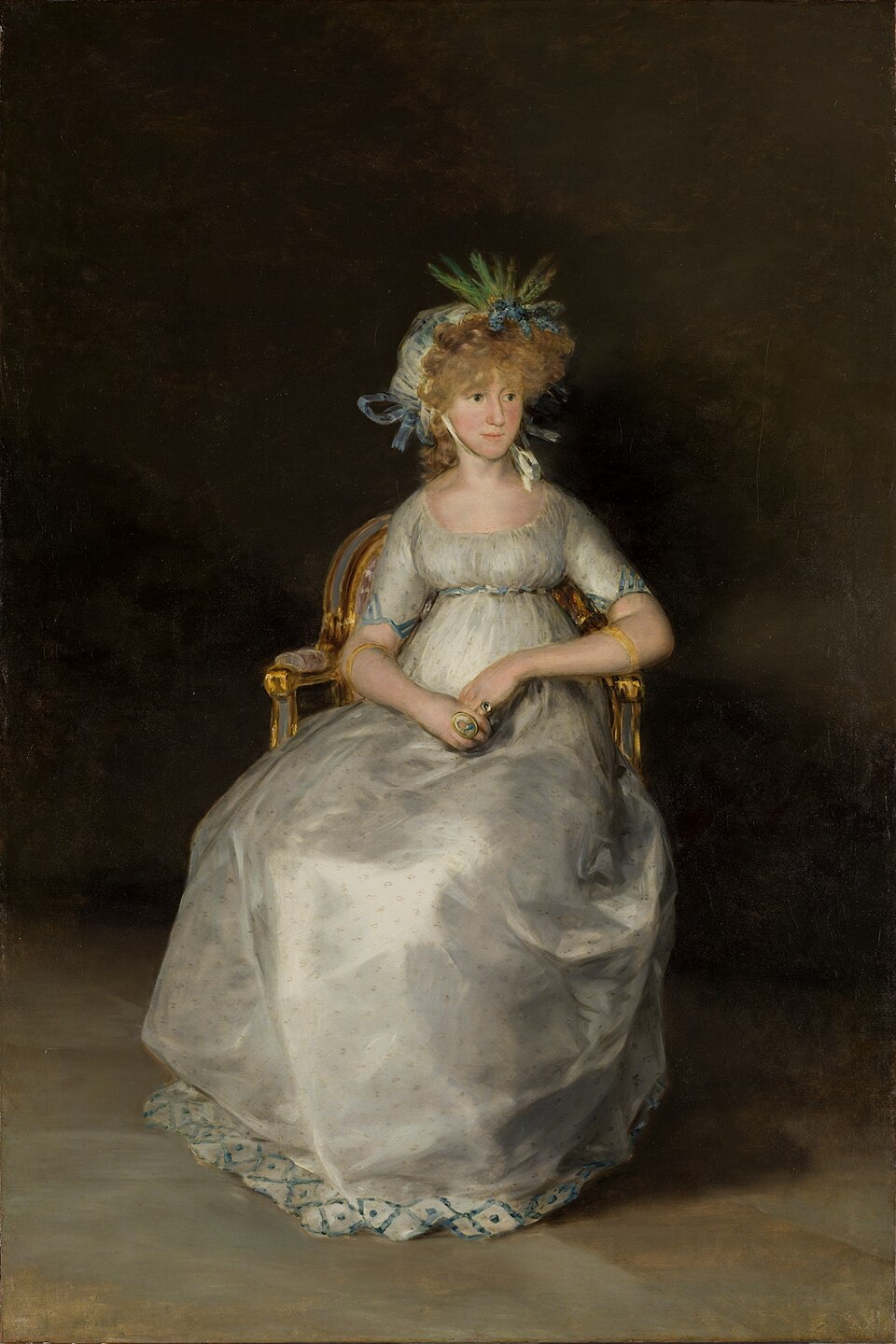
A young woman sits alone in a vast portrait, married at seventeen to the most powerful man at court. Goya had known her since she was a little girl watching him paint her family.
The story behind the painting
Goya painted this portrait around 1800. The sitter is María Teresa de Borbón y Vallabriga, 15th Countess of Chinchón, born in 1780. Her father, Infante Luis, had been expelled from court by his brother King Charles III for a marriage beneath his rank. He died when she was five, and she was taken from her mother and raised with her younger sister in a convent in Toledo. At seventeen she left it, because Charles IV and Queen Maria Luisa had decided she would marry Manuel Godoy, the royal favourite.
What to look for
The canvas is large, about 216 by 144 cm according to Wikidata, and is kept in the Museo del Prado in Madrid. It is a full portrait of a young woman of the court, dressed in the fashion of the years around 1800. Look at it knowing her age: she was barely twenty, already the most important lady in Spain after the queen, and yet the picture centres on a single figure, without her powerful husband beside her.
Meaning and intent
The marriage was one of convenience. Wikipedia says the queen, who may have had an affair with Godoy, wanted to draw him away from his longtime mistress Pepita Tudó. For Godoy, marrying the king's cousin made him officially part of the royal family. For the countess it restored privileges lost through her father's exile, including the Bourbon name and coat of arms. The portrait shows a woman raised to the summit of society by a match arranged for others' reasons.
Legacy
Her parents had been Goya's first patrons, and their support shaped his career as a portrait painter. In 1783 and 1784, as their guest at Arenas de San Pedro, he painted The Family of the Infante Don Luis, where the countess appears as a girl watching the painter at work. He also painted her as a small child in a stylish outfit. Wikipedia notes that the work should not be confused with an earlier, more famous Countess of Chinchón, after whom the cinchona tree is named.
Schon gewusst?
- Painted by Goya around 1800.
- The sitter, born in 1780, married Manuel Godoy at seventeen.
- Her parents were among Goya's first patrons.
- Held in the Museo del Prado, Madrid.
Über den Künstler
Francisco Goya (1746-1828)
Porträt · Museo del Prado · 1795-1820 in westlicher Mode
Mehr von Francisco Goya
 Die Erschießung der Aufständischen - Francisco Goya (1814)
 Die nackte Maja - Francisco Goya (1800)
 Saturn verschlingt seinen Sohn - Francisco Goya (1819)
 Die Familie Karls IV. - Francisco Goya (1800)
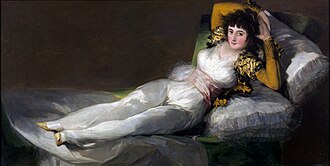 Die Bekleidete Maja - Francisco Goya (1800)
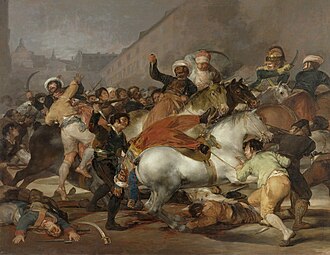 Kampf mit den Mamelucken am 2. Mai 1808 in Madrid - Francisco Goya (1814)
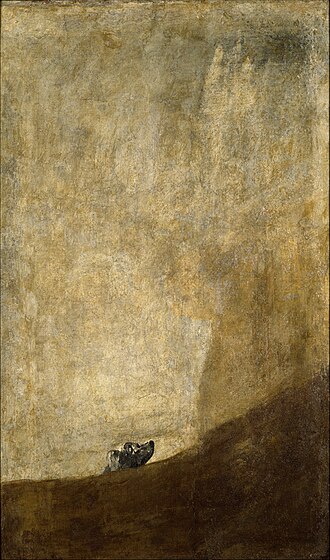 Hund - Francisco Goya (1819)
 Hexensabbat - Francisco Goya (1820s)
Werke verwandter Künstler
 Der Wanderer über dem Nebelmeer - Caspar David Friedrich (c. 1818)
 Abtei im Eichwald - Caspar David Friedrich (1800s)
 Die Freiheit führt das Volk - Eugène Delacroix (1830)
 Der Tod des Sardanapal - Eugène Delacroix (1827)
 Die letzte Fahrt der Temeraire - J. M. W. Turner (1839)
 Rain, Steam and Speed - The Great Western Railway - J. M. W. Turner (1844)
 Knabe in Blau - Thomas Gainsborough (1770)
 Mr. und Mrs. Andrews - Thomas Gainsborough (1748)