Kain und Abel
Tizian · 1540s
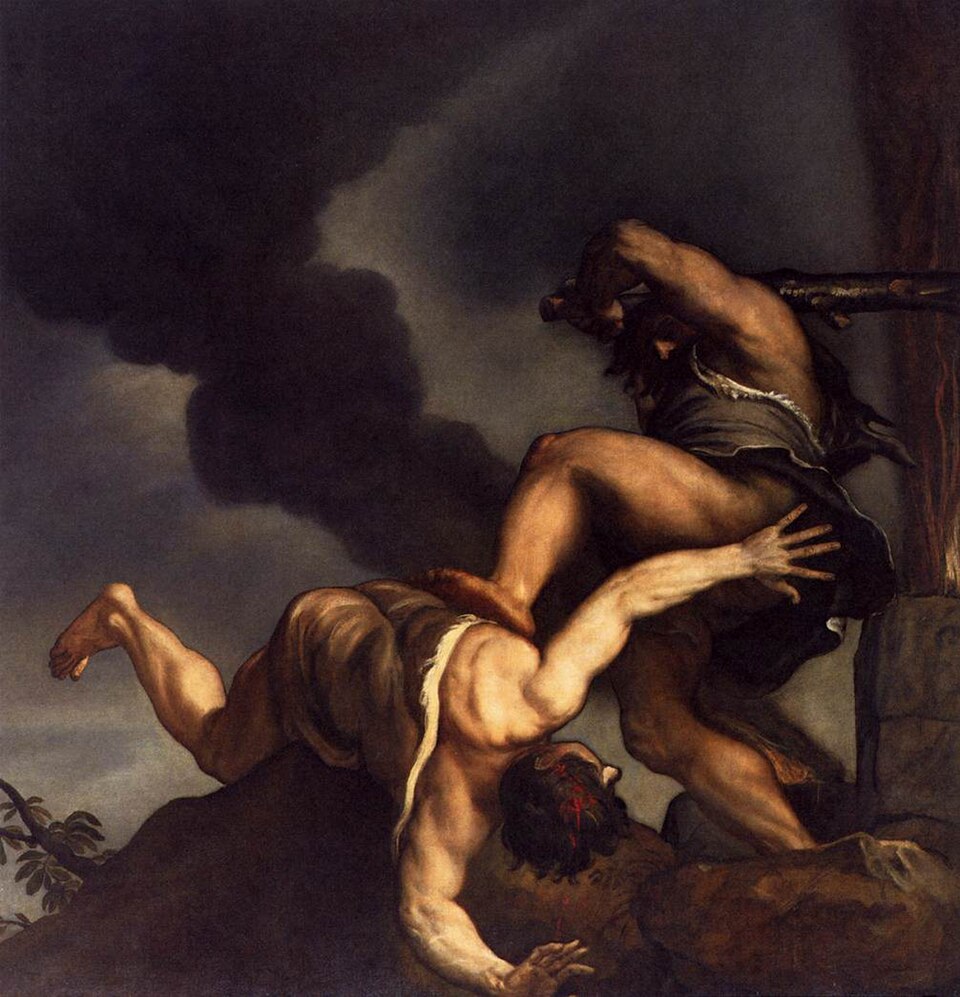
Seen from below on a sacristy ceiling, Cain plants his foot on his falling brother and raises his arm for another blow. Titian's colossal figures, under a heavy sky, come close to Michelangelo.
The story behind the painting
Titian painted Cain and Abel in about 1543 to 1545 for the church of Santo Spirito in Venice; Wikidata places it in the 1540s. Around the start of the 1540s the brothers of Santo Spirito, who already owned his early San Marco Enthroned, gave him many commissions. The subject is the first murder in Genesis: God accepted Abel's offering of firstlings rather than Cain's first fruits, and Cain, jealous, killed his brother in the fields.
What to look for
A falling man still tries feebly to defend himself with one arm, while Cain, his foot on his victim, is about to strike again. The ground is brown, the cliffs rocky, and the sky gloomy and heavy with cloud, so that we feel carried to mountain heights. The colossal brownish-yellow bodies stand out in strong relief. The canvas is about 292 by 282 cm. Because it hangs on a ceiling, the struggle is seen from below.
Meaning and intent
Georg Gronau saw this and its two companions as scenes chosen to show passionate movement with only two or three figures. For grandeur of conception, he wrote, Titian here if anywhere approaches Michelangelo, but the colour is his own: a dominant sombre tone binds strong local colours. Cain and Abel, the richest in tragic interest, is carried out in a very dark key, so that the brownish bodies become the lighter parts.
Legacy
In the 17th century the whole collection of works from Santo Spirito was moved to the basilica of Santa Maria della Salute. There, in the ceiling of the sacristy above the altar, Cain and Abel still hangs with Abraham and Isaac and David and Goliath, all from around 1543 to 1544. Gronau suggested that Titian chose such subjects from talent and temperament, unless his patrons had proposed them. The three canvases share the same brown soil, rocky cliffs and cloudy skies.
Schon gewusst?
- Painted about 1543 to 1545 for Santo Spirito, Venice.
- One of three ceiling paintings with Abraham and Isaac and David and Goliath.
- Moved to Santa Maria della Salute in the 17th century.
- Georg Gronau compared its grandeur to Michelangelo.
Über den Künstler
Tizian (1488-1576)
religiöse Kunst · Santa Maria della Salute
Mehr von Tizian
 Venus von Urbino - Titian (1538)
 Mariä Himmelfahrt - Titian (1510s)
 Himmlische und Irdische Liebe - Titian (1510s)
 Kaiser Karl V. nach der Schlacht bei Mühlberg - Titian (1548)
 Flora - Titian (1517)
 Allegorie der von der Klugheit beherrschten Zeit - Titian (1550)
 Diana und Actaeon - Titian (1550s)
 Bacchus und Ariadne - Titian (1520s)
Werke verwandter Künstler
 Das letzte Abendmahl - Jacopo Tintoretto (1563)
 Der heilige Markus befreit den gefesselten Sklaven - Jacopo Tintoretto (1540s)
 Die Hochzeit zu Kana - Paolo Veronese (1560s)
 Das Gastmahl im Hause des Levi - Paolo Veronese (1573)