Averoldi Polyptychon
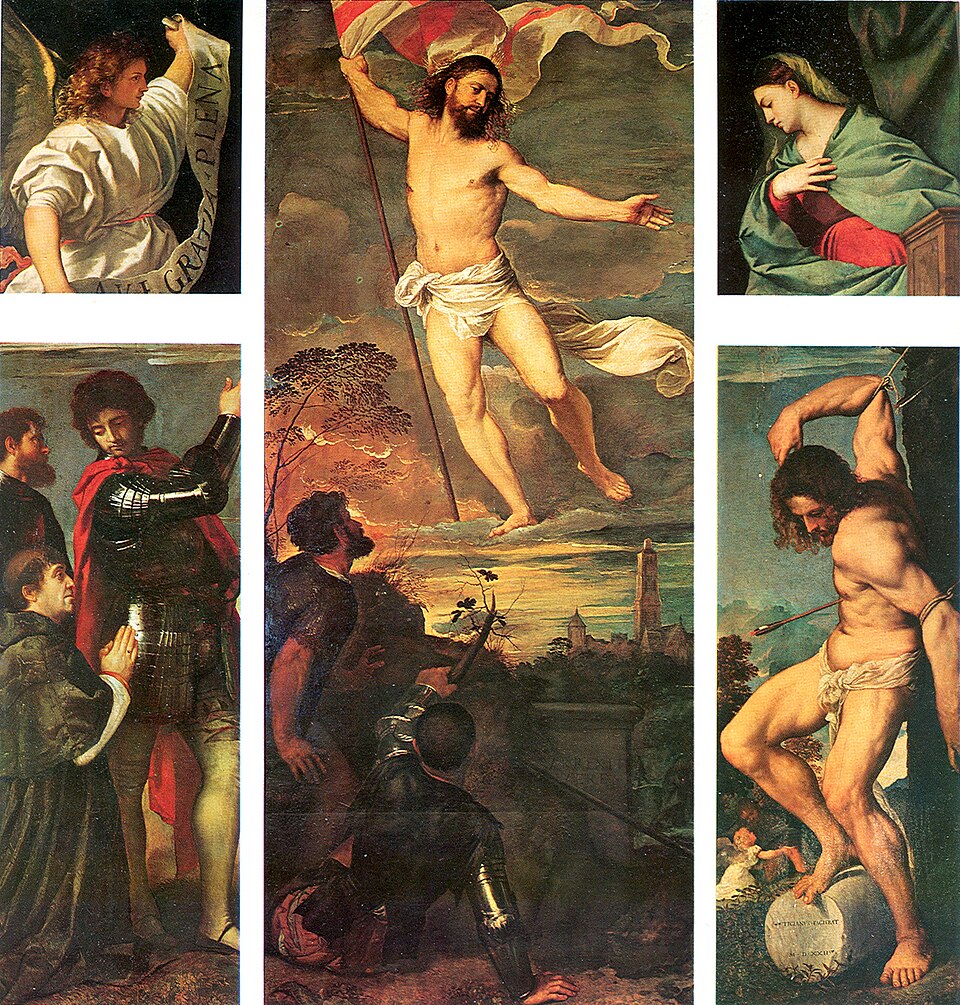
Christ bursts out of the tomb into a yellow and grey dawn, soldiers shrinking below, while on a side panel Saint Sebastian twists against a tree. Titian signed this altarpiece for Brescia in 1522, on a broken column.
The story behind the painting
The work was commissioned by Altobello Averoldi, papal legate to Venice, while Titian was official painter to the Republic of Venice, which then ruled Brescia. It is signed Ticianus Faciebat MDXXII on the column in the Saint Sebastian panel, and was delivered in 1522 to stand behind the high altar of Santi Nazaro e Celso in Brescia, replacing an altarpiece by Vincenzo Foppa. Titian was late. A first version of the Sebastian was offered to Duke Alfonso d'Este of Ferrara to make up for delays on his Bacchanals; the duke declined, and that panel is now lost. Averoldi complained about the delay as well.
What to look for
There are five panels. In the tall centre, a triumphant Christ rises high in a dark yellow and grey dawn, holding the banner of Saint George above armoured soldiers, with an ideal Jerusalem in the distance. On the left, Nazarius in shining armour, Celsus behind him, and the kneeling donor Averoldi in profile. On the right, Sebastian in a contorted pose, arms tied at different heights, his right foot on a fallen column, while in the background an angel tends Saint Roch, his bare legs showing the sores of plague. Above, the angel of the Annunciation, lit from behind, unrolls the words Ave Gratia Plena toward the Virgin.
Meaning and intent
A divided polyptych was rather old fashioned by then, probably Averoldi's own request. Titian did not unify it through space or architecture but through colour and movement, with light converging on the central scene. The Resurrection shows Raphael's influence, the Transfiguration for the placing of Christ and the Liberation of Saint Peter for the night atmosphere, and perhaps the Danube school in the dramatic landscape light. Sebastian's twist may come from Michelangelo's Punishment of Haman or Raphael's Fire in the Borgo. Sebastian and Roch were both invoked against the plague. It has been suggested that Sebastian's face resembles the risen Christ, and even Titian himself.
Legacy
The altarpiece still stands in the church of Santi Nazaro e Celso in Brescia, for which it was made. It inspired several Renaissance painters from the Brescia area, including Savoldo and Moretto. Two preparatory drawings for the Sebastian panel survive, one in the Kupferstichkabinett in Berlin and one in the Städel in Frankfurt. The donor's profile recalls Sigismondo de' Conti in Raphael's Madonna of Foligno, and the calm, muted saints' panel shows the lasting influence of Giorgione, who had worked with Titian before his death in 1510.
Schon gewusst?
- Signed and dated 1522 on the Saint Sebastian panel.
- Commissioned by Altobello Averoldi, papal legate to Venice.
- Five panels, with the Resurrection at the centre.
- Still in Santi Nazaro e Celso, Brescia.
Über den Künstler
Tizian (1488-1576)
religiöse Kunst · Frau · Maria · Hochrenaissance · Jesus Christus · Venezianische Schule · Engel · Verkündigung des Herrn
Mehr von Tizian
.jpg) Venus von Urbino - Titian (1538)
Venus von Urbino - Titian (1538)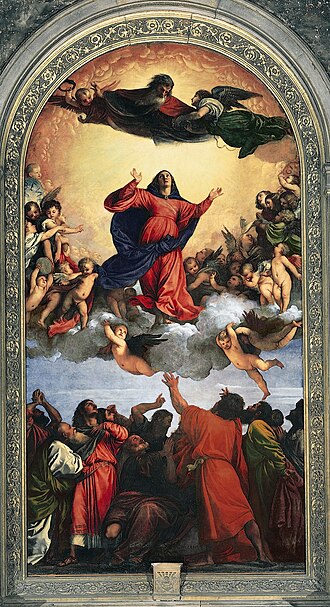 Mariä Himmelfahrt - Titian (1510s)
FXD.jpg) Himmlische und Irdische Liebe - Titian (1510s)
Himmlische und Irdische Liebe - Titian (1510s)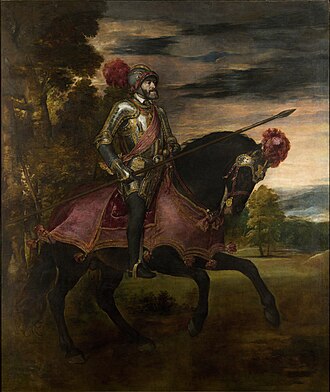 Kaiser Karl V. nach der Schlacht bei Mühlberg - Titian (1548)
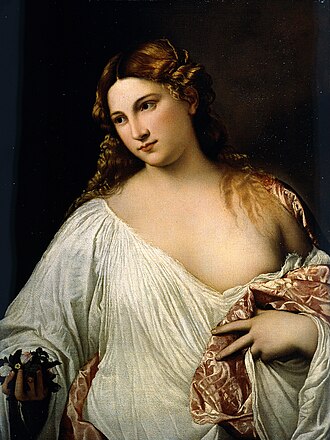 Flora - Titian (1517)
 Allegorie der von der Klugheit beherrschten Zeit - Titian (1550)
 Bacchus und Ariadne - Titian (1520s)
%20nave%20left%20-%20Altar%20of%20Madona%20di%20Ca'Pesaro.jpg) Pesaro Madonna - Titian
Pesaro Madonna - Titian