Mariä Verkündigung
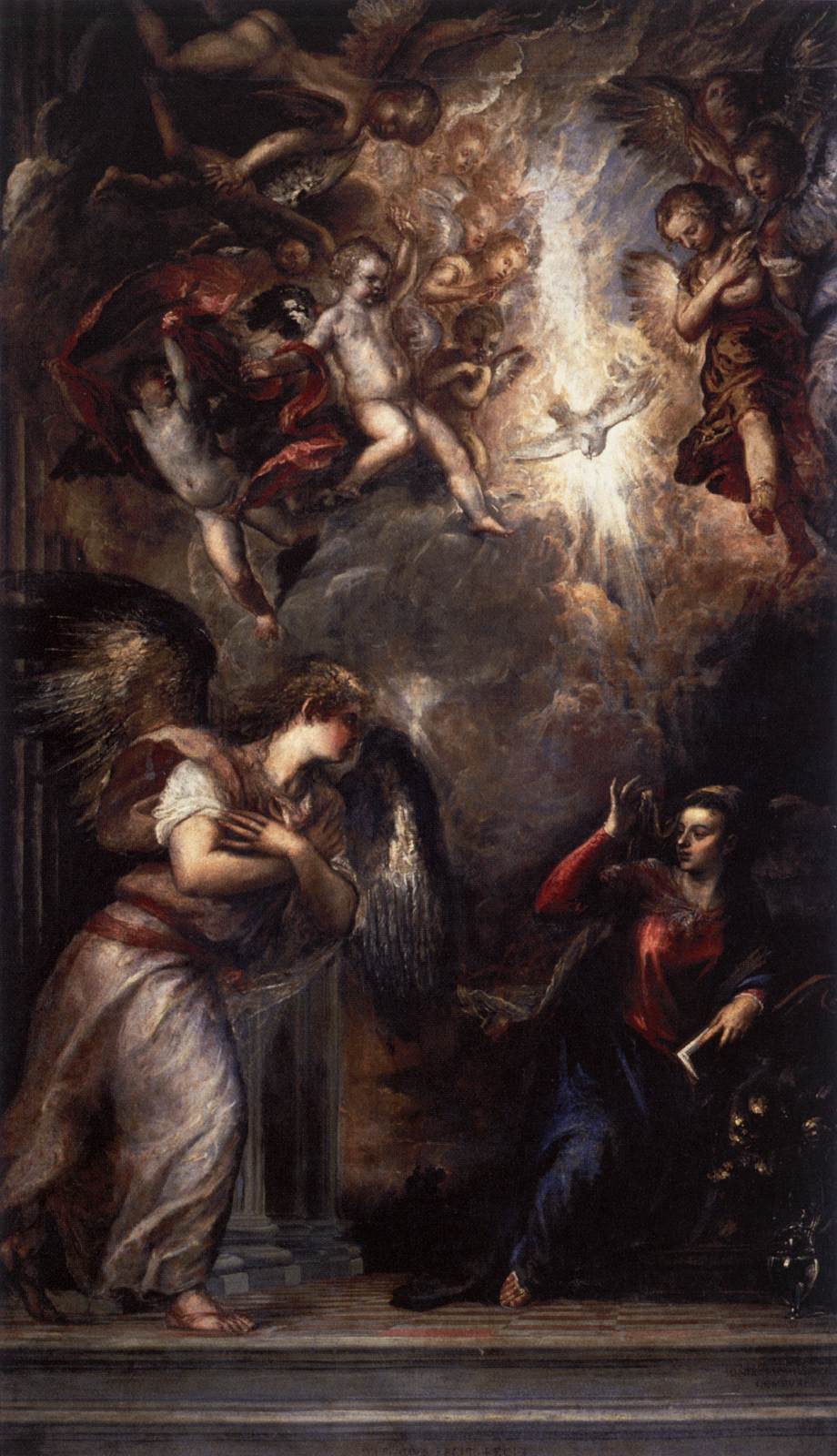
A flood of heavenly light breaks through the clouds of a Venetian church altarpiece, and a great angel rushes toward a startled Mary. Titian's late Annunciation is about the invisible becoming flesh.
The story behind the painting
Titian painted this Annunciation between 1559 and 1564, and it still remains in the church of San Salvador in Venice, for which it was commissioned. The D'Anna family originally ordered three paintings for their chapels in the church. Besides the Annunciation they commissioned a Transfiguration of around 1560 for the high altar and a Crucifixion that is now in the Church of San Domenico in Ancona. Only two of the three are still in place in San Salvador. Wikidata gives no date but records the canvas as 403 by 235 centimetres, a tall altarpiece. The subject is the moment when the Virgin Mary is told that she will bear the child of God.
What to look for
The two figures below are Mary and the angel Gabriel. Mary shows a degree of shock, while the angel is overwhelming in size compared to her, painted with more expressive brushstrokes. Look above them, where a dove sits in the opening of the sky and heavenly light pours down through the clouds into the place of the Annunciation. Titian's handling of light and colour carries the scene. Look down, too, at the red and white tiled floor and the row of columns. According to the scholar Bohde, these connect the painted setting with the real interior of San Salvador, unifying pictorial and actual space.
Meaning and intent
Bohde writes that the painting ultimately deals with the transformation of the immaterial into the material, the core of the theme of the Incarnation. The light pouring from the dove expresses that idea, and so does the way Titian paints the Virgin, with fuller flesh that stresses that Jesus was made from her body. Unlike some Venetian Annunciations, the picture does not tie the scene to the legend of Venice being founded on the feast of the Annunciation; the tiles and columns, Bohde notes, are not especially Venetian. Their purpose is to bring the miracle into the very church where worshippers stood.
Legacy
The painting has divided critics since the sixteenth century. Charles Hope, extending criticism that goes back to Giorgio Vasari, disliked its muddy colours, its physical types, the mannered pose of the Virgin, the badly drawn Gabriel and inept gestures. Bohde answers that those very muddy colours and the physicality of the figures are what make the composition so strong. That disagreement is part of the work's life. Visitors can still judge for themselves in the church for which Titian made it, a rare chance to see an altarpiece in its original setting.
Schon gewusst?
- Painted 1559-1564.
- Commissioned by the D'Anna family for San Salvador, Venice.
- Size: 403 x 235 cm.
- Still in the church of San Salvador.
Über den Künstler
Tizian (1488-1576)
religiöse Kunst · Maria · Venezianische Schule · Engel · Verkündigung des Herrn · Erzengel Gabriel
Mehr von Tizian
.jpg) Venus von Urbino - Titian (1538)
Venus von Urbino - Titian (1538)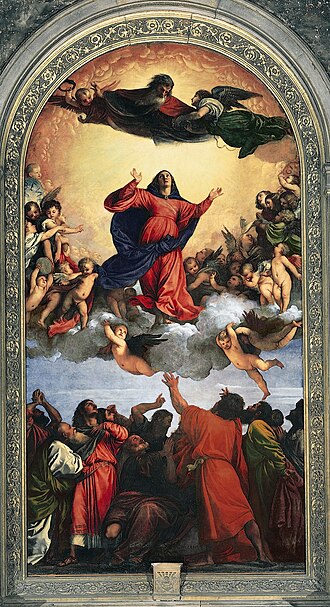 Mariä Himmelfahrt - Titian (1510s)
FXD.jpg) Himmlische und Irdische Liebe - Titian (1510s)
Himmlische und Irdische Liebe - Titian (1510s)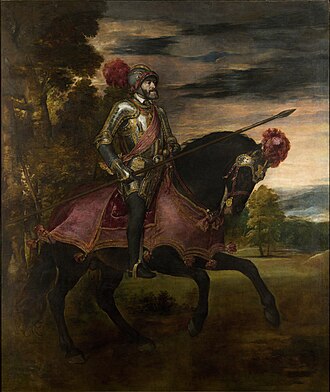 Kaiser Karl V. nach der Schlacht bei Mühlberg - Titian (1548)
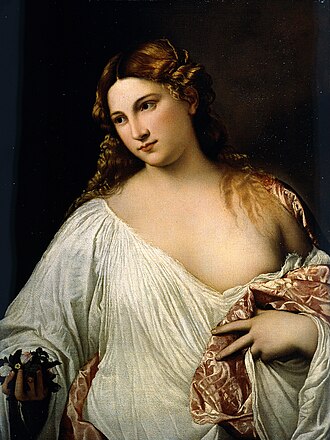 Flora - Titian (1517)
 Allegorie der von der Klugheit beherrschten Zeit - Titian (1550)
 Bacchus und Ariadne - Titian (1520s)
%20nave%20left%20-%20Altar%20of%20Madona%20di%20Ca'Pesaro.jpg) Pesaro Madonna - Titian
Pesaro Madonna - Titian