種をまく人
Jean-François Millet · 1850
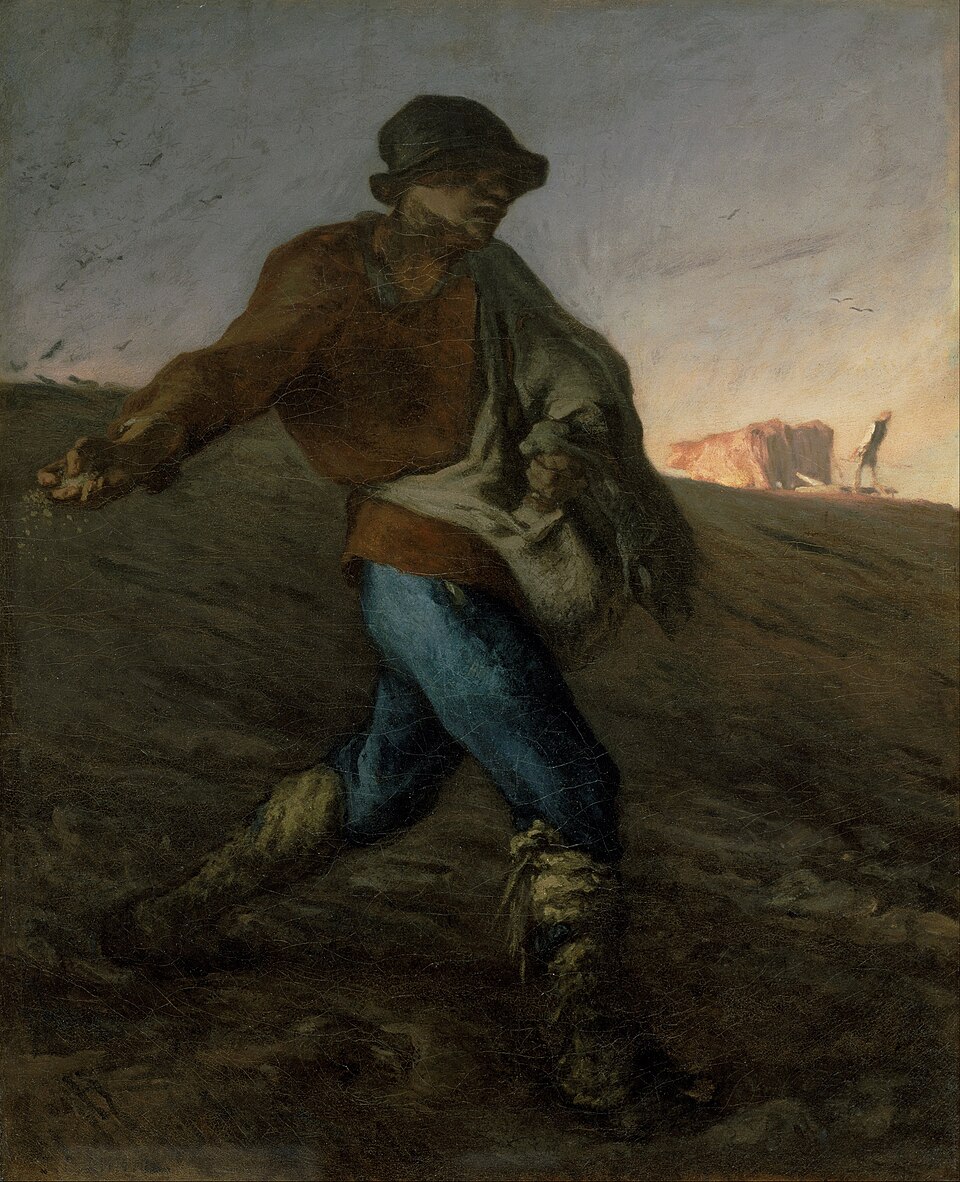
A peasant strides across a field at dawn, flinging seed with his right hand while crows wait behind him. Millet painted him in 1850, his first major picture in Barbizon, and Paris found the giant figure both powerful and unsettling.
The story behind the painting
Millet moved to Barbizon, a village in the Fontainebleau forest outside Paris, in 1849. There he joined the painters of the Barbizon School, who chose quiet, realistic landscapes and motifs over the dramatic romantic tradition. Millet was himself a farmer's son, and he set out to show the hard-working life of country people with dignity and seriousness. The Sower, painted in 1850, was the first major painting he made in Barbizon. In the same year he painted a nearly identical second version, now in the Yamanashi Prefectural Art Museum in Kofu, and it was that one he sent to the Paris Salon of 1850.
What to look for
The man is dressed as a typical peasant, his legs wrapped in straw for warmth, a bag of seed slung over his shoulder. He walks with long strides, casting grain with his right hand. The scene seems to take place in winter, and the sun shining at the top of the picture suggests dawn. On the left, crows scavenge the newly sown seed. Far off on the right, a man with oxen harrows the ground, preparing it for the sower. Nothing is prettified: the canvas, about 101.6 by 82.6 cm, shows the peasant's strength and hard life without idealising him.
Meaning and intent
Today Millet's peasants are sometimes seen as sentimental, but in his own time they were considered radical for their social realism. Showing simple farm workers on a large scale was new and controversial in the Paris art world, and Millet was often criticised for his "ugly" subjects. At the Salon of 1850, the Kofu version drew much attention: Clement de Ris praised "an energetic study full of movement", while Theophile Gautier mocked it as "trowel scrapings". The art historian Anthea Callen argues that Millet deliberately stretched the figure's proportions into a sinewy giant, and that his dominance of the space and our low viewpoint explain why he looked menacing to the Parisian bourgeoisie.
Legacy
Millet had first painted a sower in 1847 to 1848, in a version now in the National Museum of Wales, where the horizon is higher and the figure less monumental. After the Boston and Kofu pictures he returned to the motif at least three more times: an oil in the Carnegie Museum of Art in Pittsburgh, and pastels in the Clark Art Institute and the Walters Art Museum. The Boston painting has belonged to the Museum of Fine Arts since 1917. Vincent van Gogh drew deeply on Millet's farm scenes and copied The Sower in several of his own paintings, transforming it with brighter colours.
豆知識
- Painted in 1850, Millet's first major work in Barbizon.
- A near-identical twin, now in Kofu, was shown at the Salon of 1850.
- In the Museum of Fine Arts, Boston, since 1917.
- Van Gogh copied the motif in several paintings.
同じ画家の作品: Jean-François Millet
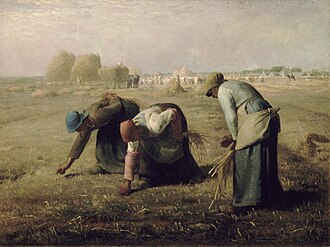 落穂拾い - Jean-François Millet (1857)
.jpg) 晩鐘 - Jean-François Millet (1858)
晩鐘 - Jean-François Millet (1858)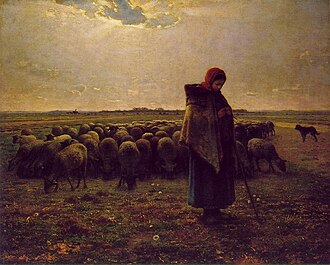 羊飼いの少女 - Jean-François Millet (1863)
.jpg) 箕をふるう人 - Jean-François Millet (1848)
箕をふるう人 - Jean-François Millet (1848).jpg) 鍬に寄りかかる人 - Jean-François Millet (1860s)
鍬に寄りかかる人 - Jean-François Millet (1860s)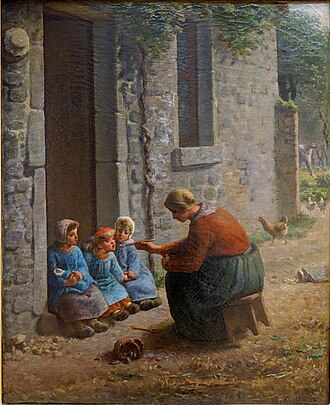 子どもに食べさせる母 - Jean-François Millet (1860)
 星の夜 - Jean-François Millet (1850s)
 星月夜
星月夜.jpg) 夜のカフェテラス
夜のカフェテラス 印象・日の出
 睡蓮
睡蓮