The Parade
エドガー・ドガ · 1866
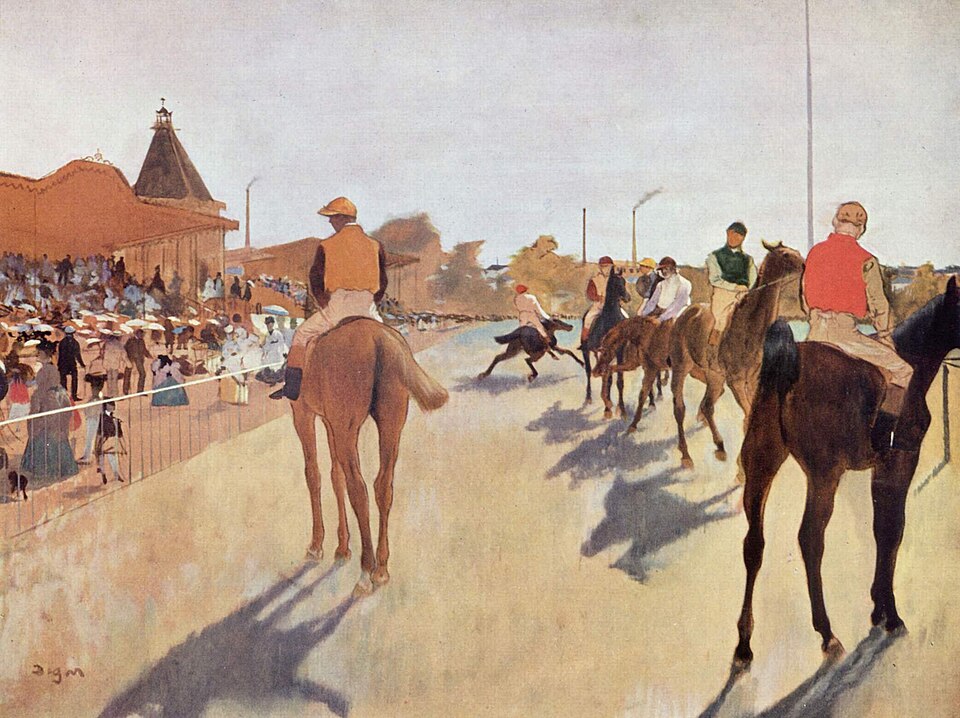
Jockeys and horses wait before a race, long shadows stretching across the grass, the stands crowded behind them. Degas painted not the race itself but the tense moment just before the start.
The story behind the painting
Horses and racing became one of Degas's recurring themes, but he did not begin there. His first exhibited work, in 1857 when he was 22, was a classical subject, Young Spartan Girls Challenging Boys. A few years later his subjects changed. The Parade, also called Racehorses in Front of the Stands, was painted between 1866 and 1868 and is one of his first pictures of a racecourse. According to the Australian art historian Malcolm Park, the scene was painted at the Le Vésinet racecourse, which opened in 1866 and closed in 1891; its site later became the Lac des Ibis.
What to look for
The canvas is modest, 46 by 61 cm. The composition runs on a diagonal, and the strong contrasts of light, especially the shadows cast by the horses, push the eye along the perspective toward a vanishing point roughly in the centre. That point picks out the last riders. Watch how the light falls across the field, how the shadows lengthen, and how the crowded stands sit behind the line of horses. Wikidata also lists a factory among the subjects, so look for signs of the modern world at the edge of this leisure scene.
Meaning and intent
Degas was not interested in the race as a performance, nor in the play of colours of the jockeys' silks or the effort of the running horses. What held him was the situation just before the start. By choosing that pause, he paints suspense instead of action: horses shifting, riders waiting, the crowd watching. The diagonal and the light carry that tension through the picture. It is an early sign of an approach that would mark his later work, catching a real moment from an unexpected angle rather than the obvious climax.
Legacy
A private owner sold the painting in 1873 or 1874. Until 1893 it belonged to Paul Durand-Ruel, the dealer known as a passionate supporter of the Impressionists. It then passed to the banker and collector Count Isaac de Camondo, who kept it until his death in 1911. That year the French state accepted it as a bequest to the national museums. It went to the Louvre, then in 1947 to the Jeu de Paume, and finally to the Musée d'Orsay when that museum opened. Wikidata dates it 1866, while the French Wikipedia gives 1866 to 1868.
豆知識
- Painted between 1866 and 1868.
- One of Degas's first racecourse pictures.
- Owned by Paul Durand-Ruel and then Isaac de Camondo.
- Bequeathed to the French state in 1911; now in the Musée d'Orsay.
画家について
エドガー・ドガ (1834-1917)
同じ画家の作品: エドガー・ドガ
 アブサントを飲む人 - Edgar Degas (1875)
 The Bellelli Family - Edgar Degas (1858)
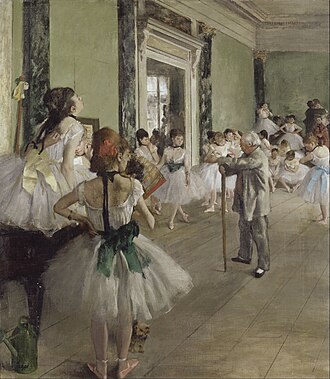 The Ballet Class - Edgar Degas (1871)
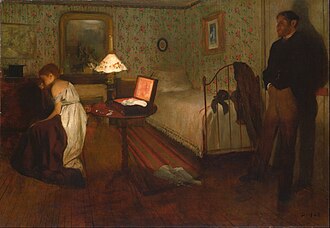 室内 - Edgar Degas (1868)
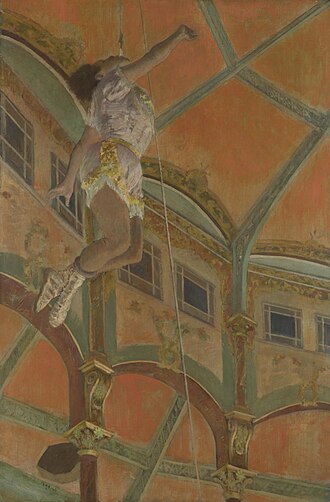 シルク・フェルナンドのマドモアゼル・ララ - Edgar Degas (1879)
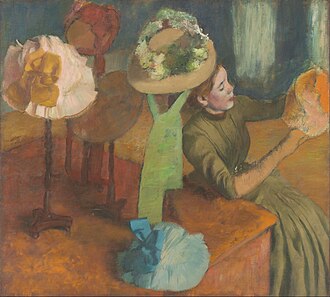 The Millinery Shop by Edgar Degas - Edgar Degas
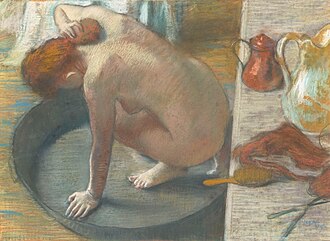 The Tub - Edgar Degas (1886)
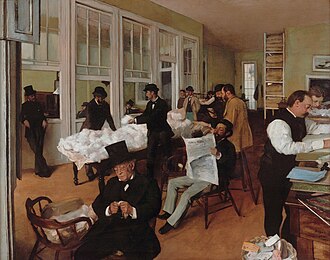 A Cotton Office in New Orleans - Edgar Degas (1873)
関連する画家の作品
 印象・日の出 - Claude Monet (1872)
 睡蓮 - Claude Monet (1906)
 草上の昼食 - Édouard Manet (1863)
 オランピア - Édouard Manet (1863)
 ムーラン・ド・ラ・ギャレットの舞踏会 - Pierre-Auguste Renoir (1876)
 舟遊びの昼食 - Pierre-Auguste Renoir (1881)
 ゆりかご - Berthe Morisot (1872)
 Summer's Day - Berthe Morisot (1879)
 The Canal du Loing at Moret - Alfred Sisley (1892)
 The Watering Pond at Marly with Hoarfrost - Alfred Sisley (1876)
 パリの通り、雨 - Gustave Caillebotte (1877)
 床削り - Gustave Caillebotte (1875)