The Aqueduct at Marly
アルフレッド・シスレー · 1874
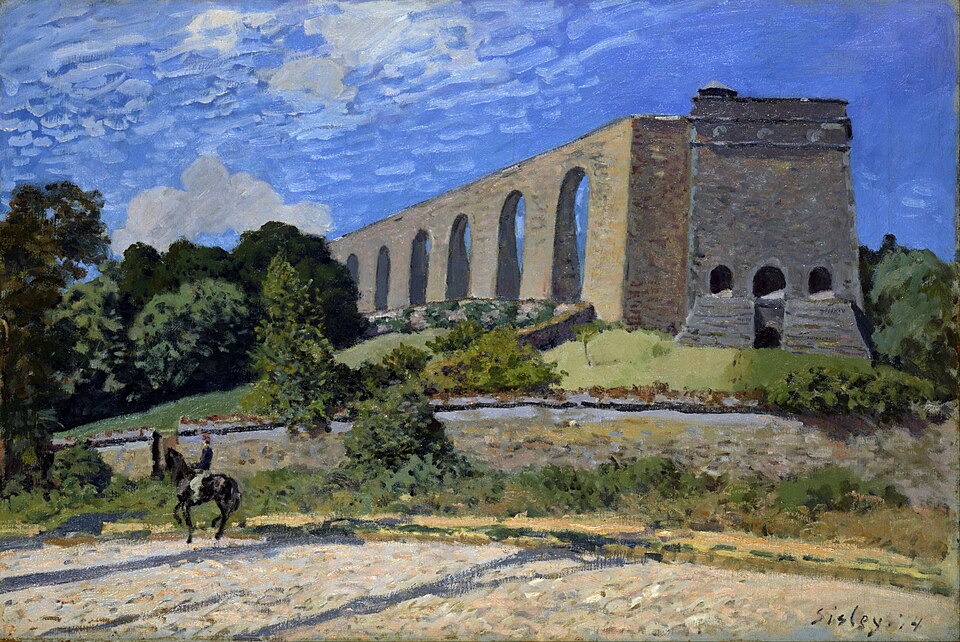
A seventeenth-century aqueduct strides across the hills above Louveciennes, already dry for years. Sisley, a refugee from war in this village, painted it in 1874, near the end of his long stay there.
The story behind the painting
British by birth, Sisley could not fight in the Franco-Prussian War. Fleeing the Siege of Paris, he first stayed at Louveciennes in autumn 1870, painting First Snow at Louveciennes. In spring 1871, with Paris under the Commune, he took refuge there again, at 2 rue de La Princesse, and found that Prussian troops had ransacked his studio, which is why few of his Louveciennes paintings from before 1871 survive. He stayed until the winter of 1874 to 1875, painting several snowy landscapes tinted pink, yellow or blue. The Aqueduct at Marly, also called The Aqueduct at Louveciennes, dates from 1874.
What to look for
The subject is the Aqueduc de Louveciennes, built in the seventeenth century. Look to the right-hand side of the canvas: that is the tour du Levant, the tower at the eastern end of the aqueduct, where during the war the Prussians had installed an artillery battery. By the time Sisley painted it, the aqueduct had been out of use since 1866, a long line of arches that no longer carried water. The canvas measures about 54 by 81 cm, a wide format that suits the stretch of the structure across the land.
Meaning and intent
In the first paintings of the aqueduct by Renoir, Monet and Pissarro, it bridges the gap between two hills as a reminder of the region's royal past. Sisley returned to it from three different angles, catalogued as D. 49, D. 133 and D. 213. The first of these, from 1872, closely followed Pissarro's Spring in Louveciennes of 1868 to 1869 and Henri Bevan's 1870 photograph The Aqueduct at Louveciennes. Coming back to the same monument again and again, after war and occupation had passed through the village, Sisley made it part of his own landscape.
Legacy
Paul Durand-Ruel bought the painting from Sisley in 1876. It later passed through Alex Reid and Lefevre in London and then to Edward Drummond Libbey in the United States, who donated it to the Toledo Museum of Art, where it hangs today. The place where it was painted has not forgotten it: a life-size reproduction stands at the site of its creation as part of the Pays des Impressionnistes scheme, so that walkers can compare Sisley's view with the aqueduct itself, still standing above Louveciennes.
豆知識
- Painted in 1874 at Louveciennes.
- Shows the Aqueduc de Louveciennes, disused since 1866.
- Bought by Paul Durand-Ruel from Sisley in 1876.
- Now in the Toledo Museum of Art.
画家について
アルフレッド・シスレー (1839-1899)
同じ画家の作品: アルフレッド・シスレー
 The Canal du Loing at Moret - Alfred Sisley (1892)
 The Watering Pond at Marly with Hoarfrost - Alfred Sisley (1876)
 La neige à Louveciennes - Alfred Sisley (1875)
 La Machine de Marly - Alfred Sisley (1873)
 The Flood at Port Marly - Alfred Sisley (1876)
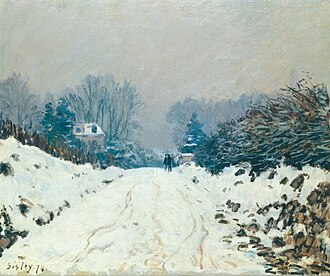 Snow landscape in Louveciennes - Alfred Sisley (1874)
 Les bords du Loing vers Moret - Alfred Sisley (1883)
 The Seine at Bougival - Alfred Sisley (1873)
関連する画家の作品
 印象・日の出 - Claude Monet (1872)
 睡蓮 - Claude Monet (1906)
 草上の昼食 - Édouard Manet (1863)
 オランピア - Édouard Manet (1863)
 ムーラン・ド・ラ・ギャレットの舞踏会 - Pierre-Auguste Renoir (1876)
 舟遊びの昼食 - Pierre-Auguste Renoir (1881)
 ゆりかご - Berthe Morisot (1872)
 Summer's Day - Berthe Morisot (1879)
 アブサントを飲む人 - Edgar Degas (1875)
 The Bellelli Family - Edgar Degas (1858)
 パリの通り、雨 - Gustave Caillebotte (1877)
 床削り - Gustave Caillebotte (1875)