Scene from the Steeplechase: The Fallen Jockey
エドガー・ドガ · 1866
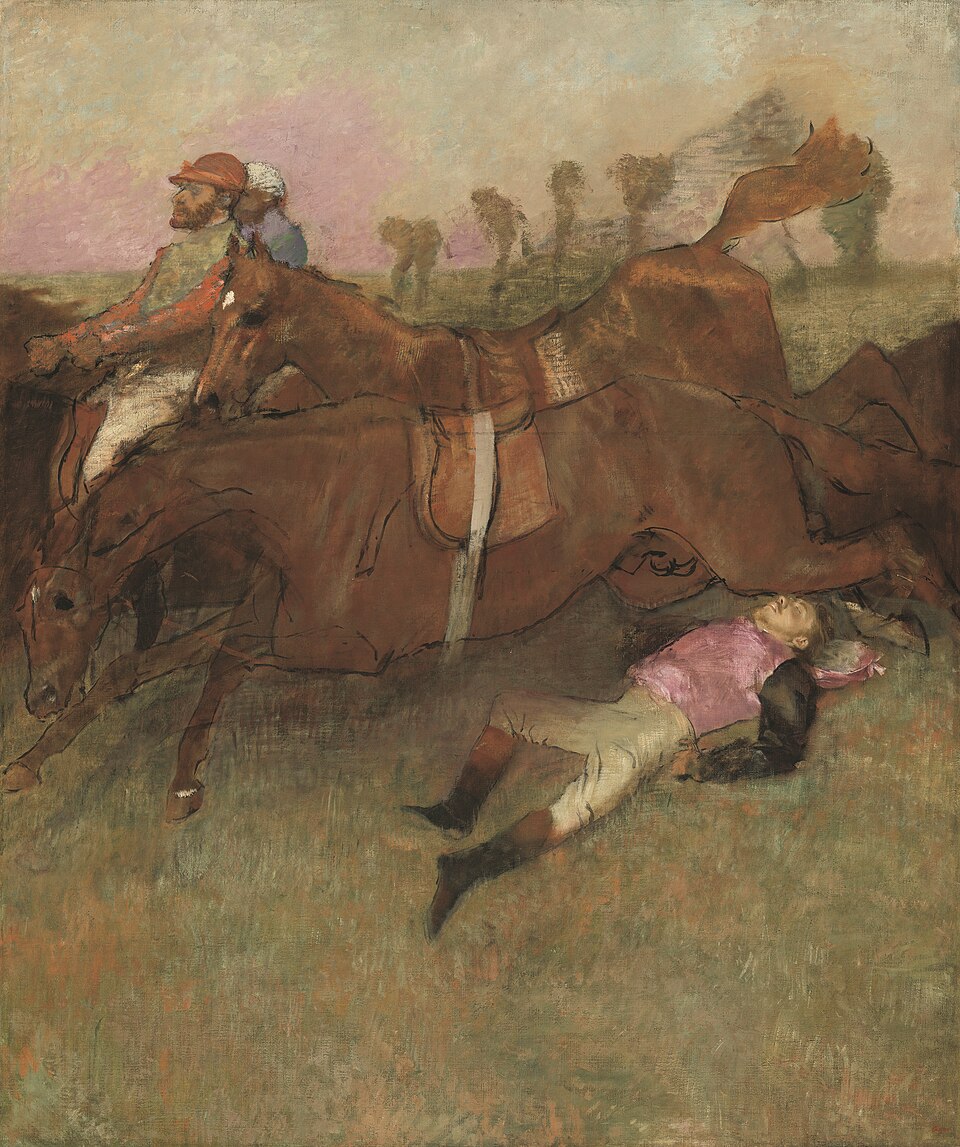
Horses thunder across the canvas while a rider lies motionless beneath them. Degas staked his early career on this huge racing picture, was disappointed by its reception, and kept repainting it for thirty years.
The story behind the painting
Before painting the work, Degas was warned by his father that he would have to support himself. He knew the Salon offered a path to success, but his Scene of War in the Middle Ages, shown there in 1865, had won little praise. So he turned to a fashionable new subject, the steeplechase. The Société des Steeple-chases had been founded only three years earlier, and the races drew an upper-class crowd because the riders were gentlemen. Degas had probably been introduced to equestrian life around 1861, through visits to Normandy and his friend Paul Valpinçon's estate. He may also have been spurred by his rivalry with Manet, whose Incident in the Bullring showed an athlete fallen in a dangerous contest.
What to look for
To make sure it would not be overlooked, Degas chose a large canvas, 180 by 152 cm. Four horses race from right to left, with three jockeys, and one jockey has fallen and lies still in the foreground. There are no spectators or stewards, so attention falls on the fallen man and the question of whether he is alive. Notice the unusual empty slope below the riders, the scale of the horses as they stampede, and their striking shadows mirroring the motion. The front horse carries much of the energy in its brushwork. The rider in the red cap may be Degas's friend Ludovic-Napoléon Lepic, and the one in the white cap at back left the sculptor Raymond de Broutelles.
Meaning and intent
Scholars have long asked who the fallen jockey is. He may be modelled on one of Degas's brothers. René might have posed, but Achille is known to have posed for jockeys in other works, and Degas's drawings show a figure closely resembling him in hair, beard and sideburns. Some read the fall as an exploration of weakness, and perhaps as a criticism of Achille, who was seen as a failure in the family. The horses in the sketches and painting have been seen as conveying a desire for freedom, rushing on above the still body. The picture may also mark Degas's shift from history painting toward modern subjects.
Legacy
At the Salon of 1866 the response was quieter than Degas hoped; attention went to Courbet's Woman with a Parrot. One anonymous critic wrote that, like the jockey, the painter was not yet entirely familiar with the horse, and thirty-one years later Degas agreed. Displeased, he reworked the canvas in 1880 to 1881, perhaps prompted by Mary Cassatt, who asked him to sell it to her horse-loving brother, and again in 1897, always leaving the jockey untouched. The dealer Joseph Durand-Ruel later bought it and had another artist restore the horses' lines. Considering it spoiled, Degas painted Fallen Jockey in 1896. The original is now in the National Gallery of Art in Washington.
豆知識
- Shown at the Paris Salon of 1866.
- Large canvas, 180 by 152 cm.
- Reworked by Degas in 1880 to 1881 and in 1897.
- Now in the National Gallery of Art, Washington.
画家について
エドガー・ドガ (1834-1917)
同じ画家の作品: エドガー・ドガ
 アブサントを飲む人 - Edgar Degas (1875)
 The Bellelli Family - Edgar Degas (1858)
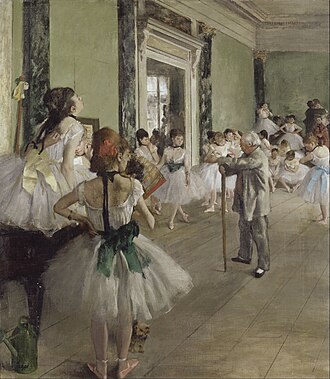 The Ballet Class - Edgar Degas (1871)
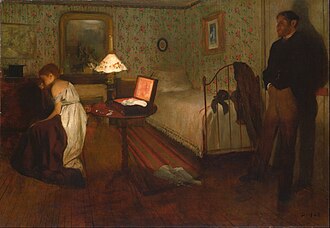 室内 - Edgar Degas (1868)
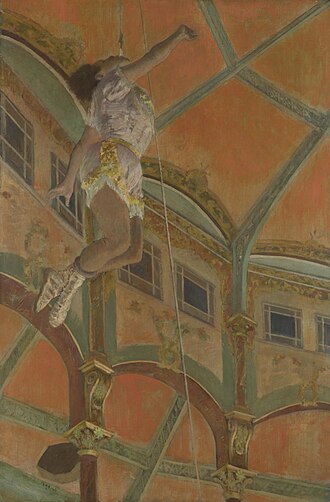 シルク・フェルナンドのマドモアゼル・ララ - Edgar Degas (1879)
 The Millinery Shop by Edgar Degas - Edgar Degas
 The Tub - Edgar Degas (1886)
 A Cotton Office in New Orleans - Edgar Degas (1873)
関連する画家の作品
 印象・日の出 - Claude Monet (1872)
 睡蓮 - Claude Monet (1906)
 草上の昼食 - Édouard Manet (1863)
 オランピア - Édouard Manet (1863)
 ムーラン・ド・ラ・ギャレットの舞踏会 - Pierre-Auguste Renoir (1876)
 舟遊びの昼食 - Pierre-Auguste Renoir (1881)
 ゆりかご - Berthe Morisot (1872)
 Summer's Day - Berthe Morisot (1879)
 The Canal du Loing at Moret - Alfred Sisley (1892)
 The Watering Pond at Marly with Hoarfrost - Alfred Sisley (1876)
 パリの通り、雨 - Gustave Caillebotte (1877)
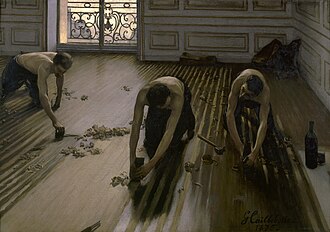 床削り - Gustave Caillebotte (1875)