Porträt Walther Silberstein
ロヴィス・コリント · 1923
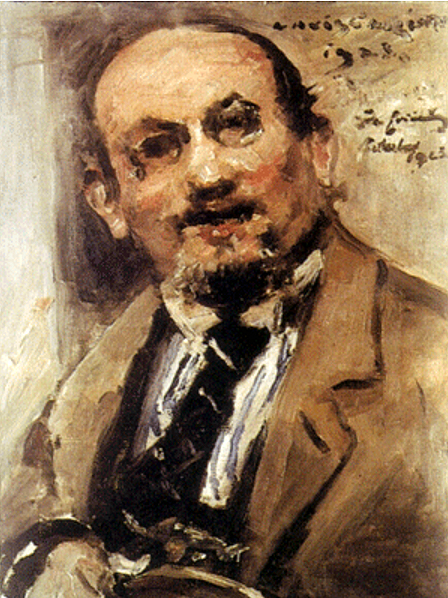
A balding man with round glasses looks straight out, hat in hand. Corinth gave this portrait to his neighbour, the Jewish tailor Walther Silberstein, in 1923. Lost under the Nazis, it returned to his family eighty years later.
The story behind the painting
Corinth painted the portrait in 1923, two years before his death. In a letter to his wife, whom he called Petermannchen, he described getting to know his neighbour Silberstein. Walther Silberstein, born 1871, was a men's tailor who ran a thriving shop called The Gentleman at the corner of Friedrichstrasse and Unter den Linden in Berlin. He lived at Klopstockstrasse 56, right next to the Corinths, was active in Berlin's Jewish community and collected art by Corinth, Max Liebermann, Lesser Ury and others. Corinth gave him the painting with a dedication, and Silberstein thanked him with a made to measure suit.
What to look for
The oil on canvas, 70 by 50 cm, is painted mostly in browns with the coarse brushstrokes typical of Corinth's late work. It is a half length portrait from a slightly oblique angle, the head turned to look directly at us. Silberstein wears round glasses, a moustache and goatee, and has a high, balding forehead. His brown jacket is open over a light shirt with a white collar and blue vertical stripes and a black tie with thin white diagonal stripes. At the bottom edge his right hand holds a hat whose brim is just visible. The background is brown and white, with a very dark area behind him beside a light strip.
Meaning and intent
The picture was long known by the wrong name. Charlotte Berend-Corinth listed it in her catalogue as a portrait of Max Silberstein, probably confusing the tailor with the banker Max Silberstein or the collector Max Silberberg, both friends of Corinth, and the error first appeared in the 1926 memorial exhibition catalogue. The original dedication, to Mr Silberstein in remembrance, October 1923, was later removed, probably by the collector Conrad Doebbecke, to prevent heirs from tracing it. Doebbecke wrote that he had no courage for this picture of a Jew and feared that some Mr Silberstein might want it back.
Legacy
Silberstein died in 1930 and his widow Ada inherited the painting. Persecuted as Jews, the family scattered: Ada and her daughter Vera were deported to Riga in 1942 and killed, and daughter Lily was murdered in Auschwitz. The painting reached Doebbecke before the war ended, passed in 1954 to the collector Felix Peltzer and later to the dealer Michael Haas, whose researcher Laurie Stein corrected the sitter's name in 2001. By chance, the Jewish Museum's Inka Bertz met Silberstein's grandson Leo Hepner in London. Unable to prove loss through persecution, he bought the picture in 2003 for his mother, and in 2025 it was given to the Jewish Museum Berlin.
豆知識
- Painted in 1923 and given by Corinth to his neighbour, the tailor Walther Silberstein.
- Long misnamed Portrait of Max Silberstein.
- Lost during Nazi persecution of the Silberstein family.
- Bought back by Silberstein's grandson in 2003, donated to the Jewish Museum Berlin in 2025.
画家について
ロヴィス・コリント (1858-1925)
同じ画家の作品: ロヴィス・コリント
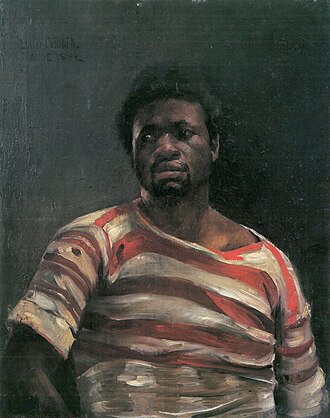 Black Othello - Lovis Corinth (1884)
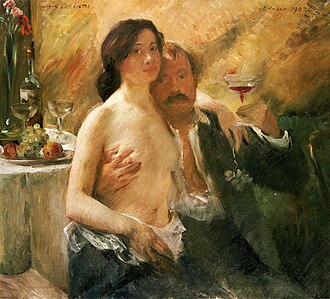 Self portrait with his wife Charlotte Berend-Corinth and a sekt glass - Lovis Corinth (1902)
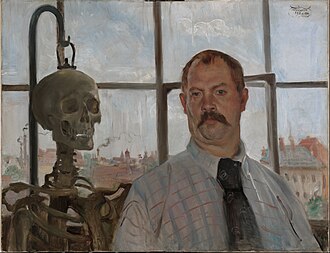 自画像 - Lovis Corinth (1896)
 Innocentia - Lovis Corinth (1890)
 Susanna in the Bath - Lovis Corinth (1890)
 The Red Christ - Lovis Corinth (1922)
 Reading Woman - Lovis Corinth (1911)
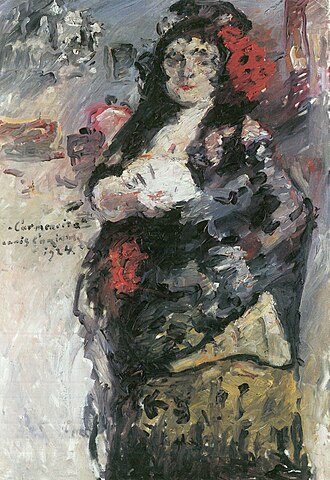 Carmencita - Lovis Corinth (1924)