Portraits at the Stock Exchange
エドガー・ドガ · 1870s
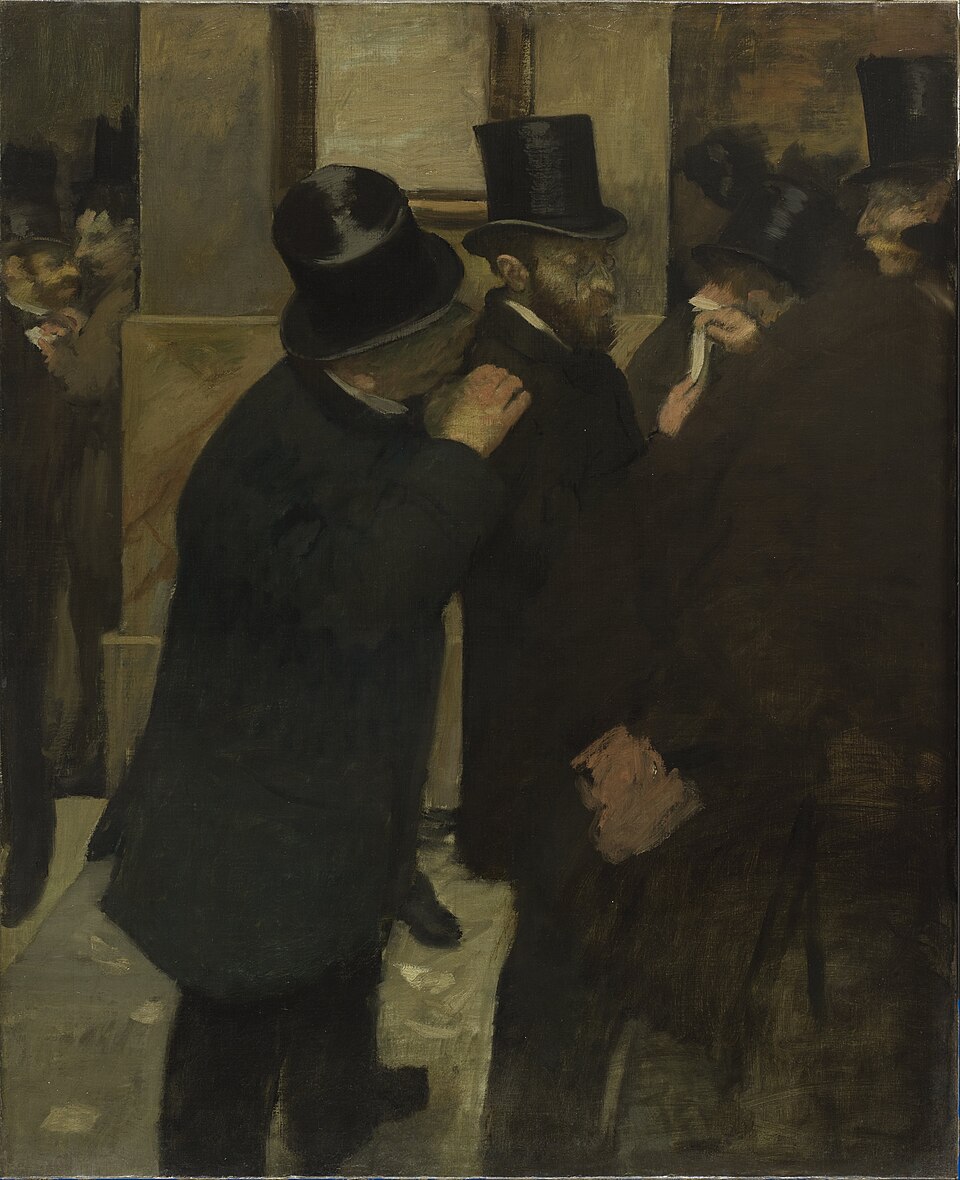
A banker in a top hat and pince-nez listens while a colleague leans over his shoulder, a slip of paper held up between them. Degas painted this corner of the Paris Bourse around 1879, and its meaning is still disputed.
The story behind the painting
Degas completed the painting in about 1879, and it already belonged to the French banker Ernest May when it was listed in the catalogue of the fourth Impressionist exhibition that year. May may have commissioned it. It may also have appeared at the next Impressionist exhibition in 1880, yet the picture remained little known until it entered the collections of the Louvre in 1923. Also called At the Bourse, it is about 100 by 82 cm and is one of the works in which Degas turned from the dance and the races to the world of finance.
What to look for
The canvas shows an interior corner of the open trading floor of the Paris Stock Exchange. Ernest May stands at the centre in a top hat and pince-nez, listening to a colleague, a certain M. Bolâtre, who leans over his shoulder. They are probably discussing a document, perhaps a bordereau, held up by a third man who is partly hidden. Look at the brushwork: quick and sketchy, closer to Impressionism than many of Degas's earlier pictures. The viewpoint is detached, as if we were a passer-by catching a private exchange.
Meaning and intent
How Degas saw these men is debated. May, the owner, was himself Jewish, but the art historian Linda Nochlin interpreted the painting as an antisemitic depiction of Jews in Paris, pointing especially to the exaggerated features and postures. The British art historian Richard Shone, writing about the oil and its pastel study, does not mention antisemitism; he describes the figures as having humdrum features and May as a seasoned figure whose expression gives nothing away. The source adds that, although antisemitism has a long history in France, there is little evidence of Degas holding this attitude until the Dreyfus affair two decades later.
Legacy
After entering the Louvre in 1923, the painting is now in the Musée d'Orsay in Paris. A smaller pastel sketch of the same subject is in the Metropolitan Museum of Art in New York. Its psychological detachment, a common viewpoint in Impressionist painting, and its sketchy handling place it among Degas's most Impressionist works, while the dispute over its intentions keeps the picture an uneasy one to look at. Both versions can still be compared today.
豆知識
- Completed about 1879; listed at the fourth Impressionist exhibition.
- Shows the banker Ernest May at the Paris Bourse.
- Read as antisemitic by Linda Nochlin; Richard Shone does not see it so.
- In the Musée d'Orsay; a pastel study is at the Met.
画家について
エドガー・ドガ (1834-1917)
同じ画家の作品: エドガー・ドガ
 アブサントを飲む人 - Edgar Degas (1875)
 The Bellelli Family - Edgar Degas (1858)
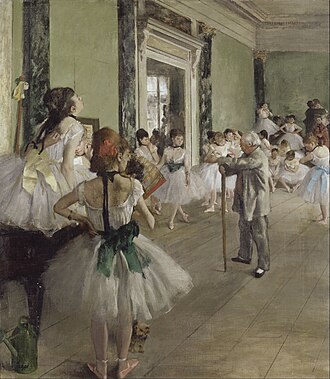 The Ballet Class - Edgar Degas (1871)
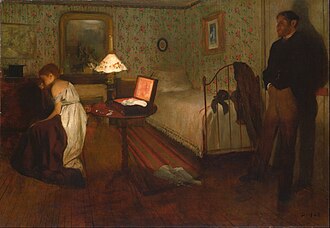 室内 - Edgar Degas (1868)
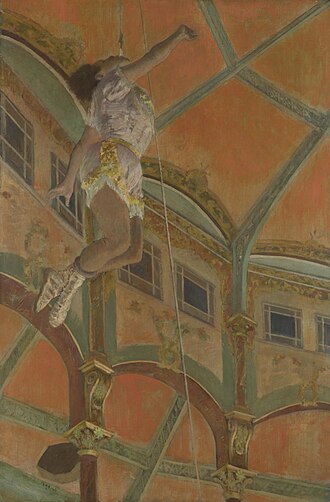 シルク・フェルナンドのマドモアゼル・ララ - Edgar Degas (1879)
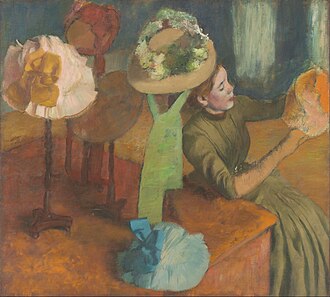 The Millinery Shop by Edgar Degas - Edgar Degas
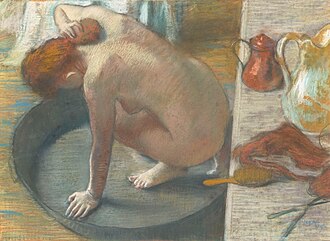 The Tub - Edgar Degas (1886)
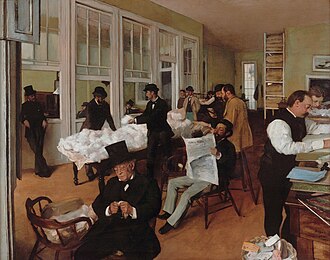 A Cotton Office in New Orleans - Edgar Degas (1873)
関連する画家の作品
 印象・日の出 - Claude Monet (1872)
 睡蓮 - Claude Monet (1906)
 草上の昼食 - Édouard Manet (1863)
 オランピア - Édouard Manet (1863)
 ムーラン・ド・ラ・ギャレットの舞踏会 - Pierre-Auguste Renoir (1876)
 舟遊びの昼食 - Pierre-Auguste Renoir (1881)
 ゆりかご - Berthe Morisot (1872)
 Summer's Day - Berthe Morisot (1879)
 The Canal du Loing at Moret - Alfred Sisley (1892)
 The Watering Pond at Marly with Hoarfrost - Alfred Sisley (1876)
 パリの通り、雨 - Gustave Caillebotte (1877)
 床削り - Gustave Caillebotte (1875)