Law and Grace
ルーカス・クラナッハ · 1529
.jpg)
A tree splits the picture in two: dry branches on the side of the Law, green ones on the side of Grace. In 1529 Cranach turned Luther's teaching into one image, and this Prague panel became the model for many others.
The story behind the painting
Painted in 1529, this is one of the two oldest known versions of Law and Grace, the other being in Gotha. Its origins are unknown, but it was probably made for a church in north Bohemia. It belonged to the Lords of Vrbno in the late 18th century, then to Count Johann Nepomuk von Nostitz-Rieneck, who lent it from 1814 to 1922 to the Picture Gallery of the Society of Patriotic Friends of Art. The National Gallery in Prague acquired it in 1950.
What to look for
In the middle a naked man sits under the Tree of Life, his body on the side of sin and his head turned toward Grace. On the left, under the Law: Moses receiving the tablets, Adam and Eve, Israelites dying from snake bites, the bronze serpent on a pole and an open tomb. The prophet Isaiah points the man to the Crucified Christ. On the right John the Baptist shows the Lamb of God, near Mary on Mount Zion, the Annunciation to the shepherds and the risen Christ crushing a serpent and a skeleton. The panel, 72 by 88.5 cm on lime wood, was cut down on the sides and bottom before 1815, losing its German texts.
Meaning and intent
It is described as the best-known and most influential allegory of the core of Luther's reform. Drawing on Luther's De Servo Arbitrio of 1525 and on Philip Melanchthon, it contrasts a faith based on the Law of the Old Testament with belief in Divine Mercy, the idea of justification by faith. After the Augsburg Confession of 1530 it read as a topical image of a Church at a crossroads. Infrared study shows a freehand underdrawing that the painter followed closely.
Legacy
The Prague type served as the model for other paintings, including a copy from around the mid-16th century, also in Prague, which still carries the lost texts naming each figure. Cranach and his workshop reworked the theme in Schneeberg, Jáchymov and Dessau, and its influence spread to Czech altarpieces, murals and epitaphs, and to an allegory by Hans Holbein the Younger. One updated version, worked on with Lucas Cranach the Younger, even places the Pope among the sinners in hell.
豆知識
- Painted in 1529, one of two oldest versions with Gotha.
- Probably made for a church in north Bohemia.
- Cut down before 1815; a copy keeps the lost texts.
- Acquired by the National Gallery Prague in 1950.
画家について
ルーカス・クラナッハ (1472-1553)
同じ画家の作品: ルーカス・クラナッハ
.jpg) 若返りの泉 - Lucas Cranach the Elder (1546)
若返りの泉 - Lucas Cranach the Elder (1546)%20-%20Venus%20and%20Cupid%20(National%20Gallery%2C%20London).jpg) ヴィーナスに訴えるキューピッド - Lucas Cranach the Elder (1520s)
ヴィーナスに訴えるキューピッド - Lucas Cranach the Elder (1520s).jpg) 慈愛 - Lucas Cranach the Elder (1540)
慈愛 - Lucas Cranach the Elder (1540)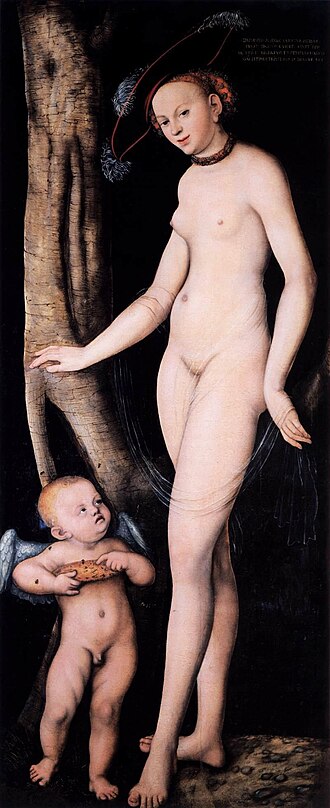 Venus and Cupid with a Honeycomb - Lucas Cranach the Elder (1531)
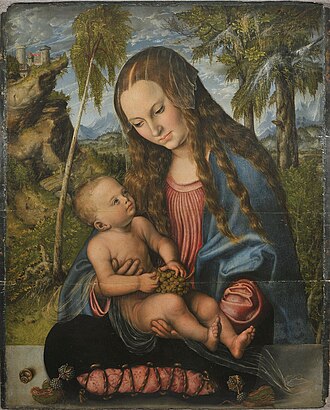 Madonna under the Fir Tree - Lucas Cranach the Elder
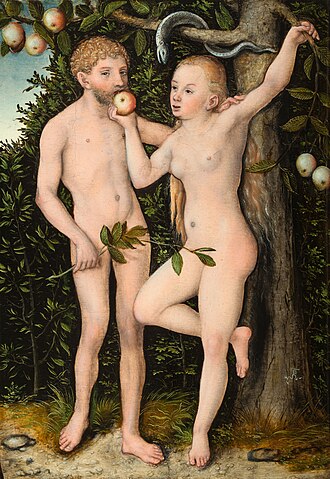 アダムとイヴ - Lucas Cranach the Elder (1538)
.jpg) Prince Johann of Anhalt - Lucas Cranach the Elder (1520)
Prince Johann of Anhalt - Lucas Cranach the Elder (1520).jpg) The Procuress - Lucas Cranach the Elder (1548)
The Procuress - Lucas Cranach the Elder (1548)
 自画像
自画像 東方三博士の礼拝