L'Estaque, Melting Snow
ポール・セザンヌ · 1870
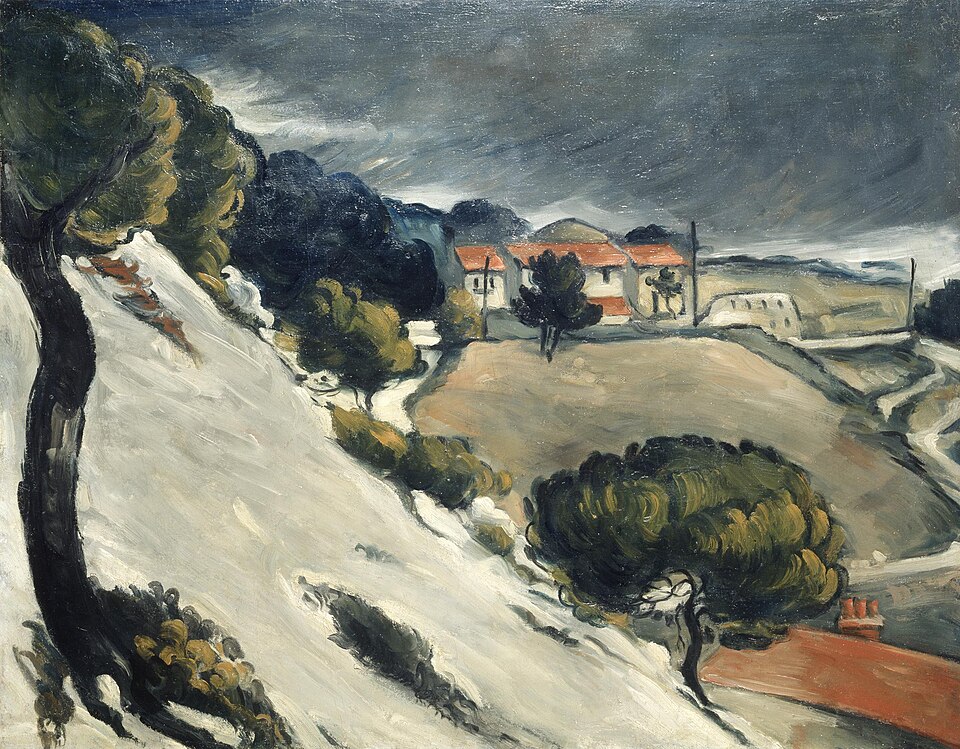
A slope of melting snow slides toward red roofs under a leaden sky. Painted in a single session, it is one of only two snowy winter scenes Cézanne ever made, and one of his most emotional landscapes.
The story behind the painting
Cézanne moved to Provence in 1870 to avoid military service in the Franco-Prussian War, and soon settled in L'Estaque, a small village near Marseille, where he painted a number of landscapes. This view from the outskirts of the village is dated about 1871 by Wikipedia, while Wikidata gives 1870. It was painted in a single session, and it is one of only two snow-laden winter subjects in his whole body of work.
What to look for
A steep hillside covered in a drift of melting snow lies under a dark grey sky. The diagonal of the hill cuts across from left to right, avalanche on one side, gloom on the other, sweeping down to rest just above the red roof of a barely visible house, an effect Meyer Schapiro said gives a rushing force to the image. Dark brown trees with twisted trunks stand on unsteady ground, and black trees in the middle form a descending arch that merges with the clouds. Apart from the red roofs and green foreground trees, the whites, greys and blacks are gloomy and thickly, quickly brushed. It is hard to tell where the viewer is standing.
Meaning and intent
Critics differ: some see the painting as wholly personal, others as a response to the war. Anna-Teresa Tymieniecka read it as a statement on social and political change, asking how we respond to red-roofed houses held as if in a vice between a leaden sky and a sliding block of snow. The work shows Cézanne's new skill with deep landscape space, yet its emotional intensity is closer to his turbulent early figure paintings than to his later, more structured landscapes.
Legacy
The painting has been compared to the work of Vincent van Gogh in the following decade, and formally it looks closer to early twentieth-century art than to the art of its own time. The writer Ronald Berman likened Cézanne's landscape to the Irati River in Hemingway's The Sun Also Rises: in both, the landscape is subjective and the observer's viewpoint is everything. As Berman put it, the foreground is the observer's space.
豆知識
- Painted near Marseille in a single session, c. 1871 (Wikidata: 1870).
- One of only two snowy winter subjects by Cézanne.
- Painted after he left Paris to avoid service in the Franco-Prussian War.
- Compared to Van Gogh and to early twentieth-century art.
画家について
ポール・セザンヌ (1839-1906)
同じ画家の作品: ポール・セザンヌ
 大水浴図 - Paul Cézanne (1900s)
 赤いチョッキの少年 - Paul Cézanne
 The Basket of Apples - Paul Cézanne (1893)
 カーテン、水差しと果物入れ - Paul Cézanne (1890s)
 Maison devant la Sainte-Victoire près de Gardanne - Paul Cézanne (1880s)
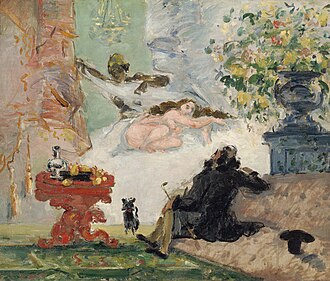 モデルヌ・オランピア - Paul Cézanne (1873)
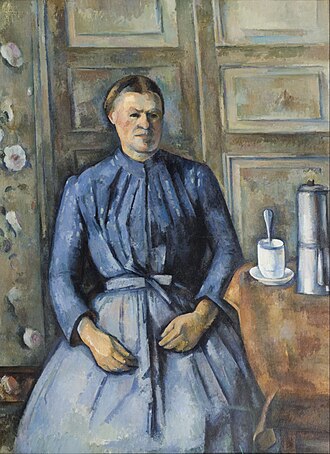 La Femme à la cafetière - Paul Cézanne (1895)
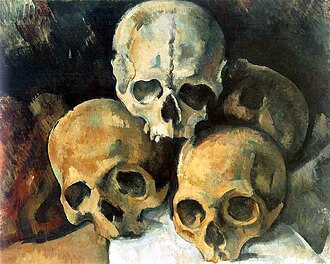 積み重ねた骸骨 - Paul Cézanne (1899)
関連する画家の作品
 星月夜 - Vincent van Gogh (1889)
 夜のカフェテラス - Vincent van Gogh (1888)
 我々はどこから来たのか 我々は何者か 我々はどこへ行くのか - Paul Gauguin (1897-1898)
 黄色いキリスト - Paul Gauguin (1889)
 Walk on the mountain - Joaquín Sorolla (1909)
 Sad Inheritance - Joaquín Sorolla (1898)
 ムーラン・ド・ラ・ギャレットの舞踏会 - Pierre-Auguste Renoir (1876)
 舟遊びの昼食 - Pierre-Auguste Renoir (1881)
 ムーラン・ルージュ - Henri de Toulouse-Lautrec (1892)
 La Toilette - Henri de Toulouse-Lautrec (1896)