Female Nude
ロヴィス・コリント · 1885
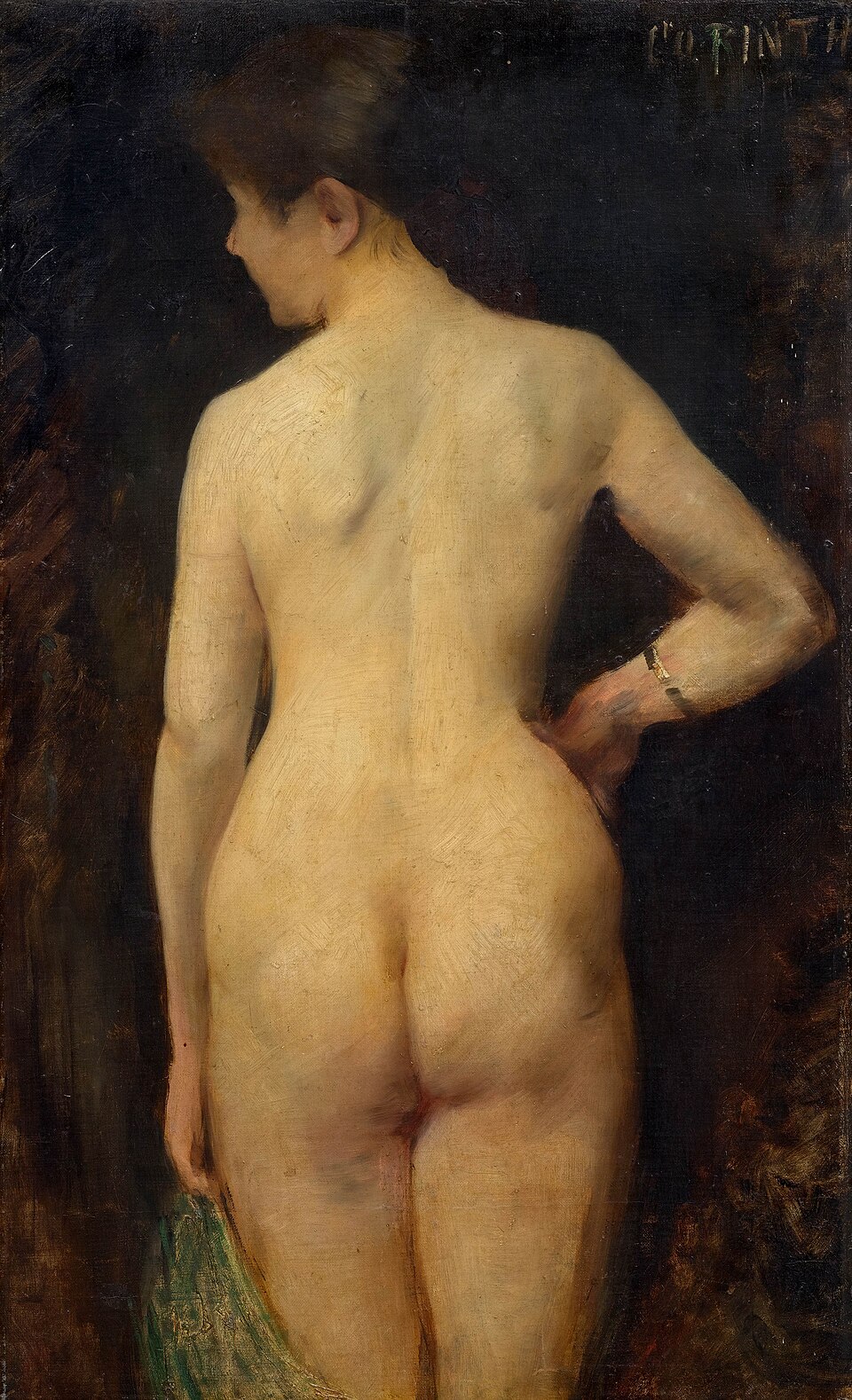
A woman stands with her back to us, hand on her hip, her body glowing in light yellow tones against a dark ground. This early canvas is the young Lovis Corinth's first painted back view of a woman, made as a student in Paris.
The story behind the painting
Lovis Corinth painted Female Nude, also called Back Nude, in 1885, during his early years of study and, according to his wife Charlotte Berend-Corinth, in Paris. He had studied from 1876 at the Königsberg Academy under Otto Günther, then moved in 1880 to the Munich Academy, where nude study was highly valued, working with Franz von Defregger and until 1884 in the class of Ludwig von Löfftz. After travelling to Italy and Antwerp, he went to Paris in October 1884 to continue at the Académie Julian, concentrating on portraits and nudes. This is his first depiction of a woman seen from behind and one of his very first nudes.
What to look for
The upright canvas shows a standing nude woman in three quarter length, down to the knees, with her back to the viewer. Her head, with long dark brown hair, tilts slightly to the left, leaving the nape of her neck free. Her left arm hangs straight down and holds a cloth or dress at the fingertips, while her right hand rests on her hip, a narrow gold bracelet above the wrist. Lit from behind, the body and especially the broad hips are modelled with strong volume and stand out from the dark background. Charlotte Berend-Corinth wrote that on the dark ground the body glows in light, yellowish colours. It is signed CORINTH at upper right.
Meaning and intent
In these years the Munich Academy was a centre of naturalism, influenced among others by the circle of Wilhelm Leibl, and Corinth followed a naturalistic manner based on close observation of body and light. Löfftz worked mainly with what Corinth called proletarian models, and the art historian Bernhart Schwenk thought Corinth's interest in that class came above all from his interest in the human figure. His fascination with the female nude, usually full bodied, runs through his entire work, with Flemish masters such as Peter Paul Rubens as models. This early back view already shows that lifelong passion taking shape.
Legacy
The painting has always been in private hands. Charlotte Berend-Corinth listed it as number 25 in her 1958 catalogue of her husband's paintings, naming a W. Becker in Munich as first owner, then a Dr. Lippmann in Berlin, and a Dr. W. Müller, who lent it to Dresden in 1927. After Corinth's death in 1925 it was shown in several memorial exhibitions: at the Nationalgalerie Berlin in 1926, at the Kunstverein Kassel that October, and at the Sächsischer Kunstverein in Dresden in early 1927. It later passed through private collections in Dresden and Hesse and was sold at auction in Zurich in 2020.
豆知識
- Painted in 1885, probably in Paris.
- Corinth's first back view of a woman and one of his first nudes.
- Catalogued as BC 25 by Charlotte Berend-Corinth.
- Shown in Corinth memorial exhibitions in 1926 and 1927.
画家について
ロヴィス・コリント (1858-1925)
同じ画家の作品: ロヴィス・コリント
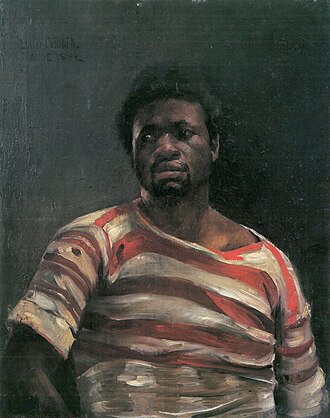 Black Othello - Lovis Corinth (1884)
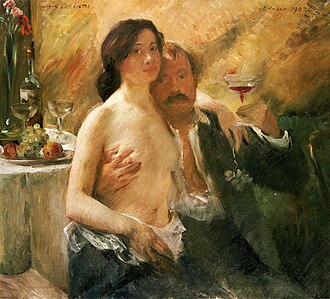 Self portrait with his wife Charlotte Berend-Corinth and a sekt glass - Lovis Corinth (1902)
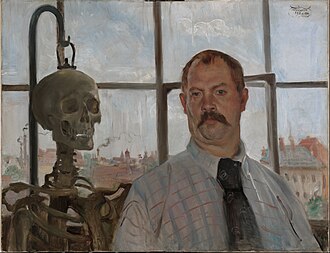 自画像 - Lovis Corinth (1896)
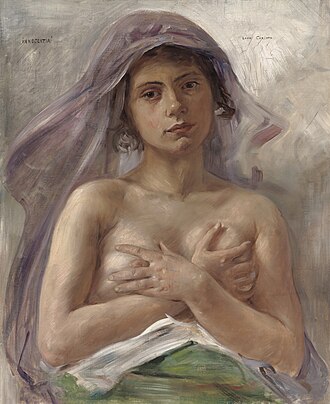 Innocentia - Lovis Corinth (1890)
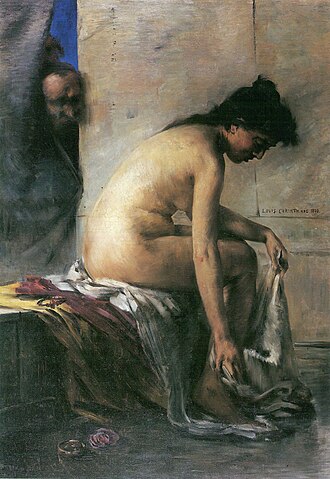 Susanna in the Bath - Lovis Corinth (1890)
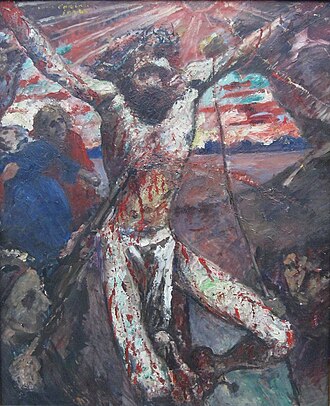 The Red Christ - Lovis Corinth (1922)
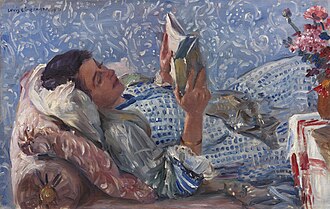 Reading Woman - Lovis Corinth (1911)
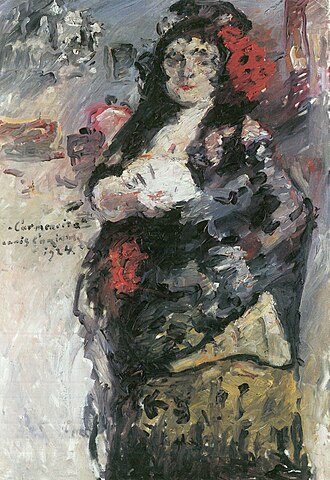 Carmencita - Lovis Corinth (1924)