コメディ・フランセーズの俳優たち
アントワーヌ・ヴァトー · 1710s
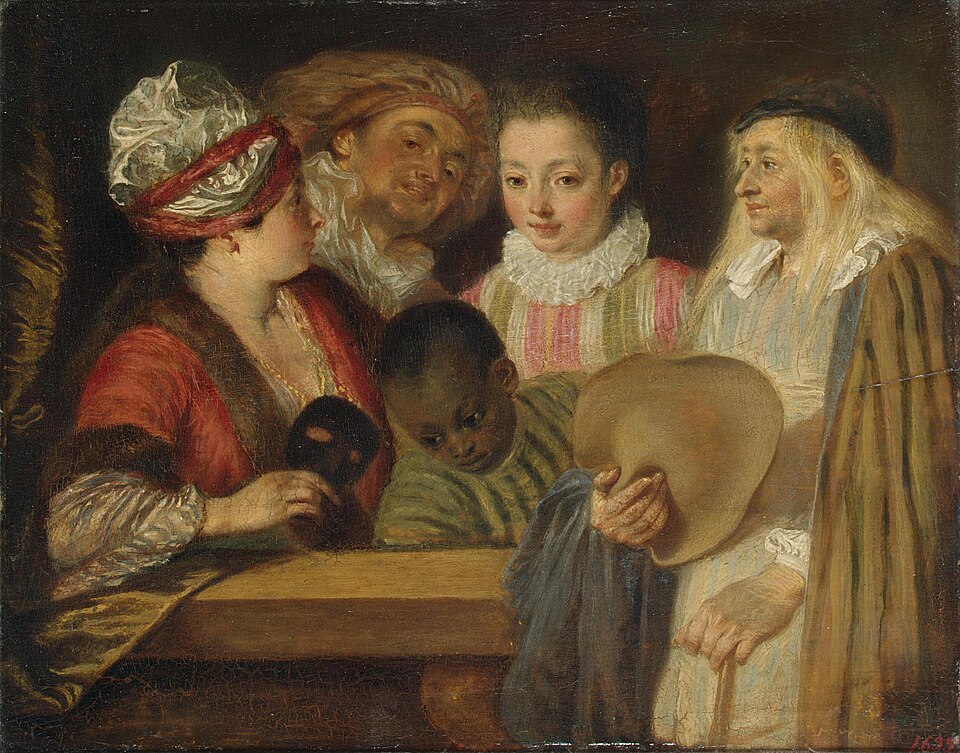
Five faces lean together over a wooden balustrade against a dark background: a woman with a black mask, a girl, a boy, a young man in a motley beret and an old man with a cane. For three centuries people have asked who they are.
The story behind the painting
Scholars date this small oil on pearwood panel variously within the 1710s. It is traditionally known as The Coquettes, a title taken from anonymous verses printed with an etching of it in the 1730s. By the mid 18th century it belonged to Louis Antoine Crozat, Baron de Thiers, nephew of the collector Pierre Crozat, and with the Crozat collection it was acquired in 1772 for Empress Catherine II of Russia. It later hung in the Gatchina Palace before returning to the Hermitage in the 1920s.
What to look for
The panel is only about 20 by 25 cm. On the right, an old man in a skullcap leans on a cane and holds a mushroom hat. Beyond the balustrade a young girl in a light striped dress with a ruff stands behind a black boy in green-striped clothes, and over her shoulder appears a young man dressed as Mezzetino. On the left, a young woman in profile, in a Polish-style red dress, holds a black mask. X-rays made in the 1970s show she was first bareheaded, in a striped costume, her hand resting on the balustrade. Most figures relate to Watteau's own drawings.
Meaning and intent
It is one of the rarest cases in Watteau's work: a compact half-length group against a darkened background instead of the landscapes of his fêtes galantes, mixing portrait and genre and drawing on Venetian painting, the Le Nain brothers and his master Claude Gillot. Early writers saw masked figures going to or returning from a ball. Others read a commedia dell'arte scene or a portrait of Watteau's contemporaries. Since the late 20th century, Russian and Western sources accept a Hermitage theory that it portrays Comédie-Française actors in Dancourt's play The Three Cousins.
Legacy
The painting has passed through many names, from Characters in Masks to The Masquerade to The Rendezvous of the Masked Ball, each one a guess at its riddle. It is generally in good condition, despite a restored crack along the old man's cloak and some losses around the girl's head. It remains on display in the Winter Palace as part of the Hermitage's permanent exhibition, a small panel that still keeps its characters half hidden behind their masks and costumes.
豆知識
- Oil on a pearwood panel, about 20 by 25 cm.
- Acquired for Catherine II with the Crozat collection in 1772.
- X-rays revealed changes to the woman on the left.
- Now identified by many as Comédie-Française actors in The Three Cousins.
画家について
アントワーヌ・ヴァトー (1684-1721)
同じ画家の作品: アントワーヌ・ヴァトー
 シテール島の巡礼 - Jean-Antoine Watteau (1717)
 ピエロ - Jean-Antoine Watteau (1718)
 ジェルサンの看板 - Jean-Antoine Watteau (1720)
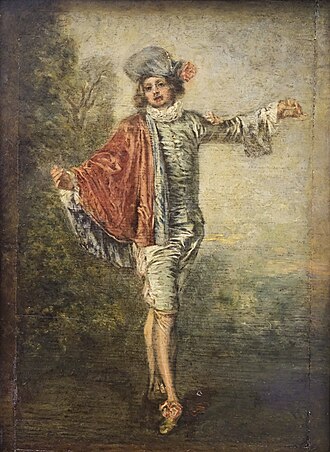 無関心 - Jean-Antoine Watteau (1710s)
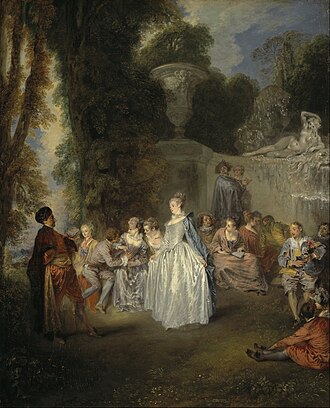 ヴェネツィアの祝宴 - Jean-Antoine Watteau (1719)
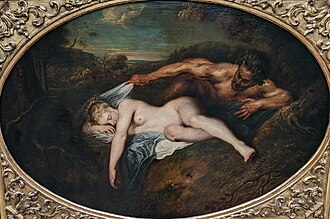 ユピテルとアンティオペ - Jean-Antoine Watteau (1716)
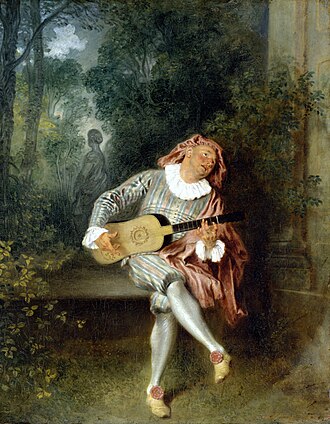 メズタン - Jean-Antoine Watteau (1717)
%20-%20Google%20Art%20Project.jpg) 調和 - Jean-Antoine Watteau (1715)
調和 - Jean-Antoine Watteau (1715)
 1808年5月3日
.jpg) 裸のマハ
裸のマハ