ウィリアム・ホガース
1697-1764
William Hogarth turned London's streets, taverns and drawing rooms into pictures you read like stories. A painter, engraver and satirist, he gave his name to a whole style: scenes so full of life and moral bite that people still call them Hogarthian.
Origins
William Hogarth was born on 10 November 1697 at Bartholomew Close in the City of London, into a lower middle class family. His father, Richard Hogarth, was a poor Latin school teacher and textbook writer, and his mother was Anne Gibbons. As a youth he was apprenticed to the engraver Ellis Gamble in Leicester Fields, where he learned to engrave trade cards, though he never completed the apprenticeship. He loved the street life and fairs of London and sketched the characters he saw. Around the same time his father, who had opened an unsuccessful Latin speaking coffee house, was imprisoned for debt in the Fleet Prison for five years. Hogarth never spoke of it, but the episode is thought to have given his work its hard edge.
Life and turning points
In 1720 Hogarth enrolled at the St Martin's Lane Academy and later at a drawing school in Covent Garden run by Sir James Thornhill. By April 1720 he was an engraver in his own right, making coats of arms, shop bills and plates for booksellers. Around 1728 to 1732 he painted small conversation pieces, group portraits in oil. In 1729 he eloped with Thornhill's daughter Jane, against her father's wishes. The breakthrough came in 1731 with A Harlot's Progress, a series of six scenes that was an immediate success, followed by A Rake's Progress. Pirated copies led him to lobby Parliament, and the Engravers' Copyright Act of 1735, known as Hogarth's Act, became the first copyright law to recognise an individual artist's rights. In 1757 he was appointed Serjeant Painter to the King.
Style and technique
Hogarth called his great idea painting and engraving modern moral subjects, treating them as a dramatic writer would: his picture was his stage. He drew on the moralising tradition of Dutch genre painting and the vigorous satire of English popular prints. His works range from realistic portraiture to comic strip like series such as Marriage A-la-Mode, painted in 1743 to 1745 and regarded by many as his finest project. He was also a fine portraitist; his full length portrait of Captain Coram and the unfinished sketch The Shrimp Girl are counted among the masterpieces of British painting. In 1753 he published The Analysis of Beauty, which sets out his idea of the serpentine Line of Beauty.
Stories and anecdotes
Hogarth's marriage began as an elopement, and Jane's mother helped win her father over by placing some of the Harlot's Progress paintings where Sir James would see them. On learning who the artist was, he is reported to have said that a man who could produce such pictures could also keep a wife without a dowry, and he soon relented. In 1745 Hogarth painted himself with his pug dog, Trump, beside volumes of Shakespeare, Milton and Swift. After a trip to France he painted The Gate of Calais and claimed to have included himself sketching the gate, with a soldier's hand on his shoulder. The couple had no children of their own but fostered foundling children, and he was a founding Governor of the Foundling Hospital.
Legacy
Hogarth died on 26 October 1764 at his home in Leicester Fields and was buried at St Nicholas Church, Chiswick, with an epitaph by his friend David Garrick. His country retreat in Chiswick is preserved today as Hogarth's House. In his lifetime his prints were widely popular and mass produced, and he was by far the most significant English artist of his generation. His prints spread across Europe and shaped book illustration in Germany and France, and he influenced generations of caricaturists. Charles Lamb said of his work that other pictures we look at, but his pictures we read. That is still the joy of standing before one: every corner holds another character, another small story.
豆知識
- Joshua Reynolds was sharply critical of Hogarth's attempts at grand history painting.
- The original paintings of A Harlot's Progress were destroyed in a fire at Fonthill House in 1755.
- His Beer Street and Gin Lane prints of 1751 supported the Gin Act of that year.
- On the day before his death he was still retouching his print The Bench.
ウィリアム・ホガースの作品
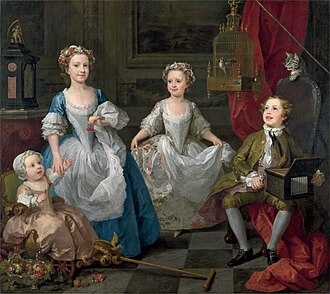 グレイアム家の子供たち - William Hogarth (1742)
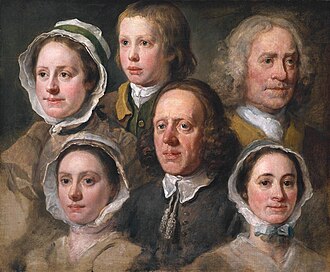 Hogarth's Servants - William Hogarth (1750s)
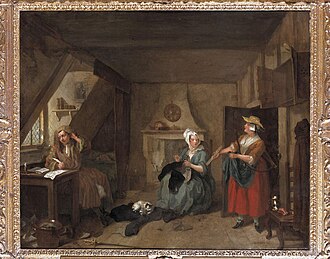 The Distrest Poet - William Hogarth (1730s)
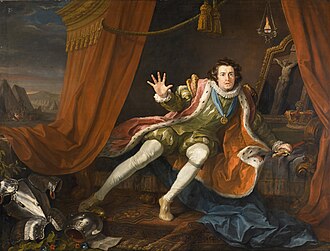 リチャード3世に扮したデイヴィッド・ギャリック - William Hogarth (1745)
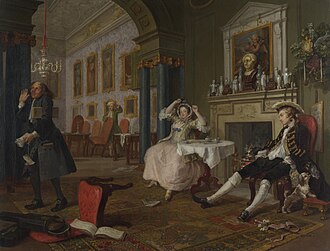 Marriage A-la-Mode: 2. The Tête à Tête - William Hogarth (1743)
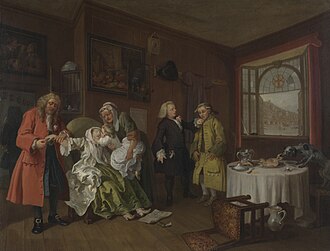 Marriage A-la-Mode: 6. The Lady's Death - William Hogarth (1743)
The Lady's Last Stake - William Hogarth (1759)
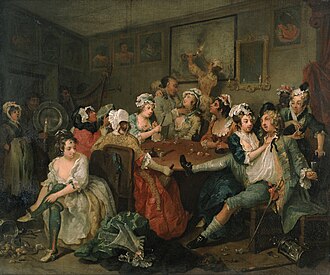 The Orgy - William Hogarth (1735)
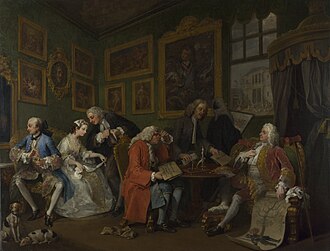 Marriage A-la-Mode: 1. The Marriage Settlement - William Hogarth (1743)
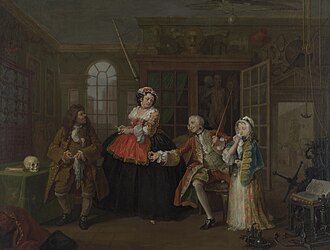 Marriage A-la-Mode: 3. The Inspection - William Hogarth (1743)