The Town Fair by the Church of Saint-Jacques in Dieppe, Morning, Sunlight
Camille Pissarro · 1901
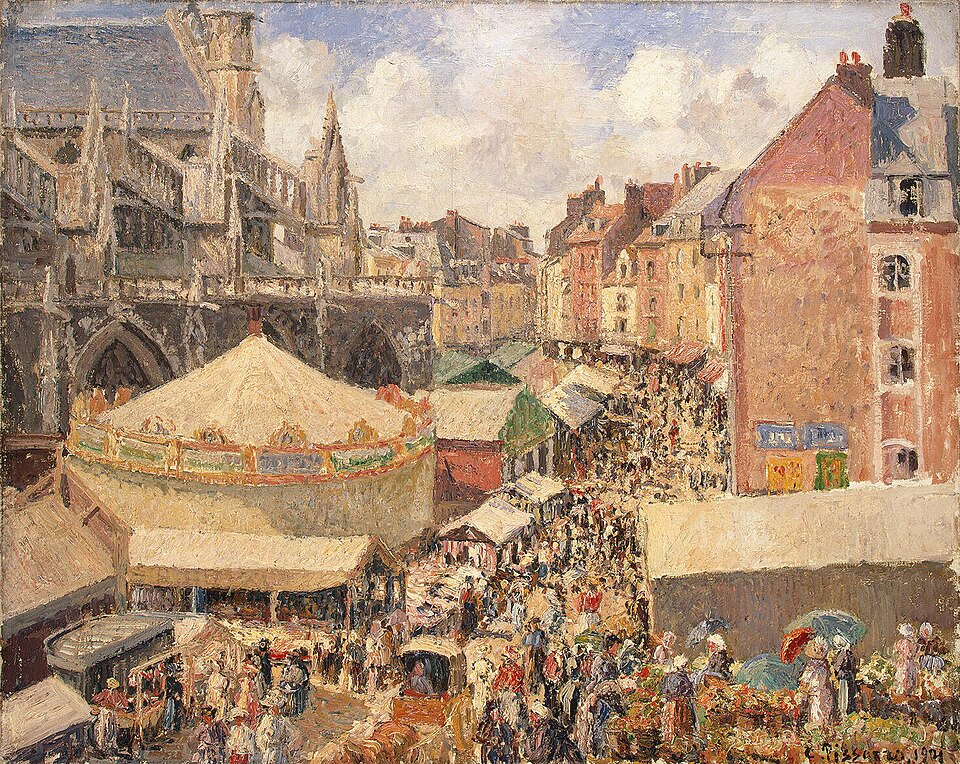
A crowded market square in Dieppe, a circus tent before the portal of Saint-Jacques, painted from a hotel window in 1901. Hidden after the war in a Soviet museum, this canvas was not shown to the public until 1995.
The story behind the painting
On 19 July 1901 Pissarro wrote from Éragny to his son Lucien that he was leaving for Dieppe and would stay at the Hôtel du Commerce, place Duquesne, with a window facing the left side of the market, the church portal, towers and picturesque houses. On 26 July he wrote that he had settled in a small hotel room facing Saint-Jacques and the market, had already begun several canvases in the rain, and had decided to paint the rain, to the dismay of the local traders. The picture was painted in late summer and early autumn 1901. In all he made nine canvases of the subject, each differing strongly in viewpoint and angle.
What to look for
On the left in the background stands the portal of the church of Saint-Jacques. In front of it are a circus tent and many lanes of covered stalls. On the right and in the centre, houses close off the market space, and a dense crowd presses around the square. This Hermitage canvas is listed as the fourth of the series and is close to the third: the same angle, and the square shown at the height of the trading day. Unlike the cloudy third canvas, this one is in morning sunlight, as its title says. Notice how many people Pissarro fits into the scene, each a small touch of colour within the larger movement.
Meaning and intent
The whole Dieppe series is thought to have been painted under the influence of Monet's Rouen Cathedrals, shown in spring 1895, which Pissarro called a breathtaking spectacle, admiring their extraordinary skill. But the source puts the difference plainly: Monet's variations exclude people, while Pissarro's are full of figures. Here the church is not alone with the light; it shares the square with the life of a market day. Lionello Venturi, who compiled the first catalogue raisonné of Pissarro's paintings in 1939, called it a masterpiece of pictorial energy, where church, houses, stalls and crowd make one complete movement toward a grand, unified effect.
Legacy
The gallery Bernheim-Jeune bought the painting in November 1901. It passed to Léon Moreau, then in 1925 to Durand-Ruel's heirs, and in 1928 to a Berlin gallery, which sold it to the collector Otto Krebs of Weimar. After Krebs died in 1941, his collection was hidden in a vault under an outbuilding of his Holzdorf estate. In 1945 Soviet troops occupied Holzdorf, trophy teams found the collection, and in 1949 it went to the Hermitage, where it stayed unknown even to most researchers; in the West it was believed lost. It was first shown in 1995 and has been on permanent display since 2001, in room 411 of the General Staff Building since 2014.
Lo sapevi?
- One of nine canvases Pissarro painted of the Dieppe market in 1901.
- Painted from his room at the Hôtel du Commerce.
- Taken from the Krebs collection in 1945 and sent to the Hermitage in 1949.
- First shown to the public in 1995.
L'artista
Camille Pissarro (1830-1903)
Hermitage Museum · cityscape · church building
Altre opere di Camille Pissarro
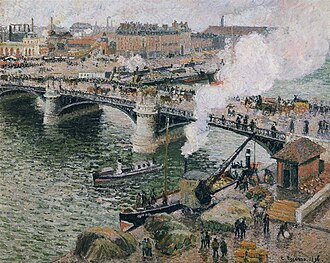 Pont Boieldieu in Rouen, Rainy Weather - Camille Pissarro (1896)
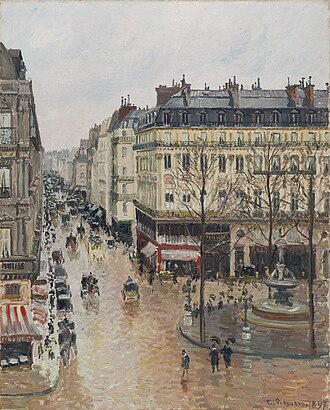 Rue Saint-Honoré in the Afternoon. Effect of Rain - Camille Pissarro (1897)
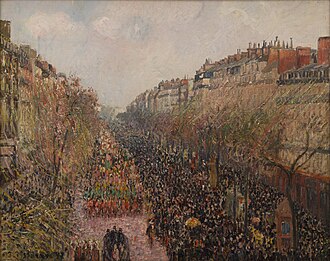 Boulevard Montmartre, Mardi Gras - Camille Pissarro (1897)
 The Côte des Bœufs, Pontoise - Camille Pissarro (1877)
 The House of the Deaf Woman and the Belfry at Eragny - Camille Pissarro (1886)
 Place du Theatre-Francais in Spring - Camille Pissarro (1898)
 The Boulevard Montmartre on a Winter Morning - Camille Pissarro (1897)
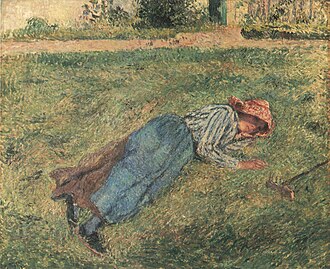 The Nap, Peasant Woman Lying in the Grass, Pontoise - Camille Pissarro (1882)
Dipinti di artisti collegati
 Impression, Sunrise - Claude Monet (1872)
 Water Lilies - Claude Monet (1906)
 Luncheon on the Grass - Édouard Manet (1863)
 Olympia - Édouard Manet (1863)
 Dance at Le Moulin de la Galette - Pierre-Auguste Renoir (1876)
 Luncheon of the Boating Party - Pierre-Auguste Renoir (1881)
 The Cradle - Berthe Morisot (1872)
 Summer's Day - Berthe Morisot (1879)
 L'Absinthe - Edgar Degas (1875)
 The Bellelli Family - Edgar Degas (1858)
 The Canal du Loing at Moret - Alfred Sisley (1892)
 The Watering Pond at Marly with Hoarfrost - Alfred Sisley (1876)