The Pork Butcher
Camille Pissarro · 1883
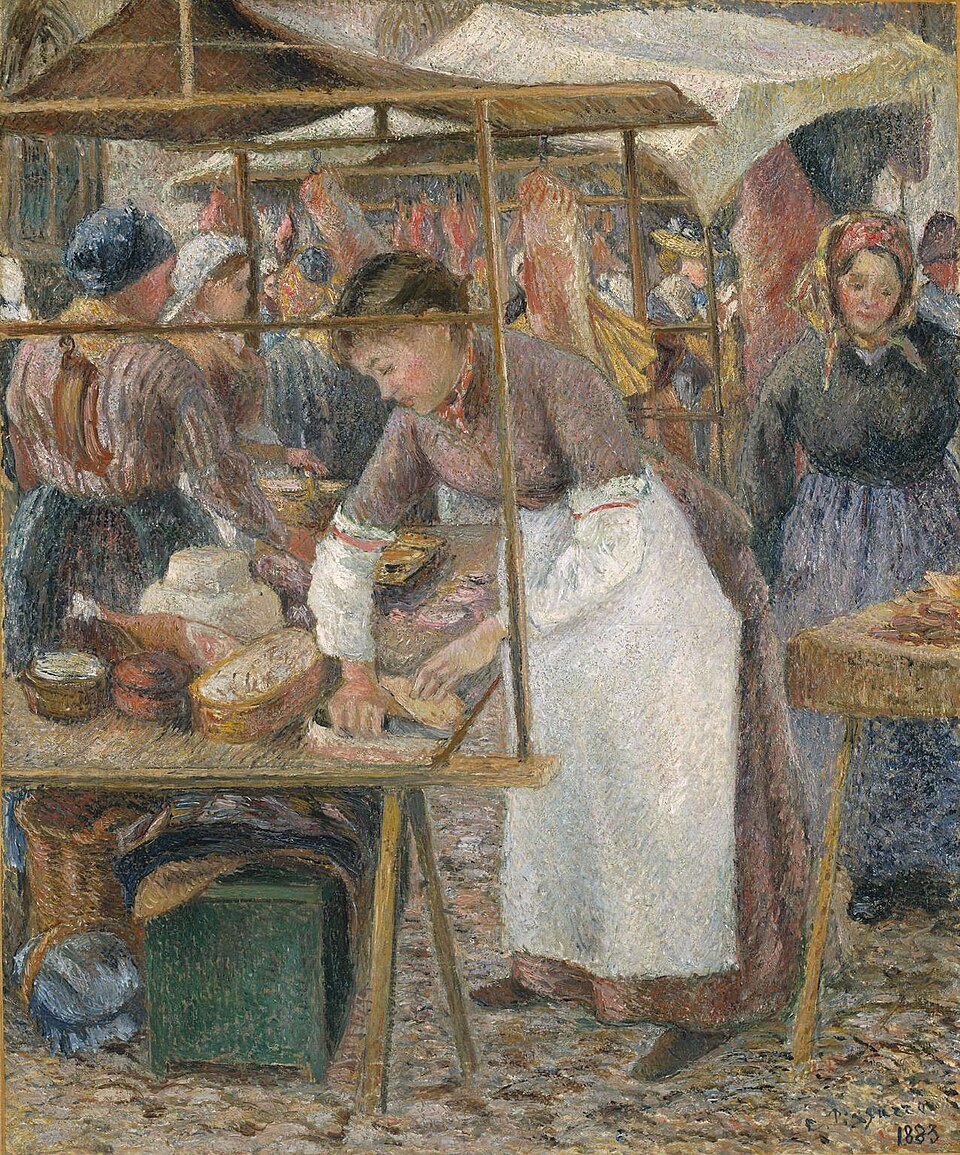
In a crowded weekly market a young woman in a white apron leans over her stall, cutting meat. Pissarro reworked the picture so thoroughly that X-rays show an older woman underneath, replaced by his own niece.
The story behind the painting
From 1881 Pissarro, living in Pontoise, was drawn to rural market scenes, and the interest continued after he moved to Osny at the end of 1882. In February 1883 he wrote to his son Lucien that he was stuck where he was, working as hard as he could on landscapes he had begun and on his market painting, which he had completely altered. X-ray studies confirm this. The figure at the right edge was first shown in profile, leaning left, and the main figure had the features of an older peasant woman. Pissarro replaced her face with that of his niece Eugénie Estruc, called Nini.
What to look for
At the centre a young woman with her hair tied back stands under the roof of her stall, seen from the side, bending forward to the left. With a knife in her right hand she cuts meat on a board on her table, where other goods are laid out for sale; crates and baskets sit beneath. Her clothes are in browns and reds, with a large white apron and white sleeve protectors. That apron is the calm centre among all the busy forms. On the right a woman in a headscarf faces us, looking at a stall only half in view, and behind them the market crowds with more stalls and people. The picture is signed lower right C. Pissarro 1883.
Meaning and intent
Around 30 July 1883 Pissarro wrote to Lucien that Nini was back in Osny and that he was making drawings of her to prepare a market painting. Unlike his other works, this picture was not observed as a whole but assembled from separate parts. The result is a market where the figures stand out gently from the background yet stay closely tied to their surroundings. Ordinary work, cutting and selling meat, becomes the quiet heart of the scene, while the life of the market moves around it.
Legacy
The painting stayed with Pissarro's son Lucien, who bequeathed it to the National Gallery in London in 1944. In 1950 it moved to the Tate Gallery, which lent it back to the National Gallery in 1997; the Tate inventory number is NO5576. It has been shown many times, from a London exhibition in 1912 and the 1930 centenary show at the Musée de l'Orangerie in Paris to the touring 1980 to 1981 retrospective in London, Paris and Boston, and in 2025 at the Museum Barberini in Potsdam.
Lo sapevi?
- Signed and dated 1883.
- X-rays show the main figure once had an older woman's face.
- Modelled on Pissarro's niece Eugénie Estruc.
- Bequeathed by Lucien Pissarro to the National Gallery, London, in 1944.
L'artista
Camille Pissarro (1830-1903)
genre art · National Gallery · Tate
Altre opere di Camille Pissarro
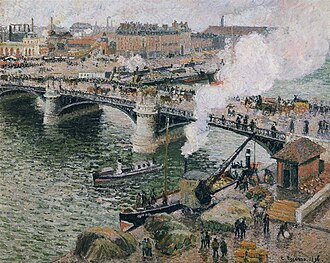 Pont Boieldieu in Rouen, Rainy Weather - Camille Pissarro (1896)
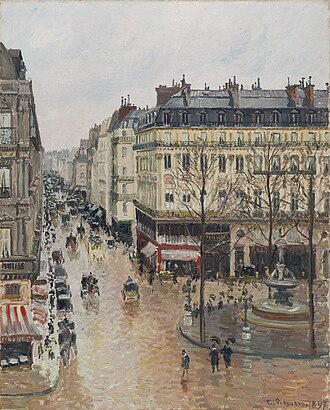 Rue Saint-Honoré in the Afternoon. Effect of Rain - Camille Pissarro (1897)
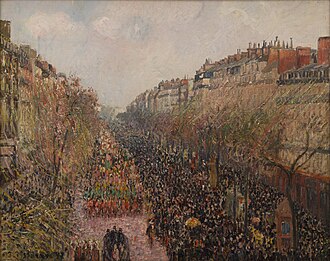 Boulevard Montmartre, Mardi Gras - Camille Pissarro (1897)
 The Côte des Bœufs, Pontoise - Camille Pissarro (1877)
 The House of the Deaf Woman and the Belfry at Eragny - Camille Pissarro (1886)
 Place du Theatre-Francais in Spring - Camille Pissarro (1898)
 The Boulevard Montmartre on a Winter Morning - Camille Pissarro (1897)
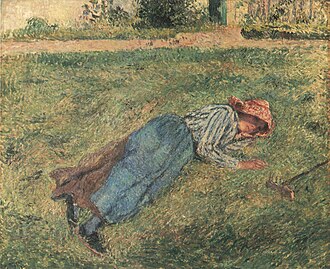 The Nap, Peasant Woman Lying in the Grass, Pontoise - Camille Pissarro (1882)
Dipinti di artisti collegati
 Impression, Sunrise - Claude Monet (1872)
 Water Lilies - Claude Monet (1906)
 Luncheon on the Grass - Édouard Manet (1863)
 Olympia - Édouard Manet (1863)
 Dance at Le Moulin de la Galette - Pierre-Auguste Renoir (1876)
 Luncheon of the Boating Party - Pierre-Auguste Renoir (1881)
 The Cradle - Berthe Morisot (1872)
 Summer's Day - Berthe Morisot (1879)
 L'Absinthe - Edgar Degas (1875)
 The Bellelli Family - Edgar Degas (1858)
 The Canal du Loing at Moret - Alfred Sisley (1892)
 The Watering Pond at Marly with Hoarfrost - Alfred Sisley (1876)