The Drawing Lesson
Jan Steen · 1665
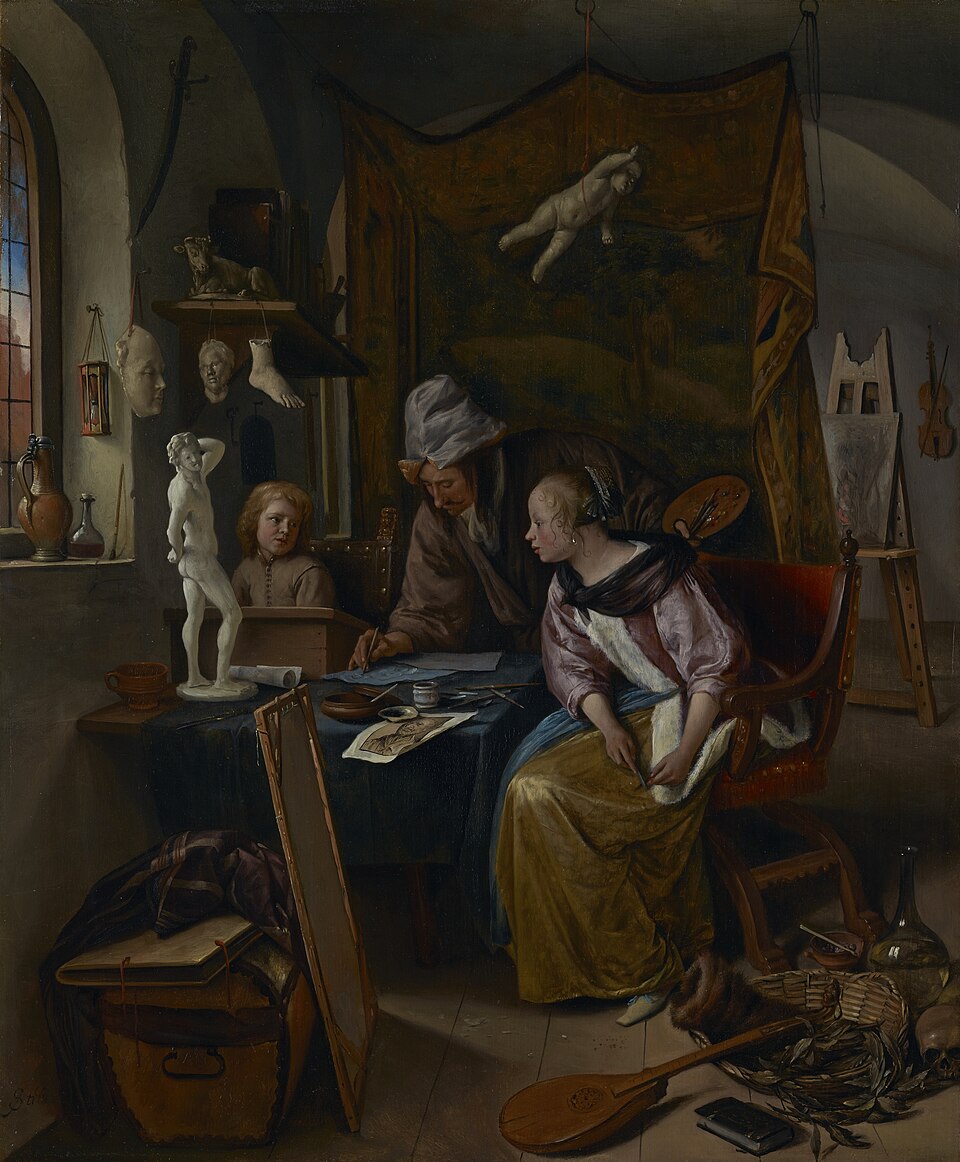
A painter, palette still in hand, leans over to correct a young woman's drawing while a boy watches. Jan Steen, famous for noisy households, painted here a calm, serious tribute to the art of painting itself.
The story behind the painting
Jan Steen, the Dutch Golden Age painter better known for lively and chaotic scenes, made The Drawing Lesson around 1665. It is an oil painting on a wooden panel, about 49 by 41 cm, signed at lower left with his monogram. The work shows an artist giving a drawing lesson to two pupils, a boy and a young woman. The source notes that its style is more serious and careful than in Steen's other works, and explains this by its purpose: it was conceived as a celebration of painting as an art, not as a comic everyday scene.
What to look for
The model for the lesson seems to be a plaster male nude, a copy of the Saint Sebastian by the Italian sculptor Alessandro Vittoria. A plaster putto hangs from the ceiling, in the style of Flemish sculptors such as Francois Duquesnoy or Artus Quellinus, and plaster body parts sit on a shelf with a sculpted bull. On the table are brushes, chalks and a print of an old man's head after Jan Lievens. The teacher holds a palette, as if he stopped painting to correct the drawing. He wears a silk robe like a kimono, then fashionable in Holland, and the young woman is dressed in satin and ermine. In the lower right lie vanitas objects: a skull, a laurel wreath, wine and a lute or cittern.
Meaning and intent
The picture can be read as an allegory of painting. The violin stands for artistic inspiration, the plaster limbs for the perfect human model painters should follow, the laurel and the skull for the contrast between short life and lasting art, and the bull may be the symbol of Saint Luke, patron of painters. The picture on the easel, perhaps the Good Samaritan, suggests a history painter at the top of his profession. The boy is an apprentice, who would start training around age ten by copying drawings, then plaster models. The critic Leo Steinberg saw an erotic subtext, with the boy watching the girl and the girl watching the nude, but not all specialists accept this reading.
Legacy
The allegorical objects sit at the edges, while the centre holds a realistic picture of how art was taught and practised in the seventeenth century, which makes the panel a rare window into a Dutch studio. The pose of the pupils, especially the boy, recalls The Letter by Gerard ter Borch. Over the centuries the panel belonged to Marc-Rene de Voyer d'Argenson, the Duke of La Valliere, the dealer Martin H. Colnaghi, the collector August de Ridder and others, before the J. Paul Getty Museum in Los Angeles acquired it in 1983. It remains there today.
Lo sapevi?
- Painted around 1665 on a wooden panel.
- Shows a painter teaching a boy and a young woman.
- Read as an allegory of the art of painting.
- In the J. Paul Getty Museum since 1983.
L'artista
Jan Steen (1626-1679)
woman · man · genre art · boy · J. Paul Getty Museum · teacher
Altre opere di Jan Steen
 The Feast of Saint Nicholas - Jan Steen (1660s)
 Girl eating oysters - Jan Steen (1658)
 A Mayor of Delft and his Daughter - Jan Steen (1655)
 Beware of Luxury - Jan Steen (1663)
 'As the Old Sing, So Pipe the Young' - Jan Steen (1665)
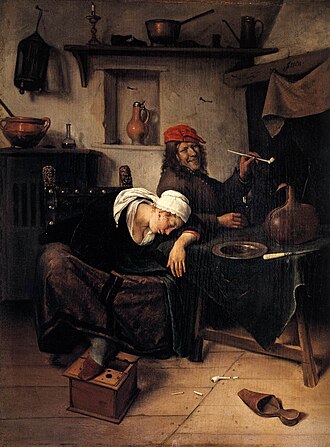 Idlers - Jan Steen (1660s)
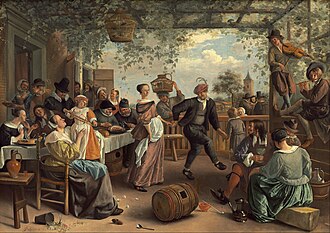 The Dancing Couple - Jan Steen (1663)
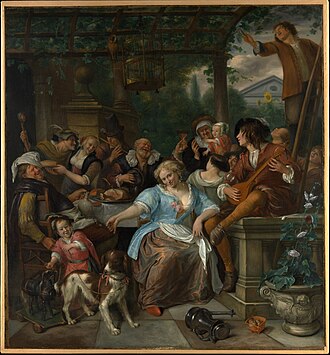 Merry Company on a Terrace - Jan Steen (1670)
Dipinti di artisti collegati
 The Night Watch - Rembrandt van Rijn (1642)
 Self-Portrait - Rembrandt van Rijn (1659)
 Girl with a Pearl Earring - Johannes Vermeer (1665)
 The Milkmaid - Johannes Vermeer (c. 1658)
 A Militiaman Holding a Berkemeyer, Known as the ‘Merry Drinker’ - Frans Hals (1620s)
 Laughing Cavalier - Frans Hals (1624)
 The Windmill at Wijk bij Duurstede - Jacob van Ruisdael (1670)
 The Jewish Cemetery - Jacob van Ruisdael (1650s)
 The Courtyard of a House in Delft - Pieter de Hooch (1658)
 A Woman Peeling Apples - Pieter de Hooch (1663)