Portrait of a man holding a skull
Frans Hals · 1610s
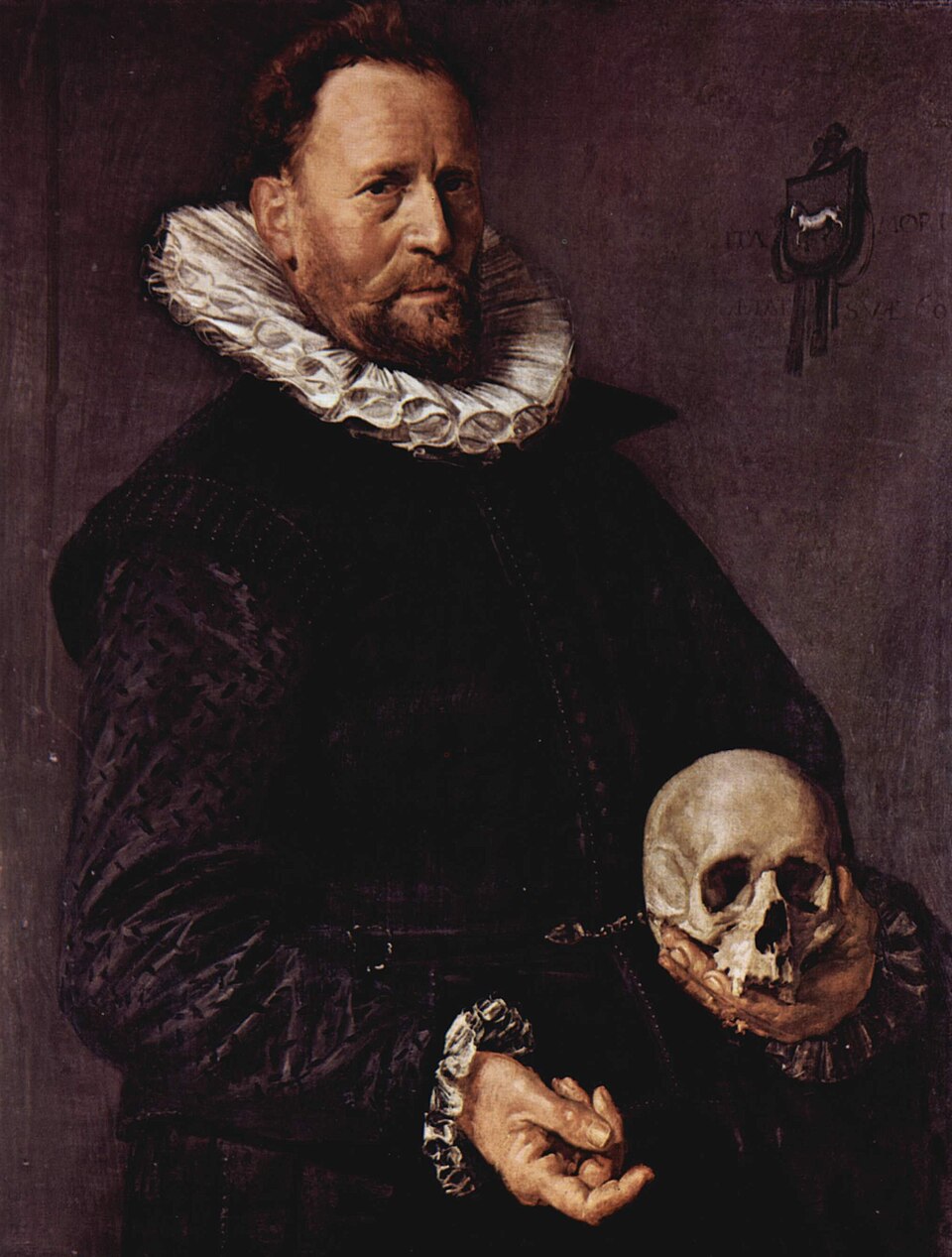
A sixty-year-old man looks straight at us and holds a skull in his hand. It is one of the very earliest paintings we know by Frans Hals, and its partner, a portrait of his wife, hangs in another country, cut from the same oak tree.
The story behind the painting
Frans Hals probably painted this early work in Haarlem around 1610 to 1614, though authoritative writers differ slightly; Claus Grimm dates it a little later, to 1617 or 1618. Hals had been admitted to the Haarlem Guild of Saint Luke only in 1610, in his late twenties. The sitter has not been identified, and no record of the portrait survives from Hals's time. A Latin note beside a small banner in the upper right gives his age as 60. The painting is generally agreed to be one of a pair of marriage portraits; his wife's portrait hangs at Chatsworth House.
What to look for
The man is shown three-quarter length, turned to the right while looking straight at us, stern but engaging. In his left hand he holds a skull; with his right he gestures toward it, and perhaps toward the heavy gold chain his wife wears in her portrait. Light falls from the left onto his face, his hand and the skull. Hals uses a nearly monochrome dark palette: a black doublet with damask sleeves, small jet or glass beads, a plain starched ruff. The small banner seems to show a white horse like the Saxon Steed of the Twente region.
Meaning and intent
The skull is a memento mori, a reminder that everyone must die, and the text beside the banner adds a dour Latin warning, ita mori, this is what becomes of us. Hung beside his wife's portrait, the skull too would seem to be looking at us. Black dress was fashionable among Dutch merchants, professionals and magistrates, evoking seriousness and sobriety, and Hals would become famous for handling it. Vincent van Gogh later wrote to his brother Theo that Frans Hals must have twenty-seven shades of black.
Legacy
The oil on panel measures about 94 by 73 cm and is made from a single, unusually broad oak plank. Its grain mirrors the panel of the Portrait of a Woman Standing at Chatsworth: husband and wife were painted on bookmatched panels from the same part of the same tree. The back was cradled, probably in the nineteenth or early twentieth century. In 2023 Larry Keith cleaned and conserved both portraits at the National Gallery in London for its Frans Hals exhibition. The painting belongs to the Barber Institute of Fine Arts in Birmingham.
Lo sapevi?
- One of Frans Hals's earliest known works, about 1610 to 1614.
- The sitter was 60; his identity is unknown.
- Pendant to the Portrait of a Woman Standing at Chatsworth, on panels from the same oak.
- In the Barber Institute of Fine Arts, Birmingham.
L'artista
Frans Hals (1591-1666)
portrait · man · Dutch Golden Age painting · standing · beard · human skull · ruff · Barber Institute of Fine Arts · doublet · handlebar moustache
Altre opere di Frans Hals
 A Militiaman Holding a Berkemeyer, Known as the ‘Merry Drinker’ - Frans Hals (1620s)
 Laughing Cavalier - Frans Hals (1624)
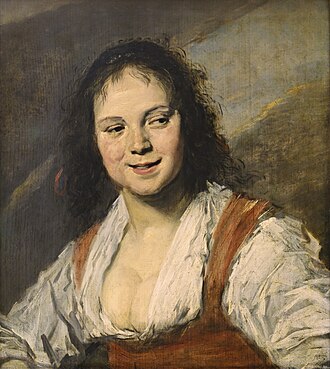 Gipsy Girl - Frans Hals (1628)
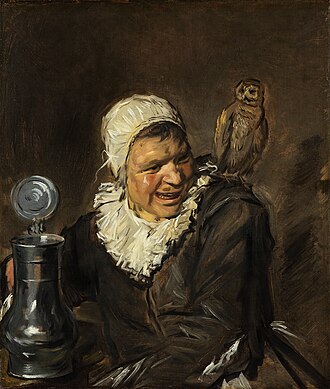 Malle Babbe - Frans Hals (1640s)
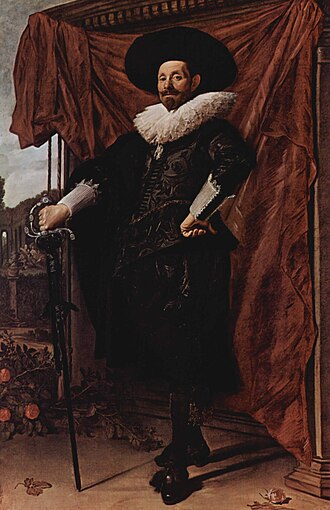 Willem van Heythuysen posing with a sword - Frans Hals (1625)
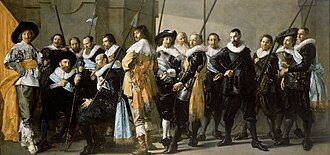 Militia Company of District XI under the Command of Captain Reynier Reael - Frans Hals (1630s)
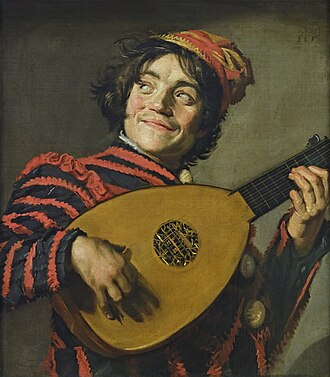 Jester with lute - Frans Hals (1623)
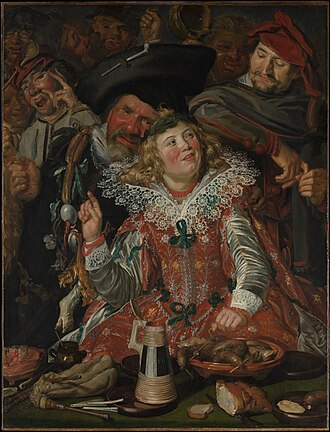 Merrymakers at Shrovetide - Frans Hals (1610s)
Dipinti di artisti collegati
 The Night Watch - Rembrandt van Rijn (1642)
 Self-Portrait - Rembrandt van Rijn (1659)
 Girl with a Pearl Earring - Johannes Vermeer (1665)
 The Milkmaid - Johannes Vermeer (c. 1658)
 The Feast of Saint Nicholas - Jan Steen (1660s)
 Girl eating oysters - Jan Steen (1658)
 The Windmill at Wijk bij Duurstede - Jacob van Ruisdael (1670)
 The Jewish Cemetery - Jacob van Ruisdael (1650s)
 The Courtyard of a House in Delft - Pieter de Hooch (1658)
 A Woman Peeling Apples - Pieter de Hooch (1663)