Madonna and Child
Raphael · 1504
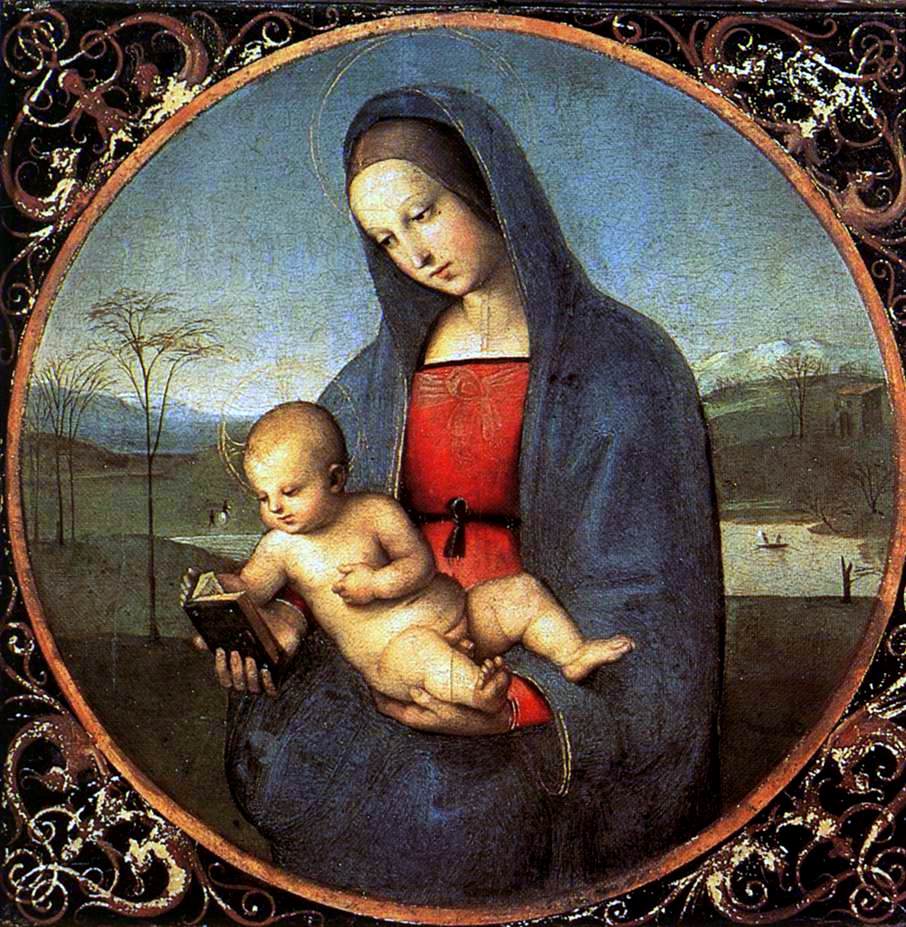
Barely 18 cm across, this is one of the smallest paintings Raphael made. Mary and her child bend over a book together, while snowy mountains fade in the distance behind them.
The story behind the painting
Known as the Conestabile Madonna, after a family who once owned it, this tondo is usually dated around 1504. Its exact date is unknown: it was first thought to be from about 1500 to 1502, and recent estimates suggest 1504. Its patron is uncertain too. Some scholars think Alfano di Diamante, a merchant banker who led the Alfani family of Perugia, commissioned it, while other sources find no record of any patron. The Alfani family owned it around 1600, perhaps through Domenico Alfani, who worked with Raphael in Perugia.
What to look for
Mary holds the child and a book, and both are reading, the child gazing at the page intently. Hugo Chapman suggests it is a Bible or a breviary. Behind them a gentle landscape rolls back to snowy mountains, with a river or lake at mid level, a few bare trees and four tiny figures. The muted, natural tones set off the blue and red of Mary's clothes. Raphael began it as a square and turned it into a circle by painting the corners, and he does not show the full length of her robes. It measures only 17.5 by 18 cm.
Meaning and intent
A change of mind lies under the paint. When the work was moved from wood to canvas, an underdrawing showed that Mary first held an apple or a pomegranate, not a book. That earlier idea closely resembles a drawing by Berto di Giovanni, The Virgin and Child with a Pomegranate, now in Berlin, and Raphael's drawing looks more hesitant, suggesting it came first. Raphael returned to the idea in a drawing in Vienna that combines both a pomegranate and a book. The calm Perugian landscape behind the figures reflects a setting seen in many of his early paintings.
Legacy
The ornate square frame was long thought to be part of Raphael's design. Jürg Meyer zur Capellen notes it is made of many pieces, has been restored several times, and has a filled hole in the lower frieze, perhaps for a candle holder. Its mismatched parts suggest it was made independently. After the Alfani, the Conestabile della Staffa family owned the painting in Perugia. Around 1868 the National Gallery in London showed strong interest, but Tsar Alexander II acquired it in 1871, the same year it was transferred to canvas. It passed to the Hermitage in Saint Petersburg in 1880.
Lo sapevi?
- Known as the Conestabile Madonna; about 17.5 x 18 cm.
- An underdrawing shows Mary first held an apple or pomegranate.
- Transferred from wood to canvas in 1871.
- In the Hermitage, Saint Petersburg, since 1880.
L'artista
Raphael (1483-1520)
religious art · woman · Mary · Christ Child · High Renaissance · boy · mother · Hermitage Museum
Altre opere di Raphael
 Sistine Madonna - Raphael (1510s)
 La fornarina - Raphael
 Madonna of the Goldfinch - Raphael (1500s)
 The Marriage of the Virgin - Raphael (1504)
 La velata - Raphael (1510s)
 Three Graces - Raphael (1504)
 Alba Madonna - Raphael (1510)
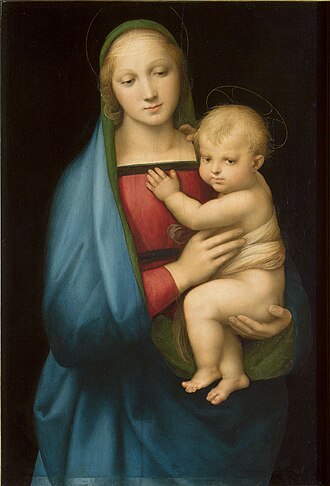 Madonna del Granduca - Raphael (1500s)
Dipinti di artisti collegati
 Venus of Urbino - Titian (1538)
 Assumption of the Virgin - Titian (1510s)
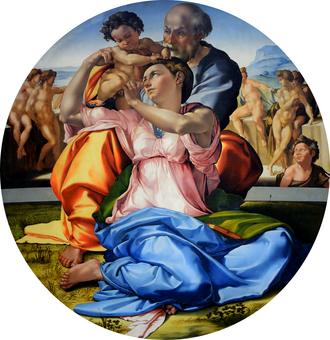 Doni Tondo - Michelangelo (1500s)
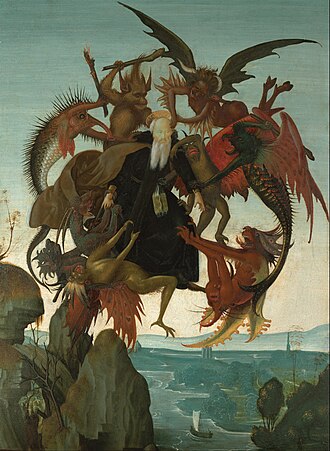 The Torment of Saint Anthony - Michelangelo (1487)
 Mona Lisa - Leonardo da Vinci (1503-1519)
 Lady with an Ermine - Leonardo da Vinci (1490)
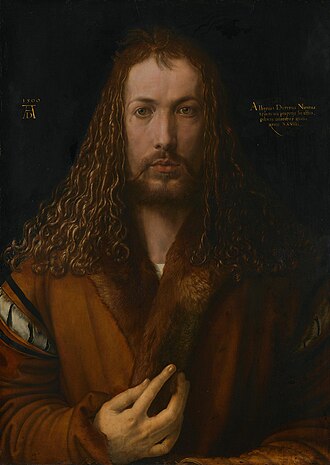 Self-Portrait with Fur-Trimmed Robe - Albrecht Dürer (1500)
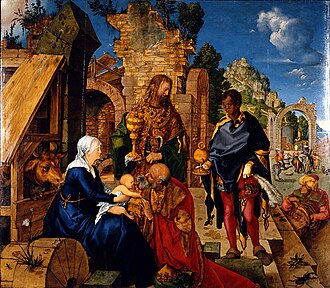 Adoration of the Magi - Albrecht Dürer (1504)
 The Birth of Venus - Sandro Botticelli (c. 1485)
 Primavera - Sandro Botticelli (1480s)
 The Garden of Earthly Delights - Hieronymus Bosch
 Ship of Fools - Hieronymus Bosch (1500s)