La neige à Louveciennes
Alfred Sisley · 1875
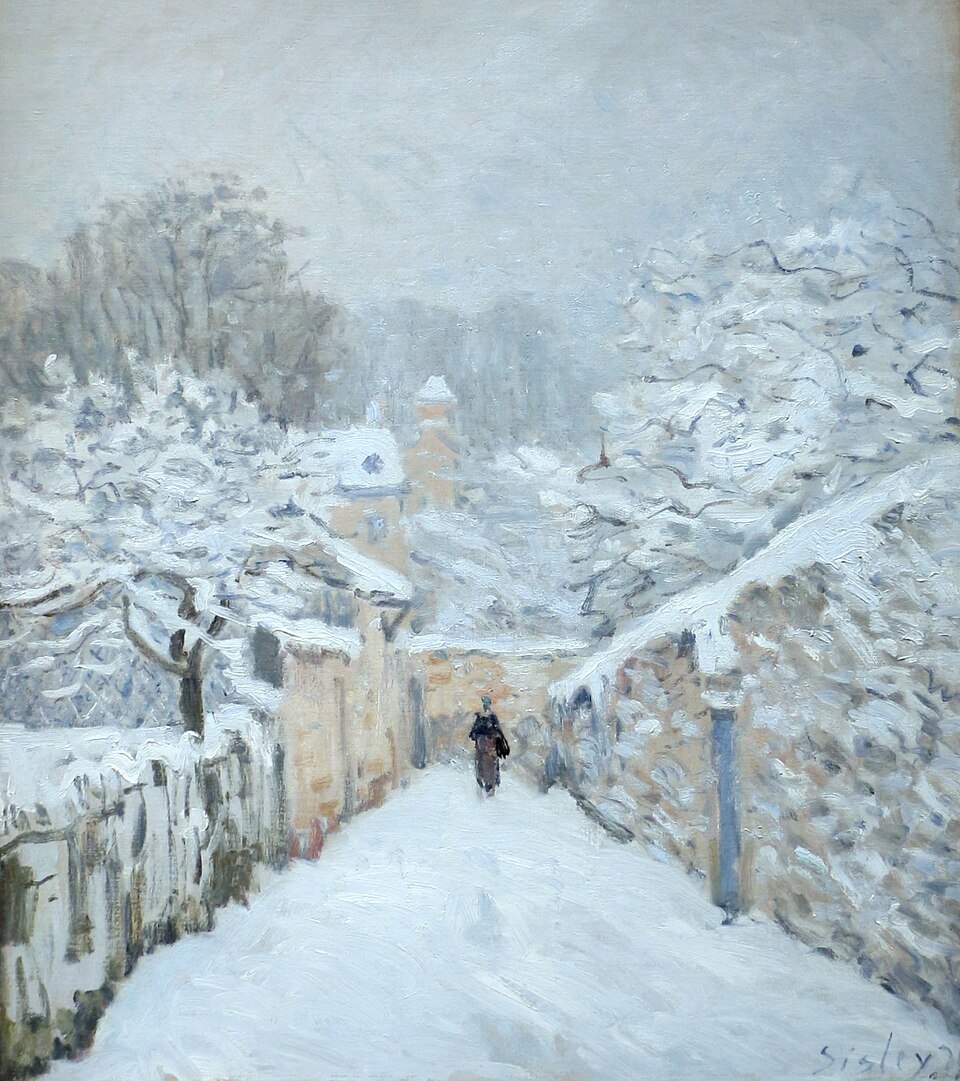
A narrow lane climbs between snowy walls, the sky hangs grey and heavy, and far ahead a woman walks away with a basket on her arm. Sisley made silence visible in this small winter scene at Louveciennes.
The story behind the painting
The subject is the chemin de l'Étarché, a narrow lane leading off the rue de La Princesse in Louveciennes, where Sisley lived from 1872 to 1874 before moving to Marly in 1875. The picture was long dated 1878, when Sisley had already left Louveciennes; a recent reassessment dates it 1875, his great period of snow scenes, and Wikidata also gives 1875. He painted the same lane from his house in A Garden at Louveciennes (1873) and in The Chemin de l'Étarché under Snow (1874), and from the other end for this canvas and Corner of the Village of Voisins, so the four can be seen as a series. It measures 61 by 50.5 cm.
What to look for
The catalogue of its first owner, Count Armand Doria, describes it: a rising lane, cold silent snow on the ground, on the hedge to the left, on the wall to the right, on the trees and on the roofs glimpsed between branches, a grey sky padded with sadness, and on the path a peasant woman walking away with a basket. Notice the two walls: the right one high and massive, the left one lower and broken, opening toward the first houses of the village. The palette is almost monochrome, blue-greys against ochre and white. Only the walls, tinted with a faint ochre, warm the cold harmony of a winter day.
Meaning and intent
Despite his love of open air, Sisley shows what critics called a classical sensibility. He places the only figure on the central vertical axis and aligns the top of the right wall with the base of the left. The viewpoint is unusually low, so that, as Giorgio Cricco and Francesco Di Teodoro explain, sky and landscape, the true protagonists, spread across most of the surface. The sky matters most. In 1892 Sisley wrote to Adolphe Tavernier that the sky cannot be only a background, and that he always began a canvas with the sky. The small distant woman, hurrying home, seems to yield to a nature that dominates her.
Legacy
The painting belonged to Count Doria from 1877, then to the playwright Georges Feydeau, then to Count Isaac de Camondo, who bequeathed it to the French state in 1908. It entered the Louvre, later the Jeu de Paume, and since 1986 the Musée d'Orsay. David Schiff suggested it may have inspired the title of Debussy's piano piece Des pas sur la neige of 1909 to 1910. The poet Jean-Michel Maulpoix evoked it in 2004, seeing in it a calm space of life against a world growing ever more hurried, and Elizabeth Kostova described it at the end of her 2010 novel The Swan Thieves.
Lo sapevi?
- Shows the chemin de l'Étarché in Louveciennes.
- Once dated 1878, now dated 1875.
- Bequeathed to the French state by Isaac de Camondo in 1908.
- May have inspired the title of Debussy's Des pas sur la neige.
L'artista
Alfred Sisley (1839-1899)
landscape painting · Musée d'Orsay · Impressionism · tree · landscape · snow · winter · Louveciennes · path
Altre opere di Alfred Sisley
 The Canal du Loing at Moret - Alfred Sisley (1892)
 The Watering Pond at Marly with Hoarfrost - Alfred Sisley (1876)
 The Aqueduct at Marly - Alfred Sisley (1874)
 La Machine de Marly - Alfred Sisley (1873)
 The Flood at Port Marly - Alfred Sisley (1876)
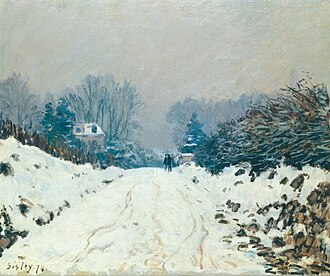 Snow landscape in Louveciennes - Alfred Sisley (1874)
 Les bords du Loing vers Moret - Alfred Sisley (1883)
 The Seine at Bougival - Alfred Sisley (1873)
Dipinti di artisti collegati
 Impression, Sunrise - Claude Monet (1872)
 Water Lilies - Claude Monet (1906)
 Luncheon on the Grass - Édouard Manet (1863)
 Olympia - Édouard Manet (1863)
 Dance at Le Moulin de la Galette - Pierre-Auguste Renoir (1876)
 Luncheon of the Boating Party - Pierre-Auguste Renoir (1881)
 The Cradle - Berthe Morisot (1872)
 Summer's Day - Berthe Morisot (1879)
 L'Absinthe - Edgar Degas (1875)
 The Bellelli Family - Edgar Degas (1858)
 Paris Street; Rainy Day - Gustave Caillebotte (1877)
 Les raboteurs de parquet - Gustave Caillebotte (1875)