Esther, Ahasuerus, and Haman
Jan Steen · 1668
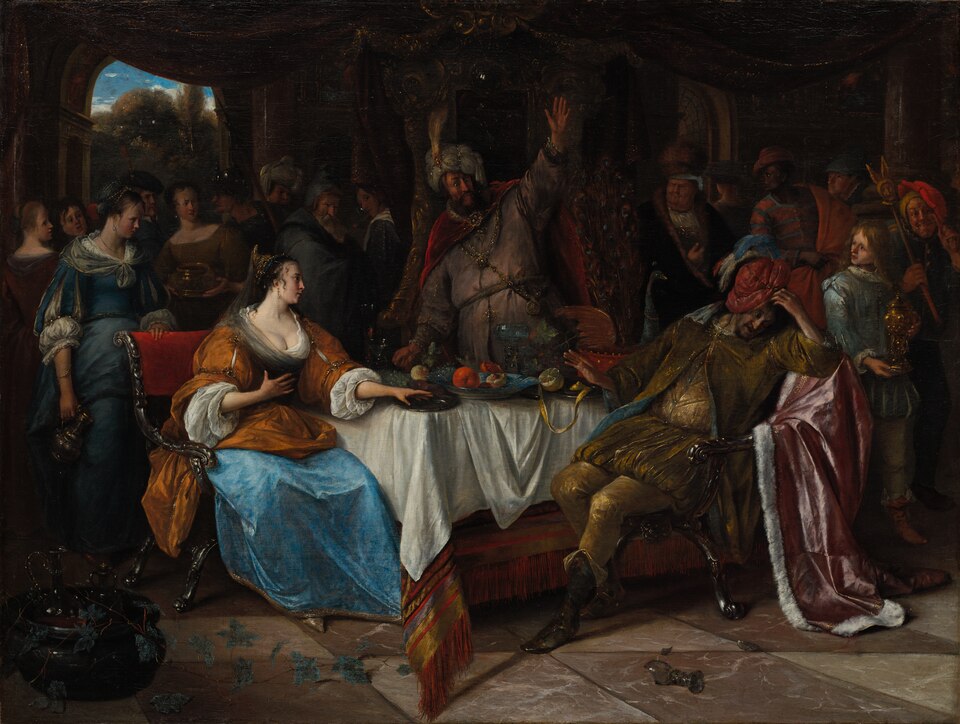
A king leaps up in fury, a glass falls from a minister's hand, and a queen sits calm in the light. Jan Steen staged a Bible banquet like a Dutch play, set among Delft pottery and wine glasses.
The story behind the painting
The scene comes from the Book of Esther. King Ahasuerus marries Esther without knowing she is Jewish. His minister Haman plots to destroy the Jewish people. At the request of her cousin Mordecai, Esther reveals who she is and begs the king to spare her people; Ahasuerus agrees and has Haman executed instead. Steen paints the exact moment at a banquet of the three when the king learns of Haman's plot from Esther's own lips. The painting, around 1668, is now in the Cleveland Museum of Art, and Steen made other pictures of the same subject.
What to look for
Ahasuerus rises in rage while Haman knocks over his glass in surprise. Like a conductor, the king silences the room with one gesture, and every figure freezes in a studied pose. Light falls on the banquet table and on the diamond shape formed by the king, Haman and Esther. The red of Esther's chair and the king's cape marks their royal rank; a young lady in waiting in blue stands out by her clothes and jewels. A white tablecloth and a gold silk carpet set off the figures. Mordecai emerges from the shadow, and an old dignitary seems to resemble Steen himself.
Meaning and intent
Despite the oriental touches, the court of Susa becomes a Dutch interior, with roemer glasses and Delft faience that a 17th century viewer knew. The purple, fur-trimmed cape beside Haman's broken glass speaks of how fragile power is. Steen belonged to the Guild of Saint Luke after it merged with the rederijkers, the amateur theater societies, and his set resembles the stage of Van Campen's theater in Amsterdam, built in 1638. His Esther pictures reflect Johannes Serwouters' play about Esther. For the Dutch, who felt they had fought hard for freedom from Spain, Esther's story was a model of victory over foreign oppression.
Legacy
The figure of the king, in a turban with an aigrette, recalls Rembrandt's drawing of the same three figures, and his shocked face is close to the king in Rembrandt's Belshazzar's Feast. Other possible sources are Jan Lievens' Feast of Esther of about 1625 and Pieter Lastman's Haman begging Esther for mercy of about 1618. Another Steen version, The Wrath of Ahasuerus, is at the Barber Institute of Fine Arts in Birmingham, and a further Esther picture, based on a print by Pieter Quast for an edition of Serwouters' play, is in the Hermitage. Through all of them, Steen keeps a particular simplicity and dignity in Esther and her maids.
Lo sapevi?
- Painted around 1668 by Jan Steen.
- Shows the moment Esther exposes Haman's plot at a banquet.
- The setting echoes the Amsterdam theater of Van Campen.
- Now in the Cleveland Museum of Art.
L'artista
Jan Steen (1626-1679)
religious art · woman · Cleveland Museum of Art · Ahasuerus · Esther
Altre opere di Jan Steen
 The Feast of Saint Nicholas - Jan Steen (1660s)
 Girl eating oysters - Jan Steen (1658)
 A Mayor of Delft and his Daughter - Jan Steen (1655)
 Beware of Luxury - Jan Steen (1663)
 'As the Old Sing, So Pipe the Young' - Jan Steen (1665)
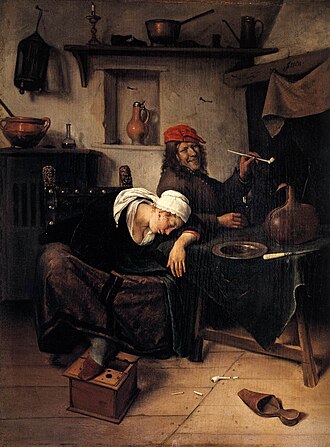 Idlers - Jan Steen (1660s)
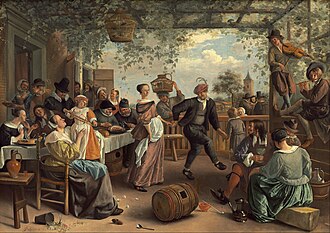 The Dancing Couple - Jan Steen (1663)
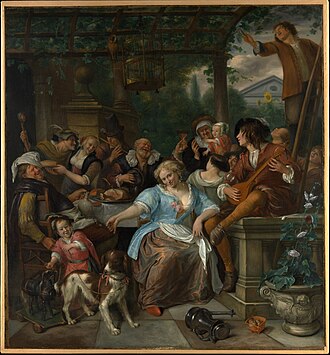 Merry Company on a Terrace - Jan Steen (1670)
Dipinti di artisti collegati
 The Night Watch - Rembrandt van Rijn (1642)
 Self-Portrait - Rembrandt van Rijn (1659)
 Girl with a Pearl Earring - Johannes Vermeer (1665)
 The Milkmaid - Johannes Vermeer (c. 1658)
 A Militiaman Holding a Berkemeyer, Known as the ‘Merry Drinker’ - Frans Hals (1620s)
 Laughing Cavalier - Frans Hals (1624)
 The Windmill at Wijk bij Duurstede - Jacob van Ruisdael (1670)
 The Jewish Cemetery - Jacob van Ruisdael (1650s)
 The Courtyard of a House in Delft - Pieter de Hooch (1658)
 A Woman Peeling Apples - Pieter de Hooch (1663)