Agony in the Garden
Andrea Mantegna · 1459
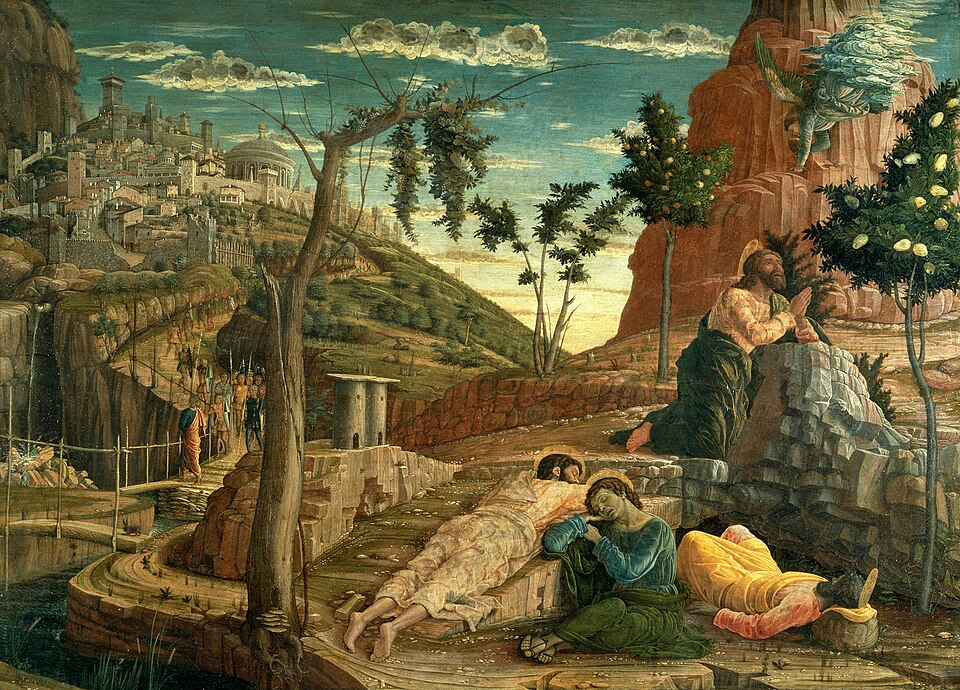
Christ kneels in prayer at dawn while three disciples sleep at his feet, and far off, soldiers led by Judas are already on their way. Mantegna packed the whole night of Gethsemane into one small panel painted in 1459.
The story behind the painting
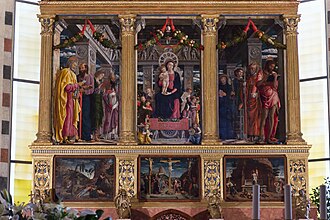
This tempera panel was most likely commissioned by Gregorio Correr, abbot of the monastery of San Zeno in Verona, after Mantegna had finished his Saint Luke Altarpiece. It was one of the predella panels beneath the great San Zeno Altarpiece. In May 1797, during the Napoleonic seizures of art, the altarpiece was taken apart and its six panels were carried to Paris. In 1806 Vivant Denon gave the two side panels of the predella, this one and The Resurrection, to the Musée des Beaux-Arts in Tours, where both still hang.
What to look for
Look at the three planes: the sleeping apostles beside a lightning-struck tree, then Christ and the angel, then the hill of Jerusalem and a mountain. Figures shrink with distance and colours fade, an early use of atmospheric perspective. The blue sky turns yellow near the horizon as dawn breaks. Shell gold, made of gold powder and a binder, picks out the haloes and even tiny bees. The bodies of James, John and Peter take on greyish, almost greenish tones that melt into the rock, while the mountain stands out in pink.
Meaning and intent
The dead tree divides the picture into two moments: on the right the prayer, on the left the soldiers guided by Judas, announcing the arrest to come. The loose, heavy bodies of the sleeping apostles make the tension in Christ's body stronger as the angel offers him the chalice of his coming suffering. The struck tree, covered by a vine that recalls the wine of the Last Supper, points to his death. Fruit trees suggest rebirth and bees chastity. The pink mountain looks ahead to the tomb painted in the last predella panel.
Legacy
The panel needed care: in 1870 it was restored in Paris and transferred onto a new poplar support prepared with gesso, a white layer that still shows through in places under the brown coating added then. Verona recovered the upper panels of the altarpiece in 1815, but the predella stayed in France, so copies of the three predella scenes made in the eighteenth century now fill their place in San Zeno. The walls of Jerusalem may follow the description of the city by Flavius Josephus. Mantegna painted the same subject again in a picture now at the National Gallery in London.
Lo sapevi?
- Painted in tempera on panel in 1459.
- Part of the predella of the San Zeno Altarpiece in Verona.
- Taken to Paris in 1797, given to Tours in 1806.
- Transferred onto a poplar panel during an 1870 restoration.
L'artista
Andrea Mantegna (1431-1506)
religious art · man · Jesus Christ · Saint Peter · John the Apostle · St. James the Elder
Altre opere di Andrea Mantegna
 Lamentation of Christ - Andrea Mantegna (1483)
 Madonna della Vittoria - Andrea Mantegna
 San Zeno Altarpiece - Andrea Mantegna (1457)
 Adoration of the Shepherds - Andrea Mantegna (1450)
 Madonna of the Caves - Andrea Mantegna (1489)
 Parnassus - Andrea Mantegna
 The Introduction of the Cult of Cybele at Rome - Andrea Mantegna (1500s)
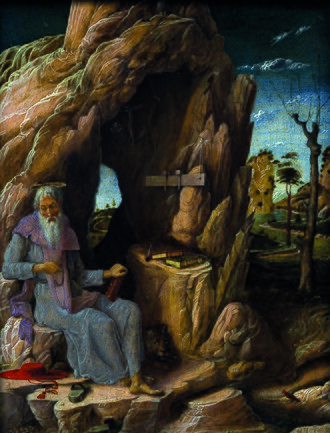 Saint Jerome in the desert - Andrea Mantegna
Dipinti di artisti collegati
 The Birth of Venus - Sandro Botticelli (c. 1485)
 Primavera - Sandro Botticelli (1480s)
 Flagellation of Christ - Piero della Francesca (1450s)
 Madonna and Child with Saints, Angels and Federico da Montefeltro - Piero della Francesca (1472)
 Mona Lisa - Leonardo da Vinci (1503-1519)
 Lady with an Ermine - Leonardo da Vinci (1490)
 Annunciation - Fra Angelico (1425)
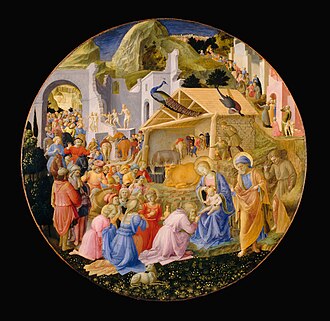 Adoration of the Magi - Fra Angelico (1430)