James McNeill Whistler
1834-1903
James McNeill Whistler signed his paintings with a butterfly that had a sting in its tail: delicate in art, combative in life. He treated painting like music, and his portrait of his mother became one of the most recognised images in the world.
Origins
James Abbott Whistler was born on 10 July 1834 in Lowell, Massachusetts, the first child of Anna McNeill Whistler and the railroad engineer George Washington Whistler. He later claimed during a trial that he had been born in Saint Petersburg, saying he did not choose to be born in Lowell. He was a moody child, and his parents found that drawing calmed him. In 1842 his father was hired by Nicholas I to engineer the Saint Petersburg to Moscow railway, and the family moved to Russia, where young James enrolled in the Imperial Academy of Arts at eleven. After his father died of cholera, the family returned to Pomfret, Connecticut. He added his mother's name McNeill only after she died in 1881.
Life and turning points
Whistler entered West Point in 1851 but was dismissed after three years, having learned drawing and mapmaking there. After a spell at the US Coast Survey, where he learned etching, he went to Paris in 1855 and never returned to the United States. He studied briefly with Charles Gleyre and met Fantin-Latour, Courbet, Manet and Baudelaire. From 1859 he made London his home. In 1877 he sued the critic John Ruskin for libel over Nocturne in Black and Gold: The Falling Rocket; he won only nominal damages, and the costs, together with debts from building his house, bankrupted him by 1879. In 1888 he married Beatrice Godwin, whose death from cancer in 1896 was a blow he never overcame. He died in London on 17 July 1903.
Style and technique
Whistler was a leading voice of art for art's sake, avoiding sentimentality and moral messages. He saw a parallel between painting and music and titled works arrangements, harmonies and nocturnes, stressing tonal harmony. From Gleyre he took two lifelong principles: that line matters more than colour, and that black is the basic colour of tonal harmony. He worked from a limited, predetermined palette, and portraits often followed a pattern of quick start, major changes, neglect, then a final rush to finish. His interest in Asian art shaped works like The Little White Girl and the Peacock Room of 1876 to 1877, now in the Freer Gallery in Washington and considered a high example of the Anglo-Japanese style.
Stories and anecdotes
His departure from West Point is said to have followed a chemistry exam where he began, silicon is a gas; he later joked that if silicon were a gas he would have been a general, though another account blames misconduct in drawing class. At the Coast Survey he was moved to the etching division after drawing sea serpents and mermaids in map margins. Whistler's Mother began, according to his mother's letter, when a model failed to appear; she first stood, but it was too tiring, so he painted her seated over dozens of sittings. The painting narrowly escaped a fire aboard a train, and in 1891 the French government bought it, the first Whistler in a public collection.
Legacy
The butterfly signature grew from his study of potters' marks on Asian china, and around 1880 he added the sting. Whistler's Mother, now in the Musée d'Orsay, has joined the Mona Lisa and The Scream among the few paintings that communicate almost instantly to almost everyone. His fourteen months in Venice in 1879 and 1880 produced etchings and pastels that helped restore his finances and changed how artists saw the city, through its back alleys and side canals. He influenced art and culture through his ideas and his friendships with leading artists and writers. His quiet harmonies of grey, blue and gold still ask us simply to look.
Lo sapevi?
- The house where he was born is now the Whistler House Museum of Art.
- He published his account of the Ruskin trial in The Gentle Art of Making Enemies.
- He founded an art school in 1898, which closed in 1901.
- He is buried in Chiswick Old Cemetery in west London.
Tonalism · American Impressionism
Dipinti di James McNeill Whistler
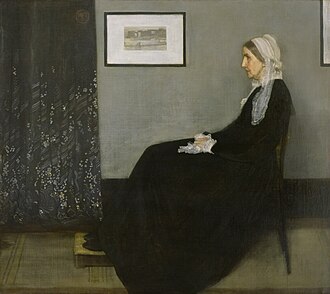 Whistler's Mother - James McNeill Whistler (1871)
%201862.jpg) Symphony in White, No. 1: The White Girl - James McNeill Whistler (1860s)
Symphony in White, No. 1: The White Girl - James McNeill Whistler (1860s)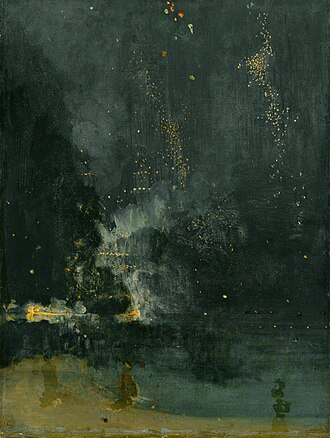 Nocturne in Black and Gold – The Falling Rocket - James McNeill Whistler (1875)
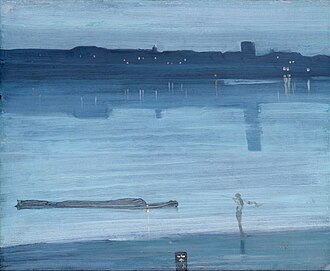 Nocturne: Blue and Silver – Chelsea - James McNeill Whistler (1871)
%201864.jpg) Symphony in White, No. 2: The Little White Girl - James McNeill Whistler (1864)
Symphony in White, No. 2: The Little White Girl - James McNeill Whistler (1864)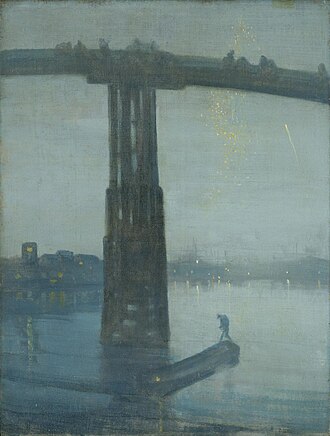 Nocturne: Blue and Gold – Old Battersea Bridge - James McNeill Whistler (1872)
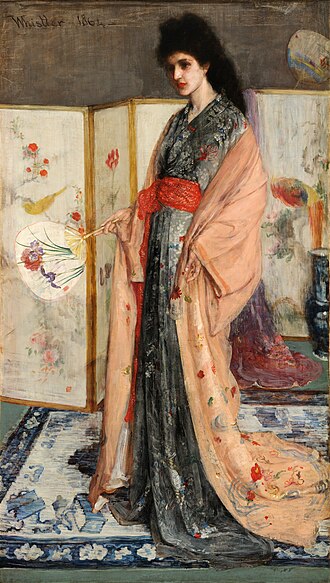 The Princess from the Land of Porcelain - James McNeill Whistler (1860s)
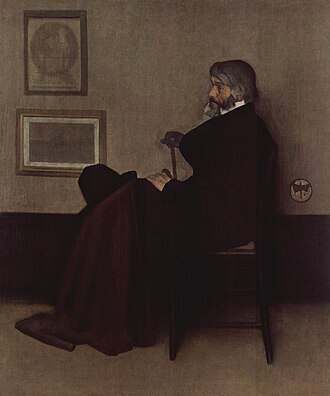 Arrangement in Grey and Black, No. 2: Portrait of Thomas Carlyle - James McNeill Whistler (1870s)
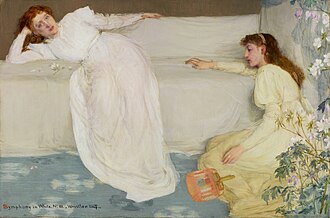 Symphony in White, No. 3 - James McNeill Whistler (1860s)
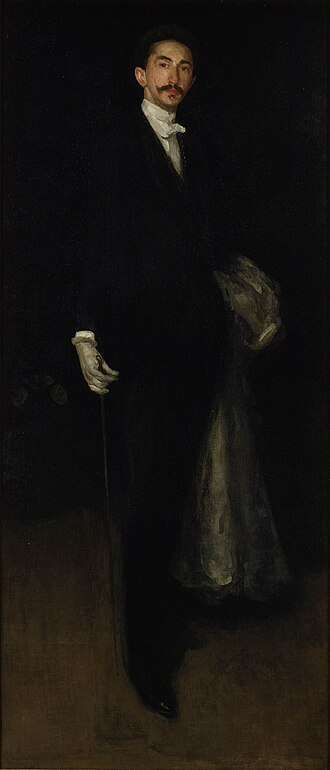 Arrangement in Black and Gold: Comte Robert de Montesquiou-Fezensac - James McNeill Whistler (1890s)