Women Friends
Gustav Klimt · 1910s
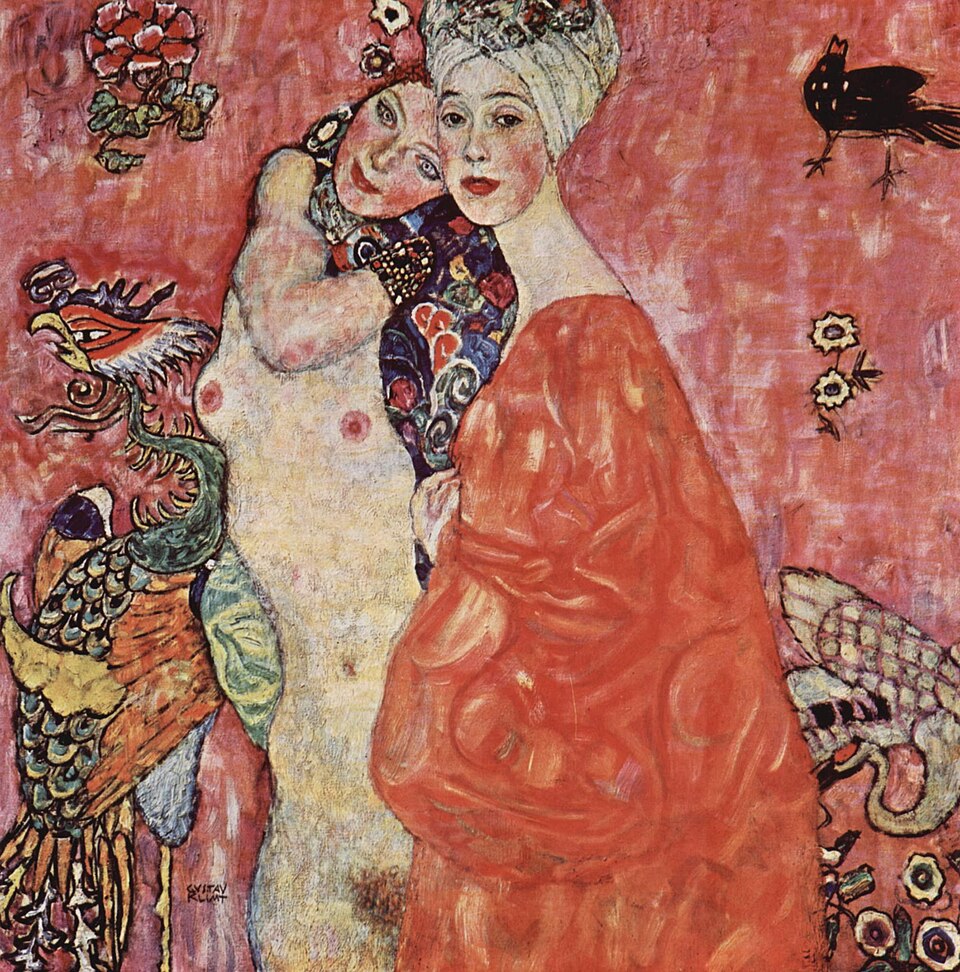
Two women gaze out at us, one nude and leaning in, one wrapped in flowing red, surrounded by birds and flowers. Klimt painted them near the end of his life. In 1945 the canvas burned in an Austrian castle.
The story behind the painting
Klimt painted Women Friends in 1916 to 1917, towards the end of his career. It is also known as The Friends or Girlfriends II. Unlike many of his portraits of the Viennese bourgeoisie, it was not commissioned, and the models are unknown, so the figures seem to be imagined rather than portraits of real sitters. It became part of the collection of August and Serena Lederer, Klimt's main patrons, who owned more of his drawings and paintings than anyone else, including the Beethoven Frieze and Schubert at the Piano.
What to look for
The nude woman leans into her companion, head tilted, arm twisted across her chest, adorned with colourful patterned jewellery and fabric tied at her neck. The clothed woman in red turns her head over her shoulder, wearing a patterned headscarf. There is no real background, only patchy pink tones, with depth hinted by the clothed woman standing slightly in front. Around them float birds, real and fantastical, and flowers, outlined in black. With no light source or natural shading, the effect is flat and illustrative, and loose brushstrokes run through clothing and skin alike.
Meaning and intent
After 1910, oriental motifs became a staple in Klimt's backgrounds, drawn from Chinese art as in his portraits of Friederike Maria Beer and Elisabeth Lederer. Here a phoenix sits at bottom left, a lotus at top left and a crane at bottom right, all symbols of luck. Klimt painted women far more than men and sought new ways to stage femininity. The relationship between the two women remains ambiguous. Lesbian love was a fashionable topic in French popular culture, and similar themes are speculated in his Water Serpents I and II.
Legacy
After Germany annexed Austria in 1938, the Lederer Collection was seized, and some works were listed as cultural treasures. In 1943 Women Friends hung in a Nazi-organised Klimt retrospective in the Secession Building in occupied Vienna, alongside The Kiss and Judith I. The works were then moved to Schloss Immendorf for protection. In 1945 a fire broke out in the castle and destroyed most of what was inside. Klimt's large canvases had little chance. The cause of the fire is still a mystery, with several unproven theories.
Le saviez-vous ?
- Painted 1916-1917, late in Klimt's career.
- Not commissioned; the models are unknown.
- Owned by the Lederer family, Klimt's main patrons.
- Destroyed by fire at Schloss Immendorf in 1945.
À propos de l'artiste
Gustav Klimt (1862-1918)
femme · double portrait · femme nue
Autres œuvres de Gustav Klimt
 Le Baiser - Gustav Klimt (1907-1908)
 Portrait d'Adele Bloch-Bauer I - Gustav Klimt (1907)
 Danaé - Gustav Klimt (1907)
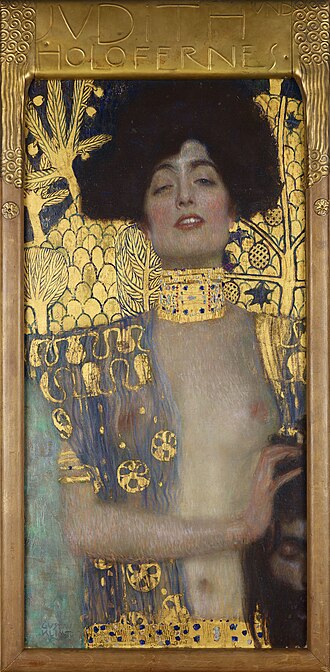 Judith I - Gustav Klimt (1901)
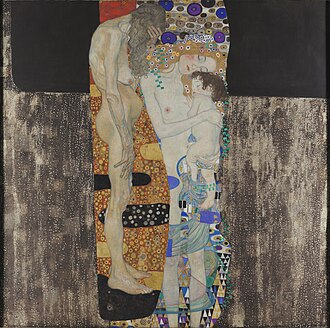 Les Trois Âges de la femme - Gustav Klimt (1905)
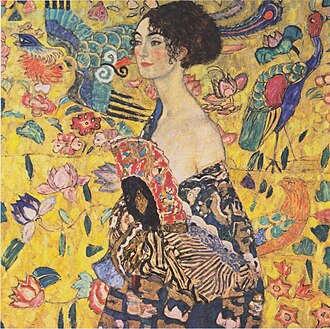 La Femme à l'éventail - Gustav Klimt (1917)
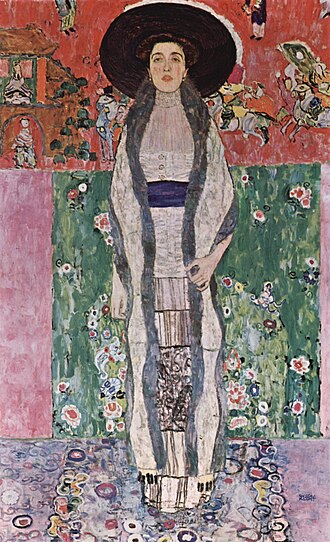 Portrait d'Adele Bloch-Bauer II - Gustav Klimt (1912)
 Portrait d'une Dame - Gustav Klimt (1910s)