L'Amante inquiète
Antoine Watteau · 1715
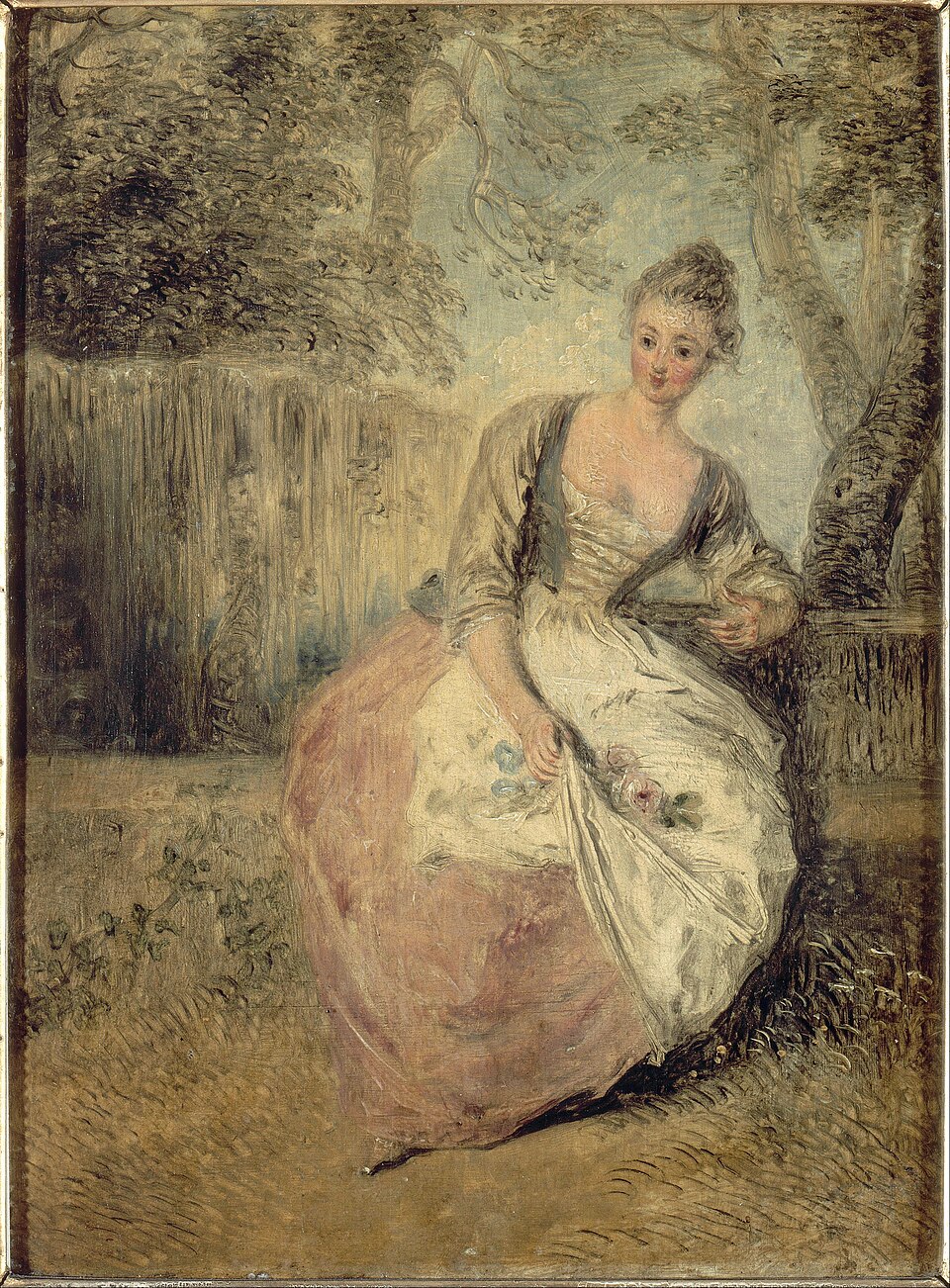
A young woman sits alone in a landscape, dressed as a shepherdess, holding cut roses in her lap. Watteau's tiny panel, barely 24 cm high, has passed from a close friend's collection through auctions and exile to the chateau of Chantilly.
The story behind the painting
The Worried Lover is an oil on panel by Antoine Watteau, now in the Musee Conde at Chantilly. Its earliest known owner was the Abbe Pierre-Maurice Haranger, canon of Saint-Germain-l'Auxerrois and one of Watteau's closest friends, who inherited many of the artist's drawings. In 1729 Edme-Francois Gersaint published it as an etching by Pierre-Alexandre Aveline, who also etched another Watteau owned by the Abbe, The Dreamer. The two were printed on the same sheet of the Recueil Jullienne, so some authors saw them as a pair; Pierre Rosenberg thought instead that they were simply brought together in the Abbe's collection.
What to look for
At 24 by 17.5 cm, this is a small, single-figure, full-length picture of a costumed character, a type Watteau often painted. A young woman is seated in a landscape in pastoral dress, holding a bunch of cut roses. With slight differences, Watteau took her figure from a double red chalk drawing, one of whose studies matches the pose exactly, and he also made an etching of a woman seated in a very similar way. Notice how much feeling rests on so little: a single figure, a turned body, and the flowers in her hands, all on a panel small enough to hold.
Meaning and intent
The title speaks of a lover's unease, and writers have read the cut roses as a symbol of love that has been consumed. That is the key to the picture's mood: the woman wears the costume of a carefree pastoral, yet the flowers she holds are already cut, their bloom spent. Because of its history, the painting has been linked to two other works by Watteau, The Chord and The Dreamer. Seen together, they suggest small, quiet scenes of feeling, each built around a single figure in costume, inviting the viewer to imagine the story that the painter leaves unsaid.
Legacy
Dating has divided scholars. The Musee Conde's curators placed it around 1717 to 1720; Ernst Heinrich Zimmermann about 1717; Helene Adhemar in 1716; Jacques Mathey about 1715; Ettore Camesasca, followed by Federico Zeri, about 1720; and Marianne Roland Michel about 1716 to 1718. Wikidata gives 1715. After the Abbe, it belonged in the 1780s to Antoine Claude Chariot, then to the painter and dealer Jean-Baptiste-Pierre Lebrun, husband of Elisabeth Vigee Le Brun. In 1868 the Duke of Aumale, son of King Louis Philippe I, acquired it in English exile, and in 1884 it was bequeathed with Chantilly to the Institut de France.
Le saviez-vous ?
- Oil on panel, only 24 by 17.5 cm.
- First owned by Watteau's close friend the Abbe Haranger.
- Dated anywhere from about 1715 to 1720 by different scholars.
- In the Musee Conde, Chantilly.
À propos de l'artiste
Antoine Watteau (1684-1721)
femme · scène de genre · position assise · fleur · musée Condé
Autres œuvres de Antoine Watteau
 Le Pèlerinage à l'île de Cythère - Jean-Antoine Watteau (1717)
 Pierrot - Jean-Antoine Watteau (1718)
 L'Enseigne de Gersaint - Jean-Antoine Watteau (1720)
 L'Indifférent - Jean-Antoine Watteau (1710s)
 Les Fêtes vénitiennes - Jean-Antoine Watteau (1719)
 Nymphe et Satyre - Jean-Antoine Watteau (1716)
 Les Acteurs de la Comédie-Française - Jean-Antoine Watteau (1710s)
 Mezzetin - Jean-Antoine Watteau (1717)
Œuvres d'artistes liés
 Tres de Mayo - Francisco Goya (1814)
.jpg) La Maja nue - Francisco Goya (1800)
La Maja nue - Francisco Goya (1800)