La Surprise
Antoine Watteau · 1710s
.jpg)
A musician dressed as Mezzetin strums his guitar while a couple beside him melts into an embrace, and a small dog watches it all. For more than a century and a half Watteau's The Surprise was lost, until an expert found it in the corner of a country house.
The story behind the painting
La Surprise is an oil on panel painted by Antoine Watteau around 1718, according to Wikipedia; Wikidata places it more broadly in the 1710s. It was made as a pendant, a companion piece, to Perfect Harmony, now in the Los Angeles County Museum of Art. Both pictures first belonged to Watteau's friend Nicolas Henin, but his heir sold them separately, after publishing an engraving of both. From then on the two paintings went different ways, and The Surprise slipped out of sight.
What to look for
The panel is small, about 36.4 by 28.2 cm. A male guitarist in the costume of Mezzetin, the comic actor of the Italian theatre, watches a couple locked in an embrace. A small dog watches the whole scene too, a second witness in miniature. The work shows Watteau's habit of reusing recurring figures, and also the influence of Flemish Baroque painting on his art. Follow the looks: the musician on the lovers, the dog on everyone, and the lovers on no one but each other.
Meaning and intent
The title suits the moment well, and the moment is a small comedy. The music seems to go on while the couple forgets the player completely, and he becomes an onlooker to a love that is not his. The same Mezzetin figure that Watteau painted elsewhere as a lonely singer here plays the role of a witness. Set beside its pendant Perfect Harmony, the picture turns into one half of a small story about music and love.
Legacy
The sources disagree about its lost years: one passage says it disappeared between 1770 and 1848 and again from 1848 to 2007, another that it was last recorded in 1764 in a collector's catalogue. For a long time it was known only from the engraving and a copy in the Royal Collection at Buckingham Palace. In March 2008 an expert who had come to appraise another work found the original in the corner of a room in a British country house, where the family had owned it since 1848 without knowing its importance. It is now in the J. Paul Getty Museum in Los Angeles.
Le saviez-vous ?
- Painted around 1718 according to Wikipedia; Wikidata gives the 1710s.
- Pendant to Perfect Harmony, in the Los Angeles County Museum of Art.
- Rediscovered in a British country house in March 2008.
- Now in the J. Paul Getty Museum, Los Angeles.
À propos de l'artiste
Antoine Watteau (1684-1721)
chien · musicien ou musicienne · musée J. Paul Getty · fête galante · danseur ou danseuse
Autres œuvres de Antoine Watteau
 Le Pèlerinage à l'île de Cythère - Jean-Antoine Watteau (1717)
 Pierrot - Jean-Antoine Watteau (1718)
 L'Enseigne de Gersaint - Jean-Antoine Watteau (1720)
 L'Indifférent - Jean-Antoine Watteau (1710s)
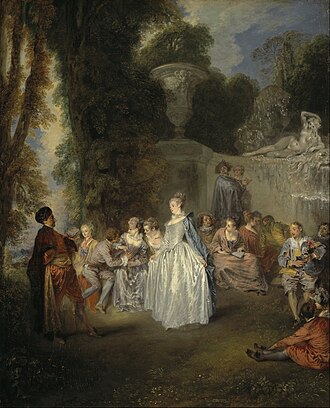 Les Fêtes vénitiennes - Jean-Antoine Watteau (1719)
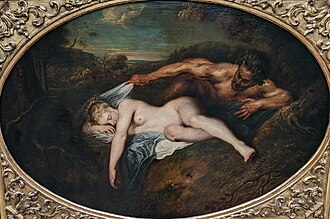 Nymphe et Satyre - Jean-Antoine Watteau (1716)
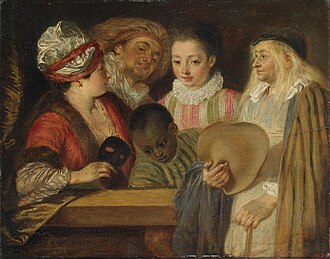 Les Acteurs de la Comédie-Française - Jean-Antoine Watteau (1710s)
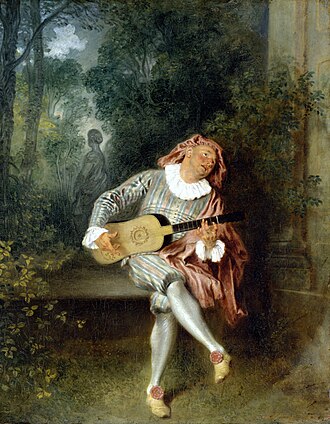 Mezzetin - Jean-Antoine Watteau (1717)
Œuvres d'artistes liés
 Tres de Mayo - Francisco Goya (1814)
.jpg) La Maja nue - Francisco Goya (1800)
La Maja nue - Francisco Goya (1800)