L'Apothéose d'Homère
Jean-Auguste-Dominique Ingres · 1827
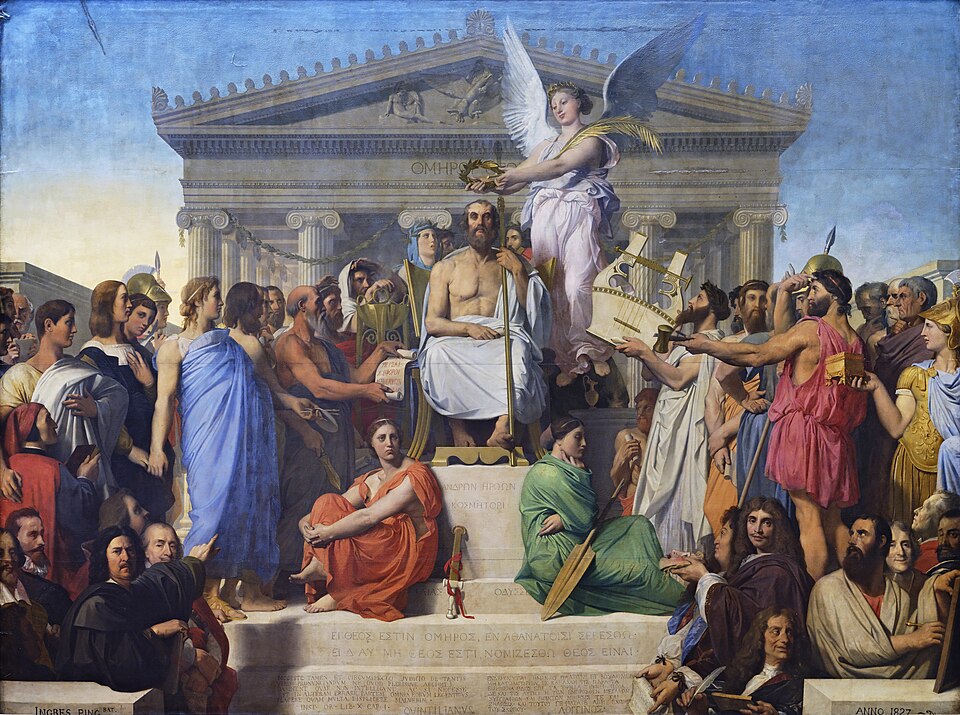
Blind Homer sits enthroned before a Greek temple as a winged figure crowns him, and forty-four great minds gather to pay homage. Ingres sketched the plan in an hour, then spent hundreds of drawings perfecting it.
The story behind the painting
The painting was a state commission to decorate a ceiling of the musée Charles X at the Louvre, rooms that now hold the ancient Egyptian galleries. It was part of a renovation through which Charles X wished to be remembered in the grand tradition of Bourbon building at the Louvre, and it had to be finished within a year. Ingres was proud that he needed only an hour to set down the broad outline in a sketch. More than 100 drawings and many painted sketches survive, showing how carefully he then fixed each detail. It was completed in 1827.
What to look for
The composition is symmetrical, centred on Homer in front of an ancient Greek temple. The first catalogue described it as Homer receiving homage from all the great men of Greece, Rome and modern times: the Universe crowns him, Herodotus burns incense, and the Iliad and the Odyssey sit at his feet. Look top left for Raphael in black and white Renaissance dress, led by Apelles in a blue cloak; at far left Dante is led by Virgil, with Poussin, copied from Poussin's own 1650 self-portrait; at right Molière is near the feet of the Odyssey. The fresh, clear colours give the effect of a fresco.
Meaning and intent
Ingres wanted to compete with Raphael, and the picture is strongly inspired by Raphael's Parnassus. The art historian Robert Rosenblum called it Ingres' most doctrinaire statement of belief in a hierarchy of timeless values based on classical precedent. Modern figures mostly stay in the lower register, though Raphael and Michelangelo are raised to stand with the ancients. It also left an impression of coldness, sharpened when Delacroix showed The Death of Sardanapalus at the same Salon of 1827. The contrast set a Romantic renewal against the purest classical tradition.
Legacy
The painting was taken down from its ceiling in 1855 and replaced that year by a copy by Paul and Raymond Balze with Michel Dumas; the original is now shown in the Louvre. Ingres kept returning to it. From 1854 to 1865 he worked on a drawing for the engraver Calamatta, aiming to amplify and complete his idea, adding dozens of figures such as Pliny the Elder, Plutarch, Louis XIV and Jacques-Louis David. He also removed Shakespeare, Tasso and Camões, now feeling they were too close to the Romantic spirit of his rival Delacroix.
Le saviez-vous ?
- Completed in 1827 for a Louvre ceiling.
- Forty-four figures surround Homer.
- Shown at the same Salon as Delacroix's The Death of Sardanapalus.
- Replaced on the ceiling by a copy in 1855.
À propos de l'artiste
Jean-Auguste-Dominique Ingres (1780-1867)
art religieux · département des peintures du musée du Louvre · néo-classicisme · peinture d'histoire · vêtement
Autres œuvres de Jean-Auguste-Dominique Ingres
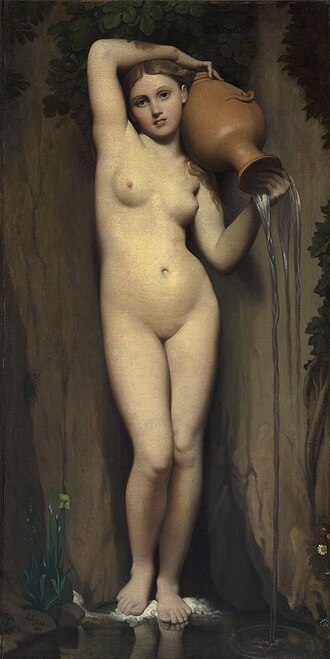 La Source - Jean-Auguste-Dominique Ingres (1856)
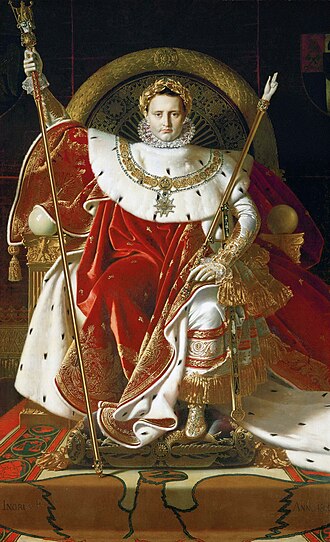 Napoléon Ier sur le trône impérial - Jean-Auguste-Dominique Ingres (1806)
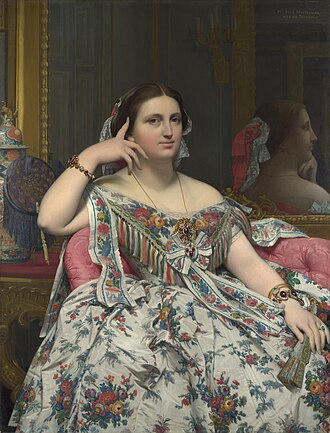 Madame Moitessier - Jean-Auguste-Dominique Ingres (1856)
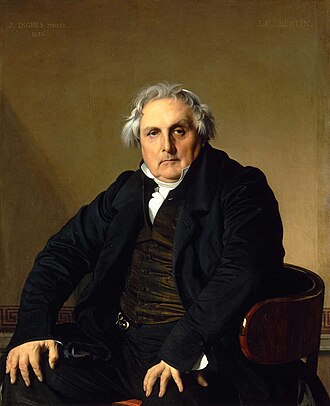 Louis-François Bertin - Jean-Auguste-Dominique Ingres (1832)
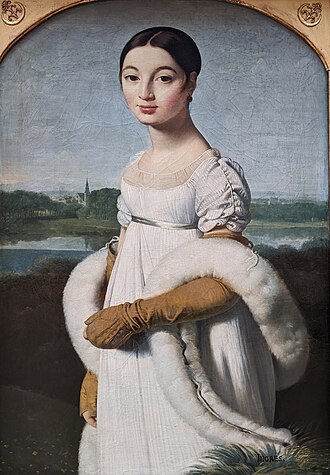 Mademoiselle Caroline Rivière - Jean-Auguste-Dominique Ingres (1806)
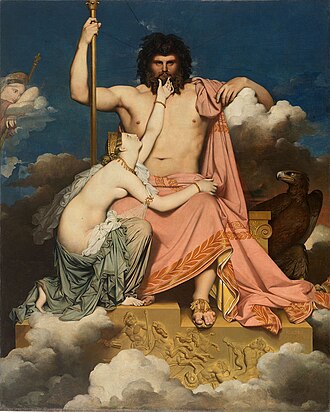 Jupiter et Thétis - Jean-Auguste-Dominique Ingres (1811)
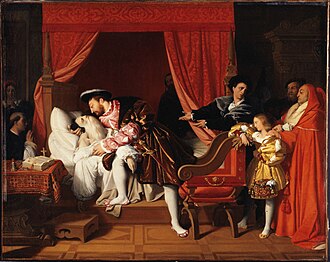 La Mort de Léonard de Vinci - Jean-Auguste-Dominique Ingres (1818)
 La Vicomtesse d'Haussonville - Jean-Auguste-Dominique Ingres (1845)
Œuvres d'artistes liés
 Le Serment des Horaces - Jacques-Louis David (1784)
.jpg) Les Sabines - Jacques-Louis David (1799)
Les Sabines - Jacques-Louis David (1799) Tres de Mayo - Francisco Goya (1814)
.jpg) La Maja nue - Francisco Goya (1800)
La Maja nue - Francisco Goya (1800)