Portrait d'Emilie Flöge
Gustav Klimt · 1902
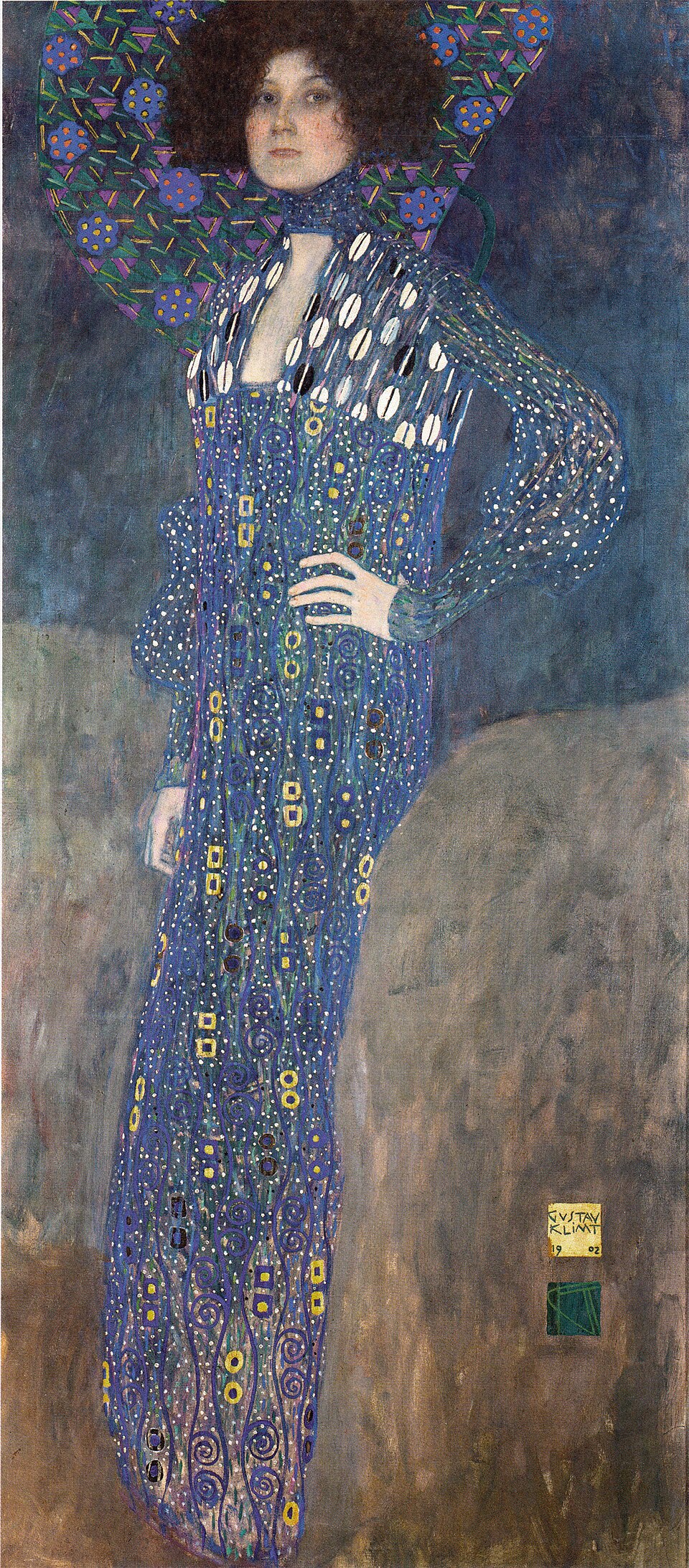
Emilie Flöge stands life-size in a flowing blue dress of her own design, scattered with spirals and squares of real gold and silver. Klimt painted the woman closest to him for six years and never felt he had caught her charm.
The story behind the painting
Emilie Flöge was one of Vienna's most successful fashion designers and helped rethink women's dress for the modern age. She and Klimt likely met in 1891, when his brother Ernst married her sister Helene; she was 17 and he was 30. After Ernst died in 1892, Klimt spent much time with the Flöge family, including summers at Lake Attersee, and became Emilie's lifelong companion, close in heart and mind. He dated the portrait 1902, when she was twenty-eight, but did not consider it finished, and completed it by the summer of 1908 at the latest.
What to look for
The canvas is tall and narrow, 181 by 84 cm. Flöge wears a long blue-mottled reform dress, the free-flowing alternative to the corset, decorated with spirals, dots and gold squares; Klimt applied some ornaments in genuine silver and gold leaf. Her flat, elongated body and patterned dress contrast with a naturally painted face. Behind her head a wreath of green, red and blue flowers, which Angela Wenzel likens to a Japanese leaf fan, balances the figure. In the lower right, two squares hold his signature and date and his monogram, recalling Japanese seals, as Frank Whitford noted.
Meaning and intent
Whitford saw this portrait as a turn toward a highly individual, intricately decorated style. Because Klimt knew the sitter well and no client had ordered it, he could drop the conventions he still kept in formal portraits and focus on colour and ornament. Ludwig Hevesi praised a blue-coloured world of majolica and mosaic, and Berta Zuckerkandl saw around the head all the colour mysticism of Byzantine backgrounds. The result is a portrait of a modern woman in clothes she designed herself, framed by ornament rather than by the trappings of rank.
Legacy
It was first shown in November 1903 at the 18th Secession exhibition as Portrait of a lady, and many upper-class Viennese women then visited both studios to order similar dresses and portraits. Yet Klimt felt he had failed to capture her charm, and her family is said to have disliked it and refused to hang it, though some historians dispute this. He promised another portrait but never painted one. In 1908 he sold it to the Lower Austria Museum; in 1921 it passed to Vienna's municipal collections, and it hangs in the Vienna Museum.
Le saviez-vous ?
- Begun in 1902, finished by summer 1908.
- Flöge wears a reform dress of her own design.
- First shown in 1903 as Portrait of a lady.
- Held by the Vienna Museum.
Wikipedia · Wikidata · Wikipedia
À propos de l'artiste
Gustav Klimt (1862-1918)
Autres œuvres de Gustav Klimt
 Le Baiser - Gustav Klimt (1907-1908)
 Portrait d'Adele Bloch-Bauer I - Gustav Klimt (1907)
 Danaé - Gustav Klimt (1907)
.jpg) Judith I - Gustav Klimt (1901)
Judith I - Gustav Klimt (1901)%20Google%20Art%20Project.jpg) Les Trois Âges de la femme - Gustav Klimt (1905)
Les Trois Âges de la femme - Gustav Klimt (1905)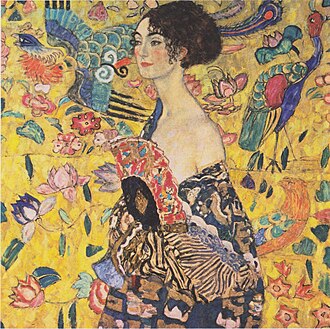 La Femme à l'éventail - Gustav Klimt (1917)
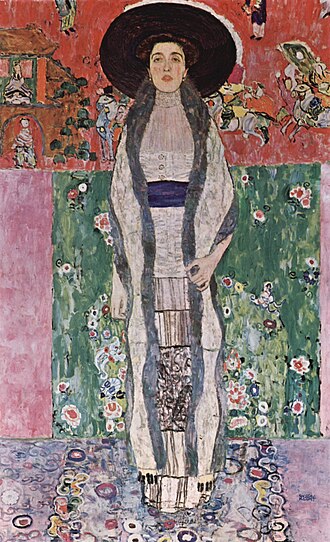 Portrait d'Adele Bloch-Bauer II - Gustav Klimt (1912)
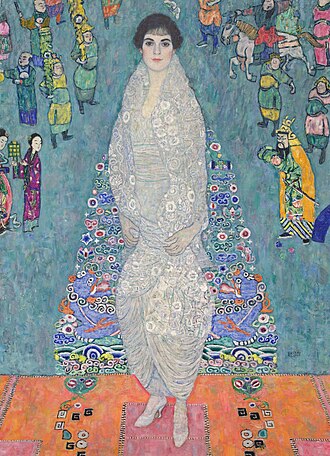 Portrait d'Elisabeth Lederer - Gustav Klimt (1910s)