Cour d'une maison avec tonnelle
Pieter de Hooch · 1658
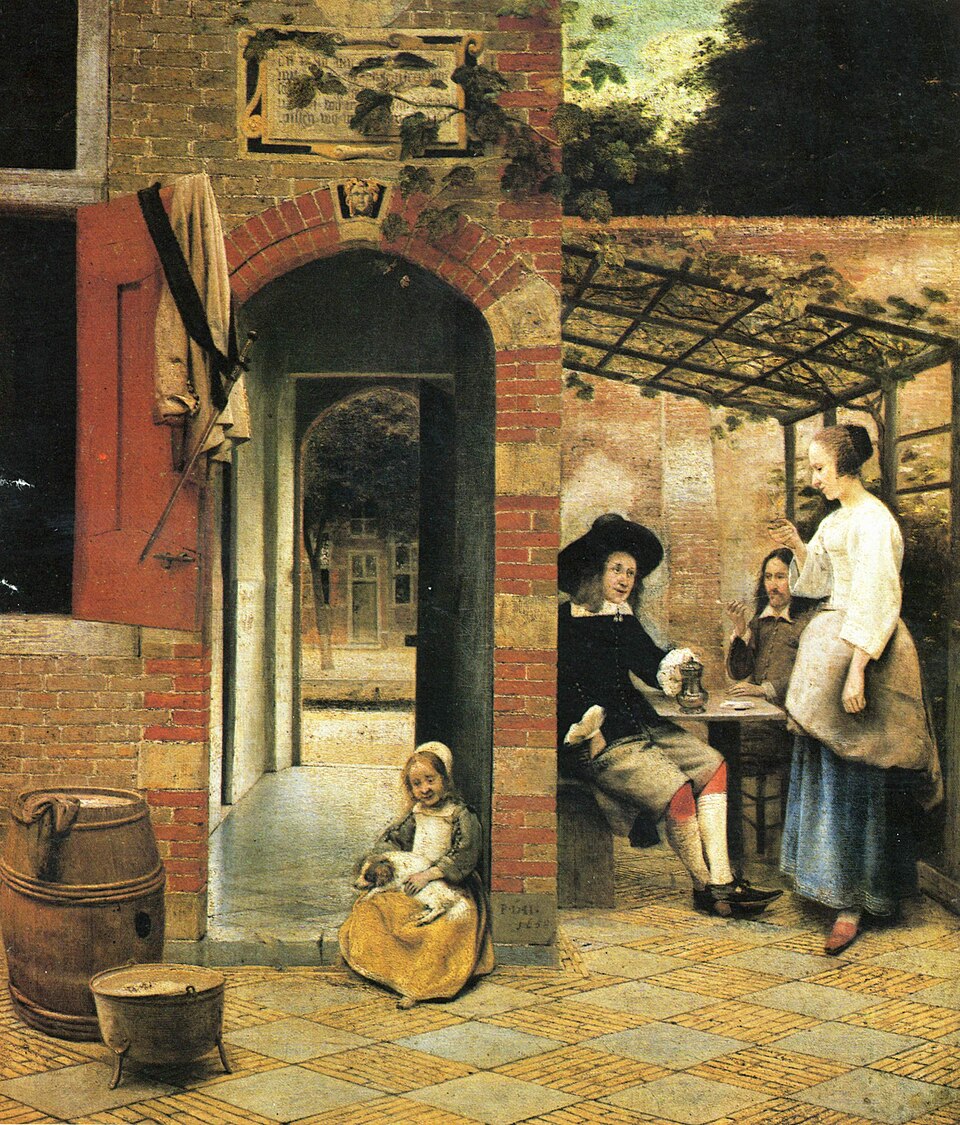
A little girl sits on a step with a dog in her lap, while behind her a woman holds out a glass of wine under a vine-covered arbour. Pieter de Hooch turned an ordinary back courtyard into a world of perfect daylight.
The story behind the painting
De Hooch signed and dated the picture on the doorpost in the middle, P D H 1658. Wikipedia dates it 1658 to 1660, while Wikidata gives 1658, the date of the signature. It was first described in 1833 by the cataloguer John Smith, and again in 1908 by Hofstede de Groot, who called it a pendant to de Hooch's courtyard picture in the National Gallery in London: above the archway is the same inscription, of which only fragments can be read, ending with the year 1614. The sources disagree on the support, too: Hofstede de Groot says panel, Smith canvas.
What to look for
We look at a house of red and yellowish-grey stone. A tall arched passage paved with tiles runs through it, opening onto a canal with trees. On the step of the archway sits a little girl in a grey jacket and yellow frock, a dog in her lap. Under a vine-clad arbour in a corner of the walls, two men sit at a table. One wears a black hat and jacket, grey breeches, red garters and white stockings. A woman stands before the other with a glass of wine. A grey cloak, a black bandolier and a sword hang on a red window-sill, and a cask and a pot complete the scene.
Meaning and intent
What Smith admired most was the light: a courtyard brightly illumined, in his words, by the most perfect daylight. Hofstede de Groot found the whole picture luminous, though he thought the lights and shadows in the passage too slightly contrasted. Smith first counted three men at the table, then corrected himself in 1842 to two. The painting gathers quiet everyday moments, a child with her pet, men at their wine, a woman serving, into one carefully built space where the eye moves from the bright yard through the arch to the street beyond.
Legacy
According to the Christie's sale record of 1992, the painting was once owned by Joséphine de Beauharnais and listed in an inventory at the Château de Malmaison in 1814. It was sold in Antwerp in 1817 from the collection of J. F. Wolschot, bought in Berlin by Edward Solly, and sold again in London in 1837. George Byng owned it by 1842, and it was shown at the British Gallery in 1839 and at the Royal Academy in 1881. Hofstede de Groot found it with the Earl of Strafford at Wrotham Park, the location Wikidata still gives. Smith also mentions a slightly lighter replica brought from Holland in 1839. Today the painting is in a private collection.
Le saviez-vous ?
- Signed and dated P D H 1658 on the doorpost.
- A pendant to de Hooch's courtyard picture in the National Gallery, London.
- Once owned by Joséphine de Beauharnais at Malmaison.
- Now in a private collection.
À propos de l'artiste
Pieter de Hooch (1629-1684)
femme · homme · scène de genre · enfant · cour d'immeuble
Autres œuvres de Pieter de Hooch
 La Cour d'une maison à Delft - Pieter de Hooch (1658)
 La Peleuse de pommes - Pieter de Hooch (1663)
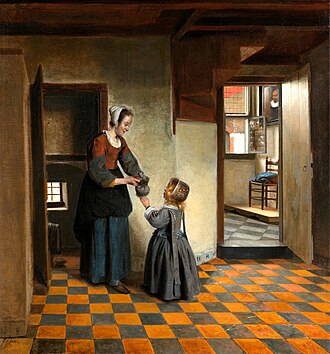 Femme avec un enfant dans un garde-manger - Pieter de Hooch
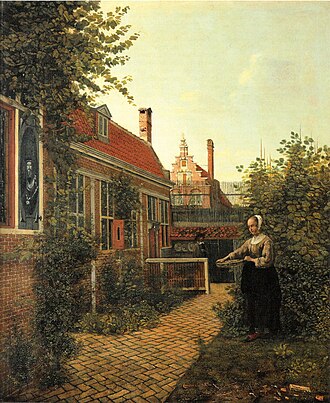 Femme dans un jardin - Pieter de Hooch (1651)
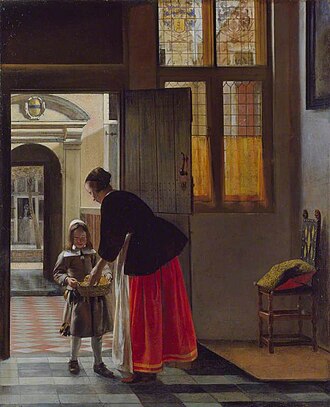 Un garçon apportant du pain - Pieter de Hooch (1663)
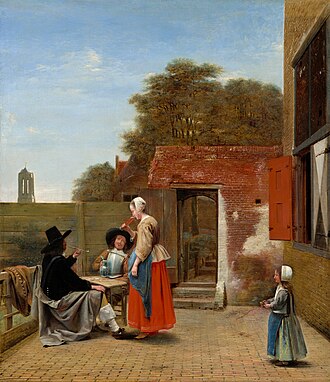 Deux hommes, femme et enfant dans une cour - Pieter de Hooch (1658)
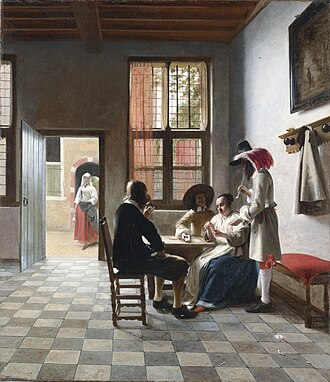 Joueurs de cartes dans une chambre ensoleillée - Pieter de Hooch (1658)
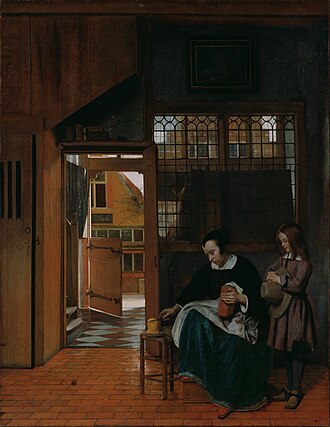 Une femme préparant du pain et du beurre pour un garçon - Pieter de Hooch (1661)