Ancient Greece and Ancient Egypt
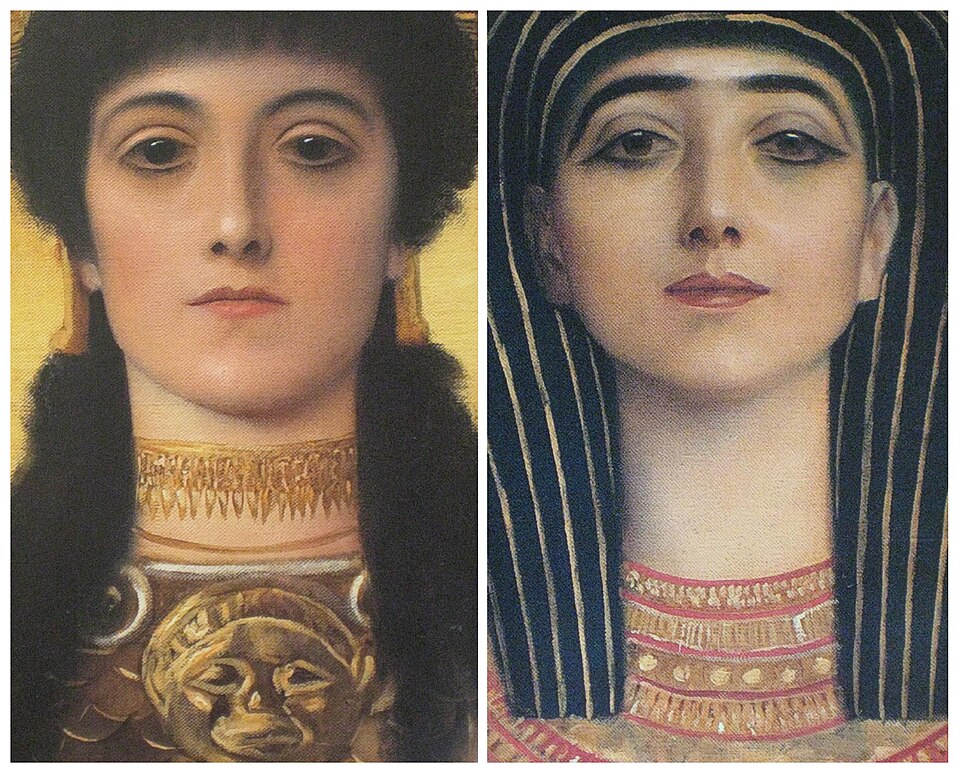
On a museum staircase in Vienna, Athena in a red robe faces a naked Isis with a vulture beside her head. Klimt painted them in 1891, and in the goddess of Egypt you can already see the daring artist he was about to become.
The story behind the painting
Ancient Greece and Ancient Egypt is a pair of spandrel and intercolumniation paintings by Gustav Klimt on the north wall, centre, of the main staircase of the Kunsthistorisches Museum in Vienna, made in 1891. Klimt painted other spandrels and intercolumniations on the same staircase, including Old Italian Art, Florentine Cinquecento and Quattrocento, and Roman and Venetian Quattrocento. These pictures are allegories of ancient Greece and old Egypt, fitted between the arches and columns of the building itself.
What to look for
Greece is Pallas Athena in the left spandrel: in a red robe against an ornamented grey ground, with a scale armour bearing Medusa's head, a spear in her left hand and a statue of Nike in her right, and a golden shield like a tondo behind her. Beside her, a Girl from Tanagra holds a laurel branch near a bronze Aphrodite taking off her sandal. Egypt is a standing Isis, naked but for jewellery, before a red wall with a vulture, holding an ankh and an unknown square object, in a black wig with golden strands. Next to her are painted coffins, a canopic chest and shabtis.
Meaning and intent
Klimt emphasises the eroticism of Isis through her nudity, her swaying hip and seductive glance, and he unsettles the viewer: instead of her usual sistrum she holds an invented object, and the vulture by her head belongs to the goddess Nekhbet, not Isis. The bending, clothed girl from Tanagra echoes the naked Aphrodite, just as clothed Athena faces naked Isis, linking Isis to the goddess of love. Athena shows the influence of historicism, while the provocative Isis signals Klimt's coming stylistic innovation. She resembles his later Nuda Veritas works, though here the theme seems erotic rather than a search for truth.
Legacy
Since Vienna's Egyptian collection was closed for its move to the new museum, Klimt drew on illustrated books by Mariette, Prisse d'Avesnes and Naville; the vulture came from a pendant from the Serapeum at Saqqara, its ram's head replaced. A black figure on the canopic chest follows a statue of Ptah in Turin, and the Athena resembles a Roman copy of Phidias's Athena Parthenos. In 1898 Klimt painted Pallas Athene, holding a small naked Nuda Veritas, and in 1898 and 1899 two Nuda Veritas works with a mirror in the right hand, echoing the ankh of this Isis.
Le saviez-vous ?
- Painted in 1891 on the staircase of the Kunsthistorisches Museum, Vienna.
- Athena and a Girl from Tanagra stand for Greece; Isis and funerary objects for Egypt.
- Klimt used illustrated books because the Egyptian collection was closed for a move.
- The Isis foreshadows his later Nuda Veritas works.
À propos de l'artiste
Gustav Klimt (1862-1918)
musée d'Histoire de l'art de Vienne · Athéna
Autres œuvres de Gustav Klimt
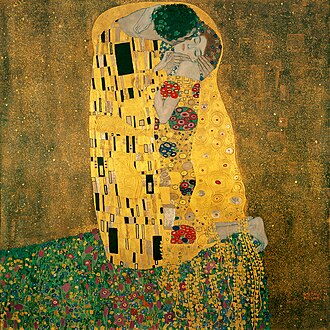 Le Baiser - Gustav Klimt (1907-1908)
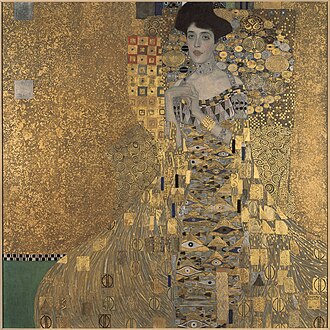 Portrait d'Adele Bloch-Bauer I - Gustav Klimt (1907)
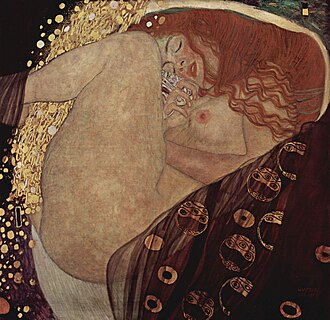 Danaé - Gustav Klimt (1907)
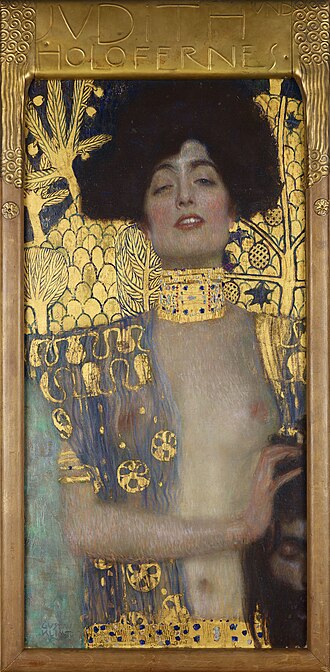 Judith I - Gustav Klimt (1901)
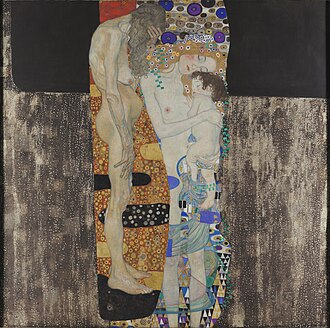 Les Trois Âges de la femme - Gustav Klimt (1905)
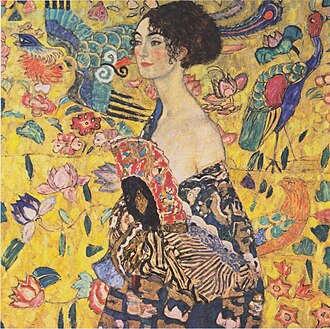 La Femme à l'éventail - Gustav Klimt (1917)
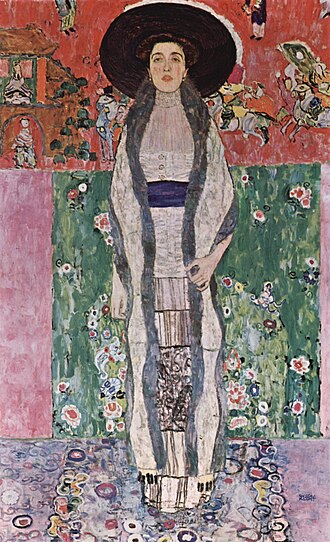 Portrait d'Adele Bloch-Bauer II - Gustav Klimt (1912)
 Portrait d'une Dame - Gustav Klimt (1910s)