Un homme avec des oiseaux morts dans une étable
Pieter de Hooch · 1655
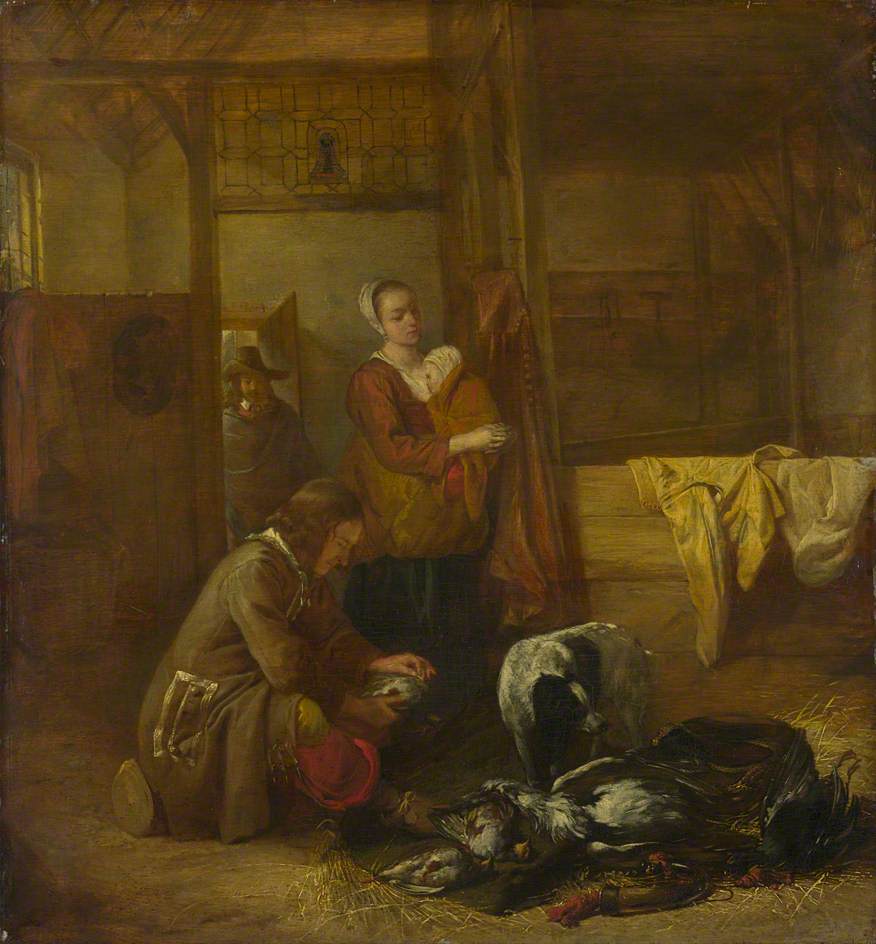
A mother with a baby gazes down at a pile of dead birds in a dim stable. But the birds are a nineteenth-century cover-up: beneath them, Pieter de Hooch had painted a wounded man.
The story behind the painting
This small oil on oak panel, about 53.5 by 49.7 cm, is by Pieter de Hooch and is now in the National Gallery, London. Its date is uncertain in the sources: the title section of Wikipedia and Wikidata give about 1655, while the description says it was completed in the 1660s. It was first recorded in a sale in Amsterdam to Ignatius Van Regemorter, a painter who lived from 1795 to 1873. Modern study of the provenance and paint suggests he was the one who painted over part of the scene, some time after he or his father bought it in 1825.
What to look for
We look into a stable or barn. On the right, clothes over a wooden plank catch the light. The entrance has geometric forms, including a stained glass pane with a cloaked figure. To the left, objects hang on a half-wall, and narrow beams climb to a high ceiling. In front, a spaniel sniffs at the dead birds, and a young woman cradling a baby gazes at them with an inscrutable expression. The palette is browns, greys and ochres, with muted pinks and reds; the brightest point is the baby's glowing red shawl, almost at the centre. Someone enters through the doorway behind.
Meaning and intent
The birds were added in the nineteenth century. The original showed a wounded man, possibly a soldier, lying on the floor with another figure tending him, which may explain the woman's look and the visitor at the door, perhaps a doctor, servant or religious figure. Dutch paintings of soldiers usually showed games and taverns, rarely the wounded. De Hooch returned to this theme in Wounded Soldier, around 1667, also a stable with a mother and child looking at a reclining figure, the standing woman at the top of a triangle. The open doorway, a device he used throughout his work, draws us into depth.
Legacy
In 1900 the painting was sold in London from the collection of Madame de Falbe as a work by Jan Baptist Weenix, an error. Later catalogues called it a collaboration between Weenix and De Hooch, though there is no evidence the two ever worked together. Its last private owner was C. Fleischmann, later Ashcroft. The sources disagree on the gift: one passage says it was donated to the museum in 1929, another that his relatives gave it in 1924, in memory of their parents, for the National Gallery's centenary. Today the original story survives only beneath the paint.
Le saviez-vous ?
- Oil on oak panel by Pieter de Hooch, in the National Gallery, London.
- The dead birds were painted over a wounded man in the 19th century.
- Once wrongly attributed to Jan Baptist Weenix.
- De Hooch painted a similar Wounded Soldier around 1667.
À propos de l'artiste
Pieter de Hooch (1629-1684)
scène de genre · National Gallery
Autres œuvres de Pieter de Hooch
 La Cour d'une maison à Delft - Pieter de Hooch (1658)
 La Peleuse de pommes - Pieter de Hooch (1663)
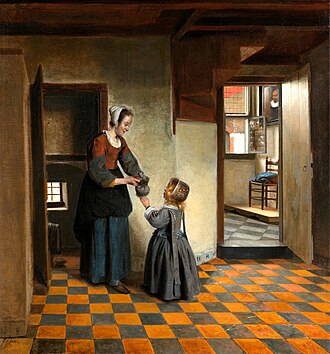 Femme avec un enfant dans un garde-manger - Pieter de Hooch
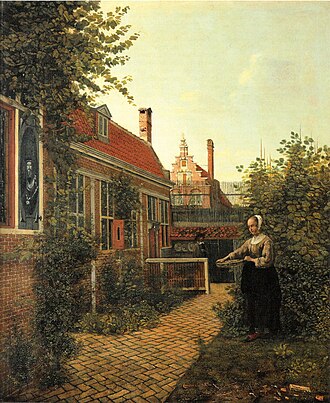 Femme dans un jardin - Pieter de Hooch (1651)
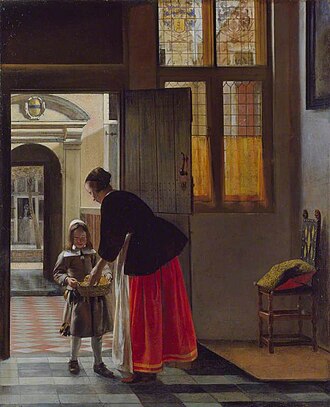 Un garçon apportant du pain - Pieter de Hooch (1663)
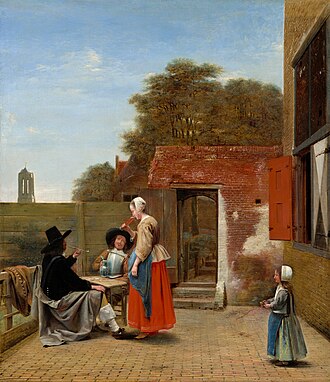 Deux hommes, femme et enfant dans une cour - Pieter de Hooch (1658)
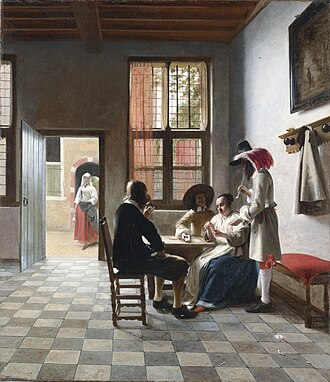 Joueurs de cartes dans une chambre ensoleillée - Pieter de Hooch (1658)
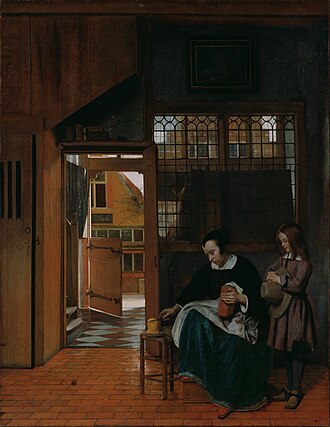 Une femme préparant du pain et du beurre pour un garçon - Pieter de Hooch (1661)